

SHA 224 Generator
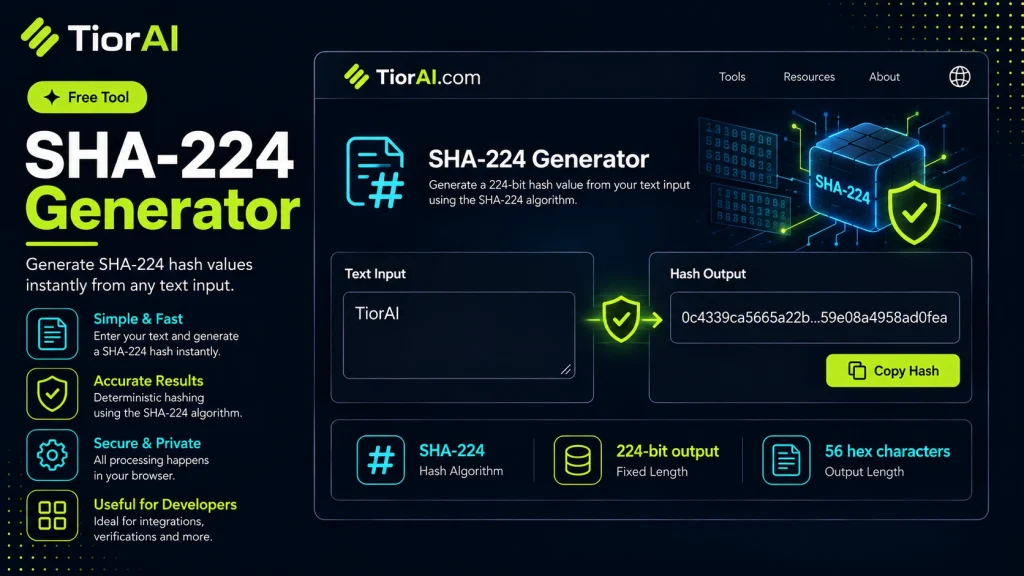
Generate SHA-224 hash from text input using WebAssembly acceleration.
How to use it
- Paste Your Input Paste your code or data into the Sha 224 Generator. The tool accepts standard input formats and validates your entry.
- Process and Transform Click the action button to process your input. Results are generated instantly with proper formatting.
- Export the Output Copy the processed output to your clipboard or download it for use in your development workflow.
Tip The Sha 224 Generator validates your input on the fly, catching syntax errors before they become bugs in production.
Understanding SHA-224 and Its Role in Cryptography
SHA-224 is a member of the SHA-2 (Secure Hash Algorithm 2) family of cryptographic hash functions, designed by the National Security Agency (NSA) and published by the National Institute of Standards and Technology (NIST). It produces a fixed-size 224-bit (28-byte) hash value from an arbitrary length input. Hash functions like SHA-224 are fundamental in computer security for ensuring data integrity, authentication, and digital signatures.
At its core, a cryptographic hash function takes input data (often called a message) and returns a seemingly random string of characters, known as the hash or digest. This output is unique to the input data; even a small change in the input produces a drastically different hash, a property called the avalanche effect.
Why SHA-224? SHA-224 is essentially a truncated version of SHA-256, offering a shorter hash output while maintaining a high level of security. It is standardized in FIPS PUB 180-4, which specifies the Secure Hash Standard (SHS). The 224-bit length provides a balance between security and performance, making it suitable for applications where a shorter hash is preferred but collision resistance and preimage resistance remain critical.
Technical Details:
- SHA-224 processes input in 512-bit blocks.
- It uses the same internal structure as SHA-256 but with different initial hash values and truncates the final output to 224 bits.
- It is collision-resistant, meaning it is computationally infeasible to find two different inputs producing the same hash.
Use in Real Projects: Developers use SHA-224 in scenarios requiring data fingerprinting, integrity verification, and digital signatures. For example, it can be used to verify file integrity during downloads, generate unique identifiers for data, or as part of password hashing schemes (though typically combined with salts and other mechanisms). It is also used in certificate generation and blockchain technologies where fixed-length, secure hashes are essential.
While SHA-224 is secure against known practical attacks, modern applications often prefer SHA-256 or higher for stronger security margins. However, SHA-224 remains relevant where output size constraints exist or compatibility with legacy systems is required.
What is SHA-224?
SHA-224 is a cryptographic hash function that belongs to the SHA-2 family, designed to produce a fixed 224-bit output from any input data. It is widely used in security applications to ensure data integrity and authentication by generating a unique fingerprint of the input.
Unlike encryption, which is reversible, SHA-224 is a one-way function, meaning you cannot retrieve the original data from the hash. This property makes it useful for verifying data without exposing sensitive information.
When to Use SHA-224
- When you need a shorter hash output than SHA-256 but still require strong collision resistance.
- In systems that require compatibility with SHA-2 algorithms but have constraints on hash size.
- For generating checksums or fingerprints to verify data integrity during transmission or storage.
- When implementing digital signatures or certificates that specify SHA-224 as the hashing algorithm.
Common Mistakes to Avoid
- Using SHA-224 alone for password hashing without additional security measures like salting and key stretching, which can lead to vulnerabilities.
- Confusing SHA-224 with SHA-256 and assuming they produce the same output length or have identical security properties.
- Expecting SHA-224 to encrypt data or be reversible, which it is not designed to do.
Technical Context
SHA-224 operates by processing input data in 512-bit blocks, using a series of logical functions and constants defined in the FIPS PUB 180-4 standard. It shares the same internal structure as SHA-256 but uses different initial hash values and truncates the final output to 224 bits. This design maintains strong security properties such as collision resistance and preimage resistance.
Developers often use SHA-224 in applications where a balance between security and output size is necessary. While SHA-256 is more common due to its longer hash and stronger security margin, SHA-224 remains relevant in legacy systems or where shorter hashes are preferred.
Common use cases
- Hashing a simple string with SHA-224
- Verifying file integrity using SHA-224
Frequently asked questions
Reviews and questions
Whether this tool gave people the answer they needed, and what they asked about it.
Sign in to review this tool.
Sign In to ReviewNo reviews yet
Be the first to say whether this tool gave you what you needed.
Ask how to read the result, or what the tool does with an edge case — or answer someone else.
Sign In to AskNo questions yet
Not sure how to read a result? Be the first to ask.