

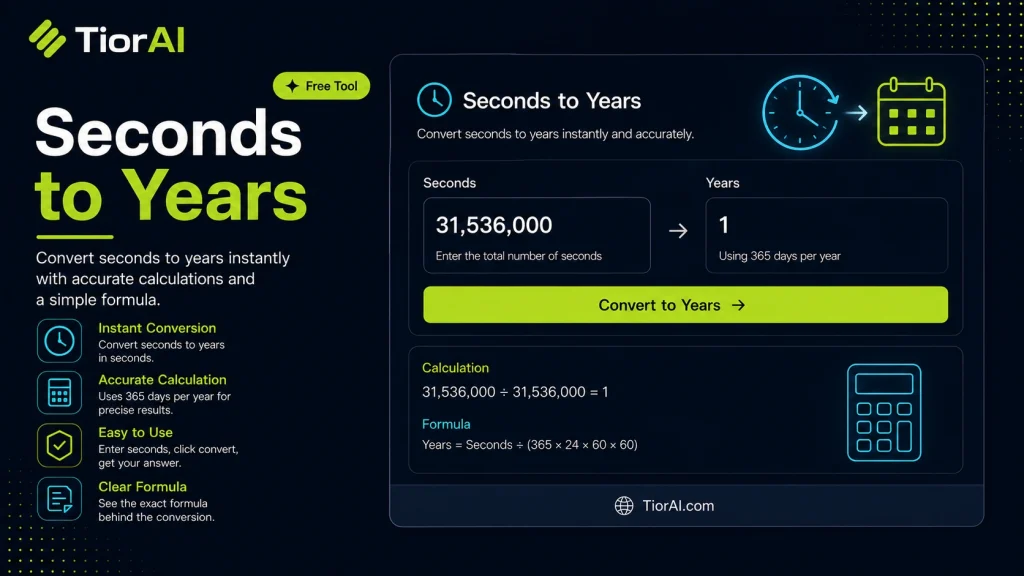
Formula: years = seconds ÷ 31557600
How to use it
- Enter Your Input Value Type or paste the value you want to convert into the input field. The tool accepts any numeric value.
- Select Units and Convert Choose your source and target units from the dropdown menus. The converted result appears instantly.
- Copy or Use the Result Click copy to grab the converted value for use in your project, document, or calculation.
Tip Need the reverse conversion? Swap source and target to convert in the opposite direction instantly.
Understanding Time Conversion: Seconds to Years
Time is measured in various units, from seconds to years, depending on the context. Converting seconds to years involves translating a small unit of time (seconds) into a much larger one (years). This conversion is essential because seconds are often used in precise measurements, such as computing durations in programming, physics, or astronomy, while years are more intuitive for understanding long periods.
Why convert seconds to years?
- Long-term data analysis: When dealing with large time spans, such as geological or astronomical events, expressing time in years is more meaningful.
- Programming and simulations: Many systems record time in seconds since a reference point (like Unix time), so converting to years helps interpret these timestamps.
- Scientific calculations: Experiments or models that track durations in seconds may need results in years for reporting or comparison.
How the conversion works: The basic formula divides the total seconds by the number of seconds in a year. Since a year can be defined as 365 days (common year) or 365.25 days (accounting for leap years), the exact conversion factor varies slightly. Typically, one year is approximated as 31,536,000 seconds (365 days) or 31,557,600 seconds (365.25 days).
Understanding Seconds to Years Conversion
Converting seconds to years is a common task when dealing with time measurements that span long durations. Since seconds are a fundamental unit of time, often used in computing and scientific contexts, translating them into years helps make sense of large time intervals.
The conversion involves dividing the total seconds by the number of seconds in a year. A standard year is usually approximated as 365 days, which equals 31,536,000 seconds. However, to account for leap years, an average year length of 365.25 days (31,557,600 seconds) is often used for better accuracy.
When to Use This Conversion
- Interpreting large time spans recorded in seconds, such as system uptimes or astronomical data.
- Converting timestamps from programming environments that count seconds since a reference date.
- Estimating the age of objects or events measured in seconds for easier understanding.
- Comparing durations across different time scales where expressing time in years is more intuitive.
Common Mistakes to Avoid
- Assuming every year has exactly 365 days, which ignores leap years and introduces small errors.
- Mixing up seconds with other units like milliseconds or minutes, leading to incorrect results.
Understanding these nuances ensures accurate and meaningful conversions from seconds to years in various practical applications.
Frequently asked questions
Reviews and questions
Whether this tool gave people the answer they needed, and what they asked about it.
Sign in to review this tool.
Sign In to ReviewNo reviews yet
Be the first to say whether this tool gave you what you needed.
Ask how to read the result, or what the tool does with an edge case — or answer someone else.
Sign In to AskNo questions yet
Not sure how to read a result? Be the first to ask.
AI tools related to this topic
Tools from the TiorAI directory that work on the same kind of job.

Wolfram Alpha
Wolfram Alpha is a computational knowledge engine that answers factual queries by performing computations on curated data, offering detailed solutions, visualizations, and an API for developers.

ChatGPT
ChatGPT is an AI chatbot by OpenAI powered by GPT-4o. It handles writing, coding, research, data analysis, and natural conversation. Free tier available, Plus at $20/month.