

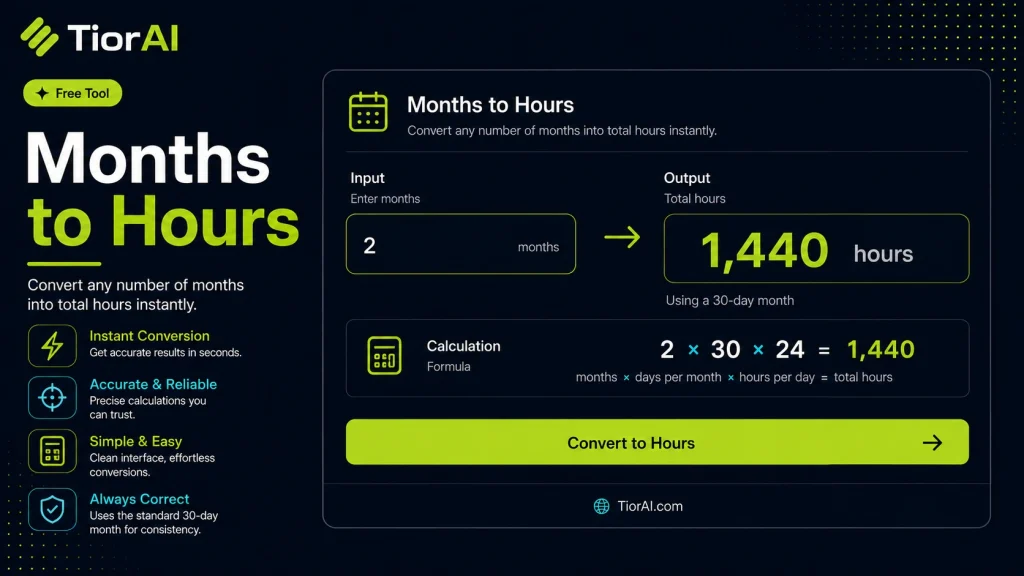
Formula: hours = months × 730.5
How to use it
- Enter Your Input Value Type or paste the value you want to convert into the input field. The tool accepts any numeric value.
- Select Units and Convert Choose your source and target units from the dropdown menus. The converted result appears instantly.
- Copy or Use the Result Click copy to grab the converted value for use in your project, document, or calculation.
Tip Need the reverse conversion? Swap source and target to convert in the opposite direction instantly.
Understanding Time Unit Conversion: Months to Hours
Converting months to hours involves translating a larger, less precise time unit (months) into a smaller, more exact unit (hours). This type of conversion is common in fields like project management, payroll calculations, and scientific research where precise time measurements are necessary.
Why convert months to hours? Months vary in length—some have 28, 30, or 31 days—so converting months to hours requires choosing a standard approximation or specifying the exact month. Typically, a month is approximated as 30 or 30.44 days (the average length of a month in a year).
How does the conversion work? The basic formula multiplies the number of months by the average number of days per month, then by 24 (the number of hours in a day). For example:
Hours = Months × Average Days per Month × 24
This calculation helps convert a vague monthly duration into a precise hourly figure, useful for scheduling, billing, or time tracking.
Common use cases include:
- Estimating total work hours over a multi-month period
- Calculating interest or depreciation periods in hours
- Converting subscription durations for software or services into hourly metrics
Understanding Months to Hours Conversion
Converting months to hours is a way to express a longer time period in a smaller, more precise unit. Since months vary in length, this conversion typically uses an average month length, often 30.44 days, to calculate the equivalent hours. The formula multiplies the number of months by the average days per month and then by 24 hours per day.
When to Use This Conversion
- Estimating total work or project hours over a multi-month period
- Calculating billing hours for subscriptions or contracts defined in months
- Converting time periods in scientific or financial models that require hourly precision
Common Mistakes to Avoid
- Assuming every month has exactly 30 days, which can lead to inaccurate results
- Ignoring leap years or specific month lengths when exact precision is necessary
Understanding these factors helps ensure your conversions from months to hours are as accurate as needed for your application.
Frequently asked questions
Reviews and questions
Whether this tool gave people the answer they needed, and what they asked about it.
Sign in to review this tool.
Sign In to ReviewNo reviews yet
Be the first to say whether this tool gave you what you needed.
Ask how to read the result, or what the tool does with an edge case — or answer someone else.
Sign In to AskNo questions yet
Not sure how to read a result? Be the first to ask.
AI tools related to this topic
Tools from the TiorAI directory that work on the same kind of job.

Wolfram Alpha
Wolfram Alpha is a computational knowledge engine that answers factual queries by performing computations on curated data, offering detailed solutions, visualizations, and an API for developers.

ChatGPT
ChatGPT is an AI chatbot by OpenAI powered by GPT-4o. It handles writing, coding, research, data analysis, and natural conversation. Free tier available, Plus at $20/month.