

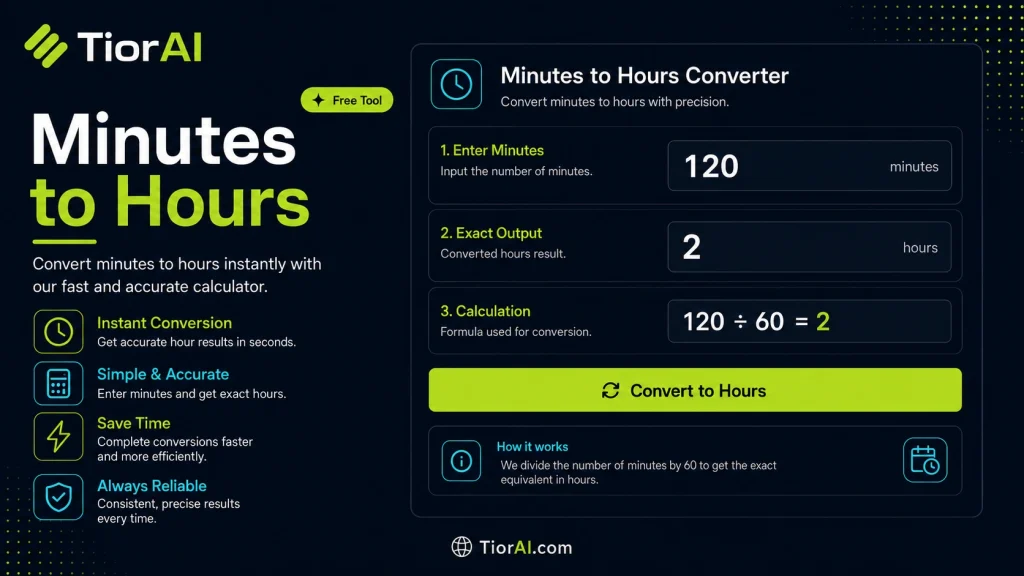
Formula: hours = minutes ÷ 60
How to use it
- Enter Your Input Value Type or paste the value you want to convert into the input field. The tool accepts any numeric value.
- Select Units and Convert Choose your source and target units from the dropdown menus. The converted result appears instantly.
- Copy or Use the Result Click copy to grab the converted value for use in your project, document, or calculation.
Tip Chain multiple conversions by copying the output and pasting it as the next input - works seamlessly.
Understanding Time Conversion: Minutes to Hours
Time is commonly measured in various units, with minutes and hours being two of the most frequently used. Converting minutes to hours is a basic but essential calculation in many fields such as scheduling, time tracking, and project management. Since 1 hour equals 60 minutes, converting minutes to hours involves dividing the total minutes by 60.
Why is this conversion important? Many activities and systems require time to be expressed in hours rather than minutes for clarity and standardization. For example, work hours, billing, and transportation schedules often use hours as the primary unit.
Common situations where this conversion is used include:
- Calculating total work time from minutes logged
- Converting exercise or study durations into hours for reports
- Estimating travel or event durations
- Programming and software development when handling time data
Understanding this conversion helps avoid confusion and ensures accurate communication of time intervals.
What is Minutes to Hours Conversion?
Converting minutes to hours is a straightforward process that involves dividing the total minutes by 60, since one hour contains 60 minutes. This conversion is essential in many real-world applications where time needs to be standardized or expressed in a more understandable format.
When Should You Use This Conversion?
- When calculating total work or study time recorded in minutes and needing to express it in hours.
- When preparing schedules or timelines that require hours instead of minutes.
- When determining hourly rates based on minutes worked.
- When summarizing time data for reports or billing purposes.
Common Mistakes to Avoid
- Mixing up minutes with seconds, which leads to incorrect conversions.
- Ignoring decimal points and rounding too early, which can cause inaccuracies in time calculations.
Technical Context
This conversion is a fundamental operation in time management and programming. Many software applications and databases store time in minutes or seconds, so converting these values to hours is often necessary for user-friendly displays or calculations. Understanding the basic formula and its correct application ensures accurate time representation across different systems.
Frequently asked questions
Reviews and questions
Whether this tool gave people the answer they needed, and what they asked about it.
Sign in to review this tool.
Sign In to ReviewNo reviews yet
Be the first to say whether this tool gave you what you needed.
Ask how to read the result, or what the tool does with an edge case — or answer someone else.
Sign In to AskNo questions yet
Not sure how to read a result? Be the first to ask.
AI tools related to this topic
Tools from the TiorAI directory that work on the same kind of job.

Wolfram Alpha
Wolfram Alpha is a computational knowledge engine that answers factual queries by performing computations on curated data, offering detailed solutions, visualizations, and an API for developers.

ChatGPT
ChatGPT is an AI chatbot by OpenAI powered by GPT-4o. It handles writing, coding, research, data analysis, and natural conversation. Free tier available, Plus at $20/month.