

SHA 1 Generator
Process and transform your code with the free sha 1 generator. Paste your input, hit the button, and get clean, formatted output — perfect for developers and engineers.
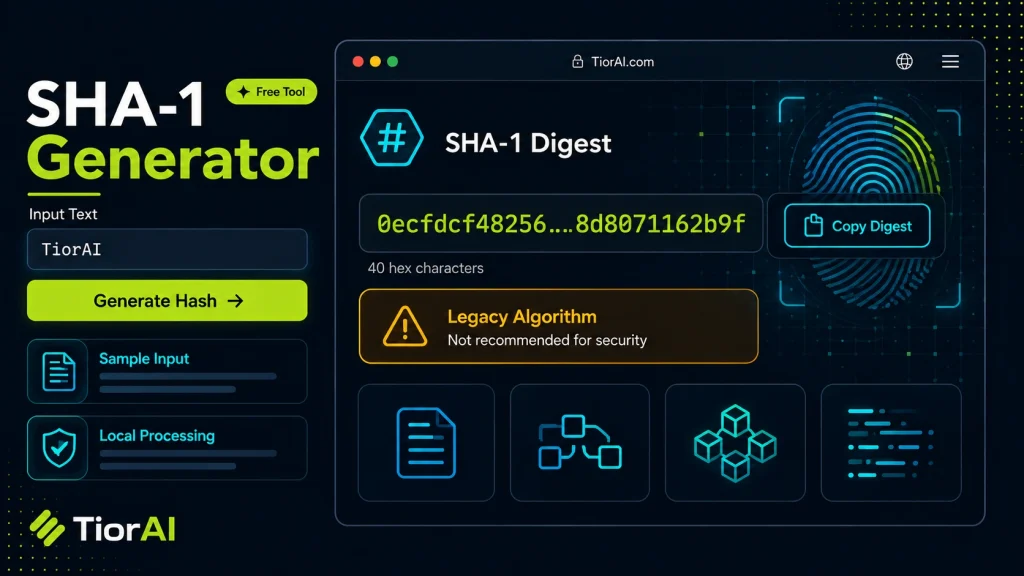
How to use it
- Paste Your Input Paste your code or data into the Sha 1 Generator. The tool accepts standard input formats and validates your entry.
- Process and Transform Click the action button to process your input. Results are generated instantly with proper formatting.
- Export the Output Copy the processed output to your clipboard or download it for use in your development workflow.
Tip Paste minified code into the Sha 1 Generator to instantly format and debug it without installing any extensions.
Understanding SHA-1 Hashing
SHA-1 stands for Secure Hash Algorithm 1, a cryptographic hash function designed to produce a fixed-size 160-bit (20-byte) hash value from arbitrary input data. It was published by the National Institute of Standards and Technology (NIST) as part of the Digital Signature Algorithm (DSA) in 1995 and standardized in the Federal Information Processing Standards (FIPS PUB 180-1).
The primary purpose of SHA-1 is to generate a unique fingerprint or digest of data, which is useful for verifying data integrity, digital signatures, and authentication processes. The hash output is deterministic, meaning the same input always produces the same hash, but even a small change in input drastically changes the output, a property known as the avalanche effect.
Developers use SHA-1 in various applications such as:
- Verifying file integrity by comparing hash values before and after transmission.
- Creating digital signatures to ensure authenticity and non-repudiation.
- Generating unique identifiers for data blocks or passwords (though password hashing now requires stronger algorithms).
Technically, SHA-1 processes input in 512-bit blocks, padding the data to fit this size, and applies a series of logical functions and bitwise operations to produce the final 160-bit hash. Despite its historical significance, SHA-1 is now considered deprecated for security-sensitive applications due to vulnerabilities discovered over time.
In real-world projects, developers often use SHA-1 to quickly generate checksums for files or data verification where collision resistance is not critical. For example, software distribution sites may provide SHA-1 hashes so users can verify downloads. However, for cryptographic security, stronger hash functions like SHA-256 or SHA-3 are recommended.
What is SHA-1?
SHA-1 (Secure Hash Algorithm 1) is a cryptographic hash function that produces a fixed 160-bit (20-byte) hash value from any input data. It was standardized by NIST in 1995 and widely used for data integrity verification and digital signatures. The algorithm processes data in 512-bit blocks and outputs a unique hexadecimal string representing the input.
Developers use SHA-1 to create fingerprints of data that help detect accidental changes or tampering. Because the hash is deterministic and sensitive to input changes, even a single bit difference results in a completely different hash output. This property is called the avalanche effect.
When to Use SHA-1
- Verifying file integrity in environments where security is not critical but compatibility and speed are important.
- Generating unique identifiers for data in legacy systems that require SHA-1.
- Quick data consistency checks during development or debugging.
- Situations where stronger hashes are not supported but a checksum is needed.
Common Mistakes with SHA-1
- Using SHA-1 for password hashing or sensitive cryptographic operations despite its known vulnerabilities.
- Assuming SHA-1 hashes are collision-proof and secure against tampering, which can lead to security breaches.
- Confusing SHA-1 hashing with encryption; SHA-1 is irreversible and does not encrypt data.
Technical Context
SHA-1 was once the standard for cryptographic hashing but has been deprecated due to advances in cryptanalysis that revealed collision vulnerabilities. Collisions occur when two different inputs produce the same hash, which compromises the integrity guarantees of the hash function.
Modern security standards recommend using SHA-256 or SHA-3 instead, which provide stronger collision resistance and better security properties. However, SHA-1 remains in use for legacy compatibility and non-critical applications.
Developers should carefully evaluate the security requirements of their projects before choosing SHA-1 and prefer more secure alternatives whenever possible.
Common use cases
- Generating SHA-1 hash for a simple string
- SHA-1 hash of an empty string
Frequently asked questions
Reviews and questions
Whether this tool gave people the answer they needed, and what they asked about it.
Sign in to review this tool.
Sign In to ReviewNo reviews yet
Be the first to say whether this tool gave you what you needed.
Ask how to read the result, or what the tool does with an edge case — or answer someone else.
Sign In to AskNo questions yet
Not sure how to read a result? Be the first to ask.