

Ipv6 Compatibility Checker
Check your IPv6 connectivity and browser support. Test if your network supports IPv6 protocol.
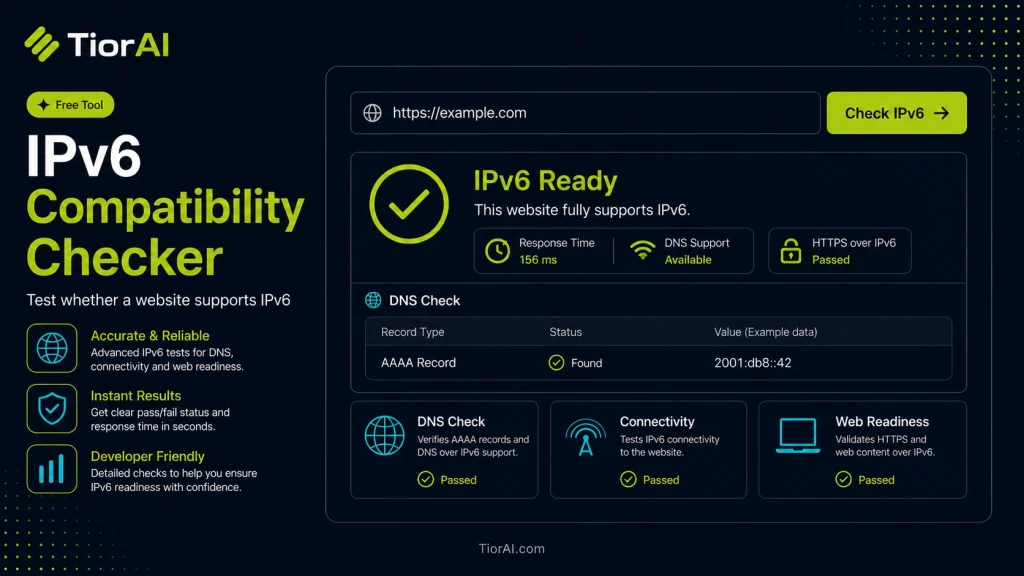
| Check | Result |
|---|---|
| Browser Support | -- |
| Connection Type | -- |
| IPv4 Address | -- |
| IPv6 Address | -- |
| Protocol | -- |
About IPv6
IPv6 is the most recent version of the Internet Protocol. It provides more IP addresses and improved security compared to IPv4.
- IPv4: 32-bit address (e.g., 192.168.1.1)
- IPv6: 128-bit address (e.g., 2001:0db8:85a3::8a2e:0370:7334)
How to use it
- Enter Domain or IP Enter the domain name, IP address, or URL into the Ipv6 Compatibility Checker to start the lookup or analysis.
- Run the Check Click the check button to query the relevant databases. Results are retrieved and displayed in seconds.
- Analyze the Results Review the detailed results including status, records, and diagnostics to troubleshoot or verify your query.
Tip Compare results from the Ipv6 Compatibility Checker with your hosting provider's dashboard to spot discrepancies early.
Understanding IPv6 and Its Importance
Internet Protocol version 6 (IPv6) is the most recent version of the Internet Protocol (IP), designed to replace IPv4, which has been the foundation of internet addressing since the 1980s. IPv6 was developed to solve the problem of IPv4 address exhaustion by providing a vastly larger address space—128 bits compared to IPv4’s 32 bits. This expansion allows for approximately 3.4 x 1038 unique IP addresses, accommodating the growing number of internet-connected devices worldwide.
Technical Standards: IPv6 is defined by RFC 8200, which outlines its packet structure, addressing format, and operational principles. Unlike IPv4, IPv6 addresses are represented as eight groups of four hexadecimal digits, separated by colons (e.g., 2001:0db8:85a3:0000:0000:8a2e:0370:7334).
Why IPv6 Compatibility Matters
As the internet transitions to IPv6, ensuring that websites, servers, and network devices support IPv6 is critical. IPv6 compatibility means that a system can communicate using IPv6 addresses and protocols without issues. Without compatibility, users on IPv6-only networks may be unable to access certain resources, leading to connectivity problems and degraded user experience.
Developers and network administrators use IPv6 compatibility checks to verify that their infrastructure supports IPv6. This involves testing DNS records, server configurations, and network paths to confirm that IPv6 traffic is properly handled.
How Developers Use IPv6 Compatibility in Real Projects
- Website Deployment: Before launching a website, developers test IPv6 compatibility to ensure the site is reachable by IPv6 clients. This includes verifying AAAA DNS records and server listening configurations.
- Network Infrastructure Upgrades: When upgrading routers, firewalls, or load balancers, engineers check IPv6 compatibility to maintain seamless connectivity.
- Application Development: Developers build applications that support both IPv4 and IPv6 to future-proof their software and avoid connectivity issues.
In summary, IPv6 compatibility is a foundational aspect of modern internet infrastructure, enabling continued growth and connectivity in an IPv6-enabled world.
What is IPv6 and Why Does Compatibility Matter?
IPv6 is the latest version of the Internet Protocol designed to replace IPv4, addressing the shortage of IP addresses by providing a much larger address space. It uses 128-bit addresses, allowing for trillions of unique IPs, which is essential as more devices connect to the internet.
For developers and network engineers, ensuring IPv6 compatibility means confirming that websites, servers, and network devices can communicate over IPv6 without issues. This is crucial because some users and networks operate exclusively on IPv6, and without compatibility, they may not reach your services.
When to Use an IPv6 Compatibility Checker
- Before launching a new website or service to verify it is reachable via IPv6.
- When upgrading or configuring network infrastructure to support IPv6.
- To troubleshoot connectivity problems reported by users on IPv6-only networks.
- During routine audits to ensure ongoing IPv6 support and compliance.
Common Mistakes to Avoid
- Assuming IPv6 support without checking DNS AAAA records or server configurations.
- Entering IPv6 addresses incorrectly due to unfamiliarity with the hexadecimal colon-separated format.
- Testing only DNS records without verifying actual IPv6 network connectivity, which can lead to false assumptions.
Technical Context for Developers
IPv6 addresses are stored in DNS as AAAA records, unlike IPv4 addresses which use A records. For full IPv6 compatibility, both DNS and server configurations must be correct. Servers need to listen on IPv6 sockets, and network devices must route IPv6 traffic properly. Developers should also consider dual-stack environments where both IPv4 and IPv6 operate simultaneously.
Using an IPv6 compatibility checker helps identify gaps in this setup by validating DNS entries and testing connectivity. This ensures that your applications and services remain accessible as the internet increasingly adopts IPv6.
Common use cases
- Checking IPv6 Compatibility of a Website
- Testing a Domain Without IPv6 Support
Frequently asked questions
Reviews and questions
Whether this tool gave people the answer they needed, and what they asked about it.
Sign in to review this tool.
Sign In to ReviewNo reviews yet
Be the first to say whether this tool gave you what you needed.
Ask how to read the result, or what the tool does with an edge case — or answer someone else.
Sign In to AskNo questions yet
Not sure how to read a result? Be the first to ask.
AI tools related to this topic
Tools from the TiorAI directory that work on the same kind of job.

Action Network
Action Network is a progressive organizing platform with free access for grassroots activists and paid plans from $15/month.

Layla Network AI
Layla is a private offline AI assistant for Android and iOS that runs local models on your phone for chat, characters and image generation.