

ASN Whois Lookup
Enter an Autonomous System Number (e.g. AS15169 or 15169) to retrieve WHOIS information.
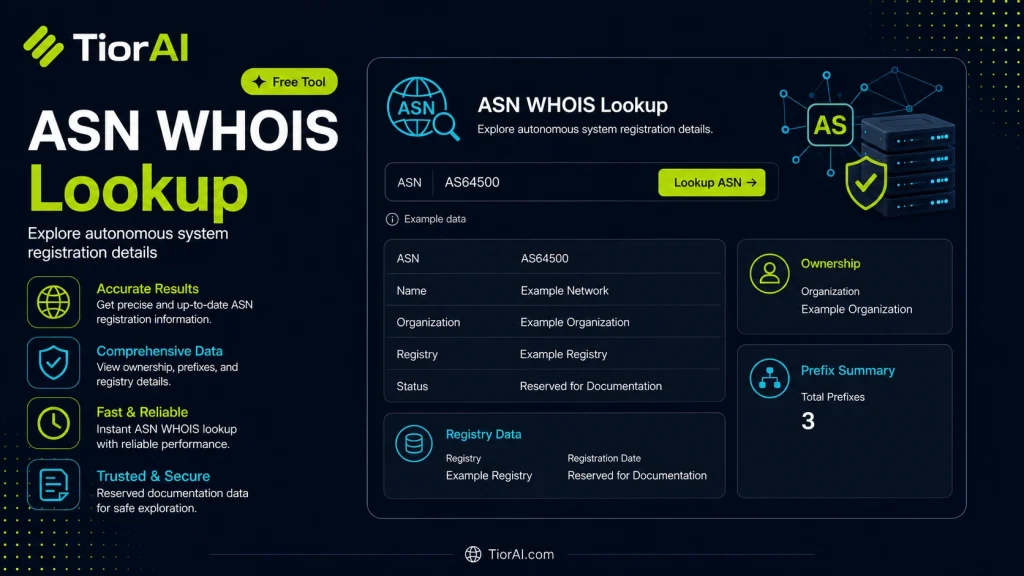
ASN Whois Lookup
Autonomous System
Full Registry Record
| Field | Value |
|---|
Registry data is retrieved live from RIPEstat, which aggregates the records of all five regional internet registries.
How to use it
- Enter Domain or IP Enter the domain name, IP address, or URL into the Asn Whois Lookup to start the lookup or analysis.
- Run the Check Click the check button to query the relevant databases. Results are retrieved and displayed in seconds.
- Analyze the Results Review the detailed results including status, records, and diagnostics to troubleshoot or verify your query.
Tip Use the Asn Whois Lookup to verify DNS propagation after making changes — it can take up to 48 hours for full propagation.
Understanding Autonomous System Numbers (ASNs) and Whois Lookup
An Autonomous System Number (ASN) is a unique identifier assigned to an autonomous system (AS), which is a collection of IP routing prefixes under the control of one or more network operators that present a common routing policy to the internet. ASNs are essential for the operation of the Border Gateway Protocol (BGP), the protocol that manages how packets are routed across the internet through different ASes.
Each ASN allows an organization to control its own routing policies and exchange routing information with other ASes. ASNs are assigned by regional internet registries (RIRs) such as ARIN, RIPE NCC, APNIC, LACNIC, and AFRINIC, following the guidelines set by the Internet Assigned Numbers Authority (IANA).
Whois lookup is a query and response protocol widely used for querying databases that store registered users or assignees of an internet resource, such as domain names, IP addresses, or ASNs. An ASN Whois lookup tool queries these databases to retrieve detailed registration information about a specific ASN, including the organization that owns it, contact information, and the range of IP prefixes announced by that ASN.
Developers and network engineers use ASN Whois lookups to troubleshoot routing issues, verify ownership of network blocks, analyze internet topology, and enhance security by identifying the origin of suspicious traffic. For example, when investigating a network attack or spam source, knowing the ASN can help trace the responsible network operator.
The ASN Whois data is structured according to standards defined in RFC 1930 and RFC 4271 for BGP, and the Whois protocol itself is specified in RFC 3912. The data returned typically includes fields like ASN number, organization name, country, contact emails, and sometimes routing policies.
In real-world projects, developers might integrate ASN Whois lookups into network monitoring tools, security incident response platforms, or automated scripts that enrich IP address data with ASN ownership information.
What is an ASN and Why It Matters
An Autonomous System Number (ASN) is a critical component of internet infrastructure. It identifies a network or group of IP prefixes controlled by a single entity that manages its own routing policies. ASNs enable the Border Gateway Protocol (BGP) to route traffic efficiently and reliably across the global internet.
Each ASN is unique and assigned by regional internet registries (RIRs). They allow organizations to participate in internet routing by advertising their IP prefixes to other networks. Without ASNs, the internet would lack the hierarchical structure needed for scalable routing.
When to Use ASN Whois Lookup
- To identify the organization responsible for a specific ASN, which helps in understanding who controls certain IP ranges.
- During security investigations to trace the origin of suspicious or malicious traffic back to its network operator.
- For network engineers configuring or troubleshooting BGP sessions to verify ASN ownership and registration details.
- When conducting research or mapping the internet’s topology by analyzing AS relationships and ownership.
Common Mistakes When Using ASN Whois Lookup Tools
- Confusing ASN lookup with IP address lookup and expecting detailed IP-specific information rather than ASN registration data.
- Relying on outdated or unofficial Whois databases that may provide incomplete or inaccurate ASN information, leading to incorrect conclusions.
Technical Context and Standards
The ASN system is governed by standards such as RFC 1930 and RFC 4271, which define BGP and the use of ASNs in routing. Whois protocol, specified in RFC 3912, is the standard method for querying registration data for internet resources including ASNs.
Developers often integrate ASN Whois lookups into network monitoring and security tools to enrich IP data with ownership information. This helps automate threat detection, routing validation, and network management tasks.
Common use cases
- Lookup for ASN 15169 (Google)
- Lookup for ASN 3356 (Level 3 Communications)
Frequently asked questions
Reviews and questions
Whether this tool gave people the answer they needed, and what they asked about it.
Sign in to review this tool.
Sign In to ReviewNo reviews yet
Be the first to say whether this tool gave you what you needed.
Ask how to read the result, or what the tool does with an edge case — or answer someone else.
Sign In to AskNo questions yet
Not sure how to read a result? Be the first to ask.
AI tools related to this topic
Tools from the TiorAI directory that work on the same kind of job.

Action Network
Action Network is a progressive organizing platform with free access for grassroots activists and paid plans from $15/month.
Layla Network AI
Layla Network AI is an AI-driven platform that automates network monitoring, anomaly detection, and troubleshooting to improve network reliability and operational efficiency.