

Whirlpool Generator
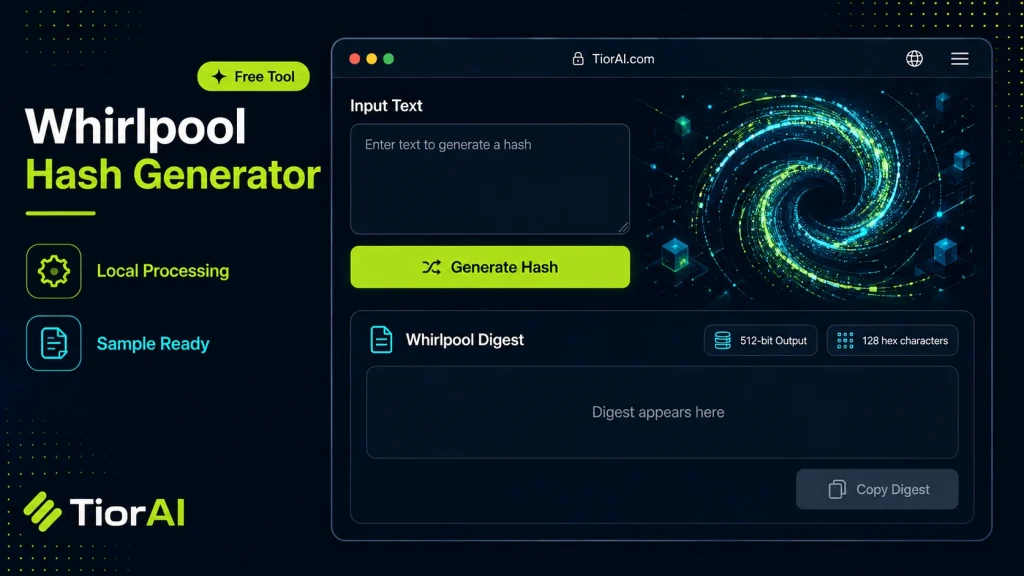
Generate Whirlpool hash from text input using WebAssembly acceleration.
How to use it
- Configure Settings Set your preferences and parameters in the Whirlpool Generator. Customize the output to match your specific requirements.
- Generate Output Click generate to create your result. The tool processes your settings and produces output instantly.
- Copy or Download Review the generated output, then copy it to your clipboard or download it for immediate use.
Tip Use the Whirlpool Generator to quickly prototype ideas before investing time in manual creation.
Understanding the Whirlpool Hash Function
Whirlpool is a cryptographic hash function designed to produce a fixed-size output (digest) from arbitrary input data. It was developed by Vincent Rijmen and Paulo S. L. M. Barreto in 2000 and is standardized in ISO/IEC 10118-3. The primary purpose of Whirlpool is to ensure data integrity and provide a unique fingerprint for data verification.
Whirlpool operates by processing input data in blocks of 512 bits through a series of transformations based on a block cipher structure. It produces a 512-bit (64-byte) hash value, which is significantly longer than many other common hashes like SHA-256 (256 bits). This longer output size enhances collision resistance, making it computationally infeasible to find two different inputs producing the same hash.
Developers use Whirlpool in security applications where strong cryptographic hashing is required, such as digital signatures, password hashing (often combined with salting and key stretching), and integrity verification of files or messages. Its design is based on a modified AES-like block cipher, which contributes to its robustness against cryptanalysis.
Whirlpool is part of the ISO/IEC 10118-3 standard, which defines hash functions for digital signatures and other cryptographic applications. While not as widely adopted as SHA-2 or SHA-3 families, Whirlpool remains a valid choice where a 512-bit hash is desired.
In real-world projects, developers might use Whirlpool when compatibility with legacy systems or specific standards is required, or when a longer hash output is preferred for security reasons. It is also used in some blockchain and cryptographic libraries as an alternative hash function.
What is the Whirlpool Hash Function?
Whirlpool is a cryptographic hash function that transforms input data of any size into a fixed 512-bit (64-byte) output. It was developed to provide strong data integrity verification and is standardized under ISO/IEC 10118-3. Unlike more common hashes such as SHA-256, Whirlpool produces a longer hash value, which increases collision resistance and security.
The function processes data in 512-bit blocks using a block cipher-like structure inspired by AES. This design helps Whirlpool resist cryptanalysis and ensures that even a small change in input drastically changes the output hash.
When to Use a Whirlpool Generator
- When your application requires a 512-bit hash output for enhanced security.
- In systems or protocols that specifically mandate compliance with ISO/IEC 10118-3.
- For verifying file or message integrity where a less common hash function can reduce the risk of collision attacks.
- When working with legacy systems that already use Whirlpool hashes.
Common Mistakes When Using Whirlpool
- Assuming Whirlpool behaves like SHA-256 and expecting similar output lengths or performance characteristics.
- Using Whirlpool alone for password hashing without salting or key stretching, which can expose passwords to brute-force attacks.
Technical Context
Whirlpool’s 512-bit output makes it suitable for applications demanding high collision resistance. However, it is less widely adopted than SHA-2 or SHA-3, so developers should ensure their cryptographic libraries support it. For password storage, Whirlpool should be combined with additional security measures like salting and iterative hashing to protect against modern attack vectors.
Overall, Whirlpool remains a robust and standardized hash function useful in specific security contexts where its properties align with project requirements.
Common use cases
- Generating Whirlpool hash for a simple string
- Whirlpool hash of an empty string
Frequently asked questions
Reviews and questions
Whether this tool gave people the answer they needed, and what they asked about it.
Sign in to review this tool.
Sign In to ReviewNo reviews yet
Be the first to say whether this tool gave you what you needed.
Ask how to read the result, or what the tool does with an edge case — or answer someone else.
Sign In to AskNo questions yet
Not sure how to read a result? Be the first to ask.