

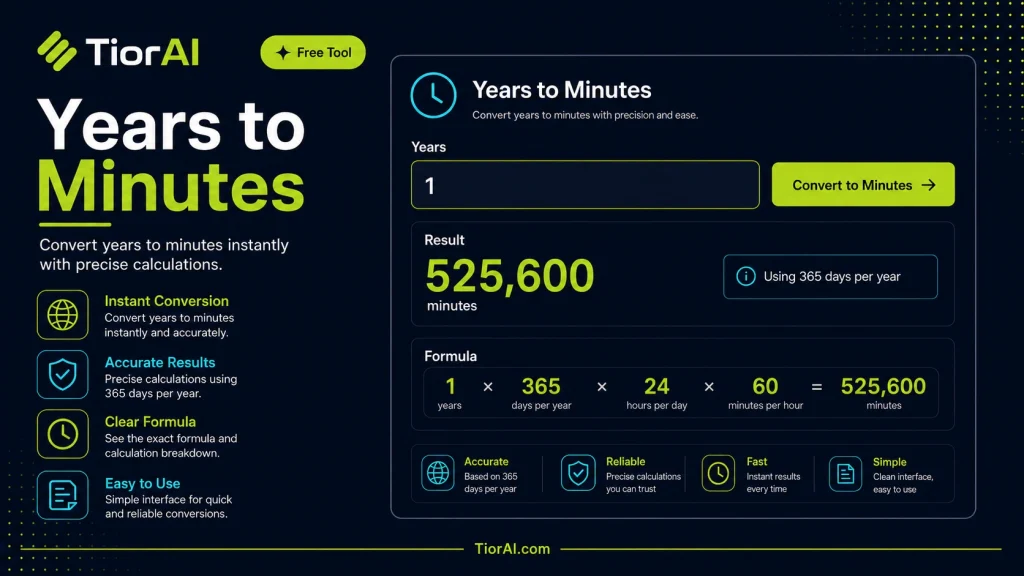
Formula: minutes = years × 365.25 × 24 × 60
How to use it
- Enter Your Input Value Type or paste the value you want to convert into the input field. The tool accepts any numeric value.
- Select Units and Convert Choose your source and target units from the dropdown menus. The converted result appears instantly.
- Copy or Use the Result Click copy to grab the converted value for use in your project, document, or calculation.
Tip Need the reverse conversion? Swap source and target to convert in the opposite direction instantly.
Understanding Time Unit Conversion: Years to Minutes
Converting years to minutes is a specific type of time unit conversion that translates a larger time scale (years) into a smaller one (minutes). This process involves understanding the relationship between different units of time and applying a consistent formula to get accurate results.
Why convert years to minutes? While years are commonly used to measure long durations, minutes are useful for more precise calculations, especially in fields like science, engineering, and project planning. For example, when calculating the total number of minutes in a lifespan or the duration of an event measured in years, converting to minutes helps in detailed time analysis.
How does the conversion work? The conversion relies on fixed time relationships: 1 year is typically considered as 365 days (or 366 for leap years), each day has 24 hours, each hour has 60 minutes. Multiplying these values gives the total minutes in a year. This conversion assumes a standard calendar year unless otherwise specified.
Common use cases include:
- Calculating total minutes lived based on age in years
- Estimating project durations or deadlines in smaller units
- Converting data for scientific experiments where precise time measurement is required
- Financial calculations involving interest rates or investments over years, converted into minutes for detailed analysis
Understanding Years to Minutes Conversion
Converting years to minutes involves translating a large time unit into a much smaller one. This is done by multiplying the number of years by the number of days in a year, then by hours per day, and finally by minutes per hour. Typically, one year is considered to have 365 days, 24 hours per day, and 60 minutes per hour, resulting in 525,600 minutes per year.
This conversion is essential when you need more precise time measurements. For example, scientists may convert years into minutes to analyze processes occurring over long periods but requiring detailed timing. Similarly, project managers might break down long-term schedules into minutes for better tracking.
When to Use This Conversion
- Analyzing durations originally expressed in years but requiring finer granularity.
- Performing scientific or engineering calculations needing minute-level precision.
- Converting age or experience into minutes for demographic or statistical purposes.
- Breaking down project timelines into smaller units for detailed scheduling.
Common Mistakes to Avoid
- Assuming every year has exactly 365 days and ignoring leap years, which can introduce small errors.
- Confusing different year definitions, such as calendar versus fiscal years, leading to inaccurate conversions.
Understanding these details ensures accurate and meaningful conversions from years to minutes, supporting precise time-based calculations across various fields.
Frequently asked questions
Reviews and questions
Whether this tool gave people the answer they needed, and what they asked about it.
Sign in to review this tool.
Sign In to ReviewNo reviews yet
Be the first to say whether this tool gave you what you needed.
Ask how to read the result, or what the tool does with an edge case — or answer someone else.
Sign In to AskNo questions yet
Not sure how to read a result? Be the first to ask.
AI tools related to this topic
Tools from the TiorAI directory that work on the same kind of job.

Wolfram Alpha
Wolfram Alpha is a computational knowledge engine that answers factual queries by performing computations on curated data, offering detailed solutions, visualizations, and an API for developers.

ChatGPT
ChatGPT is an AI chatbot by OpenAI powered by GPT-4o. It handles writing, coding, research, data analysis, and natural conversation. Free tier available, Plus at $20/month.