

Utf8 Encode
UTF-8 is a widely used character encoding standard that converts text into a sequence of bytes. It can represent every character in the Unicode standard, making it suitable for international text, symbols, and emojis. UTF-8 uses one to four bytes per character, which allows it…
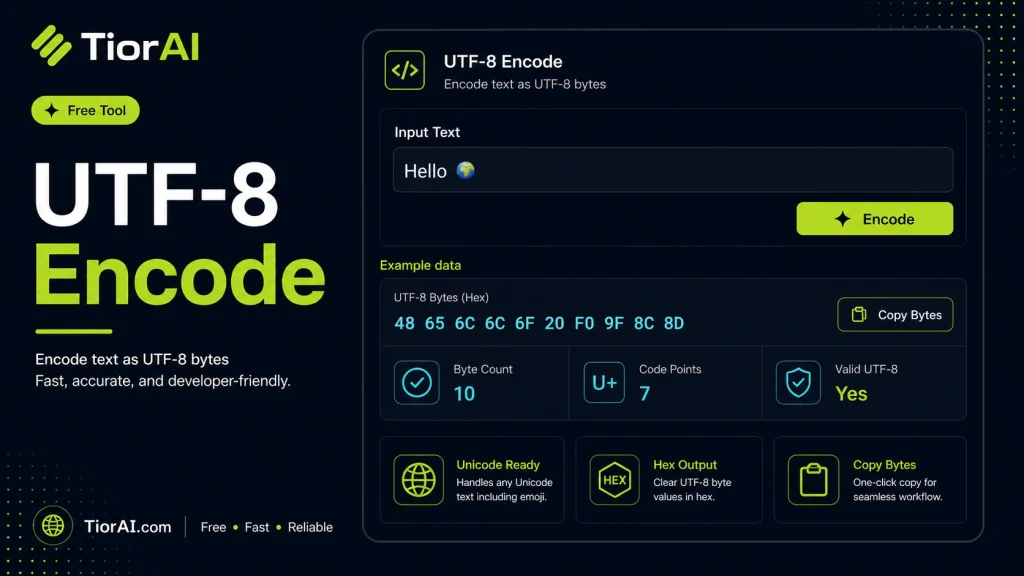
| Encoded Output | - |
|---|
How to use it
- Enter Your Input Value Type or paste the value you want to convert into the input field. The tool accepts any numeric value.
- Select Units and Convert Choose your source and target units from the dropdown menus. The converted result appears instantly.
- Copy or Use the Result Click copy to grab the converted value for use in your project, document, or calculation.
Tip Bookmark this converter - it handles edge cases like zero values and very large numbers accurately.
Understanding UTF-8 Encoding
UTF-8 is a character encoding standard that represents text in computers and communication systems. It encodes every character in the Unicode character set using one to four bytes, allowing for the representation of virtually all characters from all writing systems, including symbols and emojis.
Encoding text into UTF-8 is essential because it ensures consistent and universal interpretation of characters across different platforms, programming languages, and devices. Without proper encoding, text data can become corrupted or display incorrectly, especially when transferring data between systems that use different default encodings.
Common situations where UTF-8 encoding is necessary include:
- Web development, where HTML pages and APIs must support multiple languages and special characters.
- Data storage and transmission, ensuring that text remains intact and readable.
- Programming, when handling strings that include non-ASCII characters.
UTF-8 is backward compatible with ASCII, meaning ASCII characters are encoded as single bytes, which helps maintain compatibility with older systems.
What is UTF-8 Encoding?
UTF-8 is a widely used character encoding standard that converts text into a sequence of bytes. It can represent every character in the Unicode standard, making it suitable for international text, symbols, and emojis. UTF-8 uses one to four bytes per character, which allows it to be backward compatible with ASCII while supporting a vast range of characters.
When to Use UTF-8 Encoding
Use UTF-8 encoding when you need to ensure text is correctly interpreted across different systems and platforms. This includes web development, API communication, data storage, and handling user input that may contain special characters or emojis. It is also essential when converting legacy text data to a modern, universal encoding format.
Common Mistakes with UTF-8 Encoding
- Confusing UTF-8 encoding with encryption or compression, which are unrelated processes.
- Assuming text is already UTF-8 encoded and skipping encoding, which can cause display errors.
- Applying UTF-8 encoding to binary data instead of text, leading to data corruption.
Understanding UTF-8 encoding helps avoid data corruption and ensures your text is universally readable and compatible with modern software and web standards.
Frequently asked questions
Reviews and questions
Whether this tool gave people the answer they needed, and what they asked about it.
Sign in to review this tool.
Sign In to ReviewNo reviews yet
Be the first to say whether this tool gave you what you needed.
Ask how to read the result, or what the tool does with an edge case — or answer someone else.
Sign In to AskNo questions yet
Not sure how to read a result? Be the first to ask.
AI tools related to this topic
Tools from the TiorAI directory that work on the same kind of job.

Wolfram Alpha
Wolfram Alpha is a computational knowledge engine that answers factual queries by performing computations on curated data, offering detailed solutions, visualizations, and an API for developers.

ChatGPT
ChatGPT is an AI chatbot by OpenAI powered by GPT-4o. It handles writing, coding, research, data analysis, and natural conversation. Free tier available, Plus at $20/month.