

Milliseconds to Seconds
Convert milliseconds to seconds and seconds to milliseconds instantly.
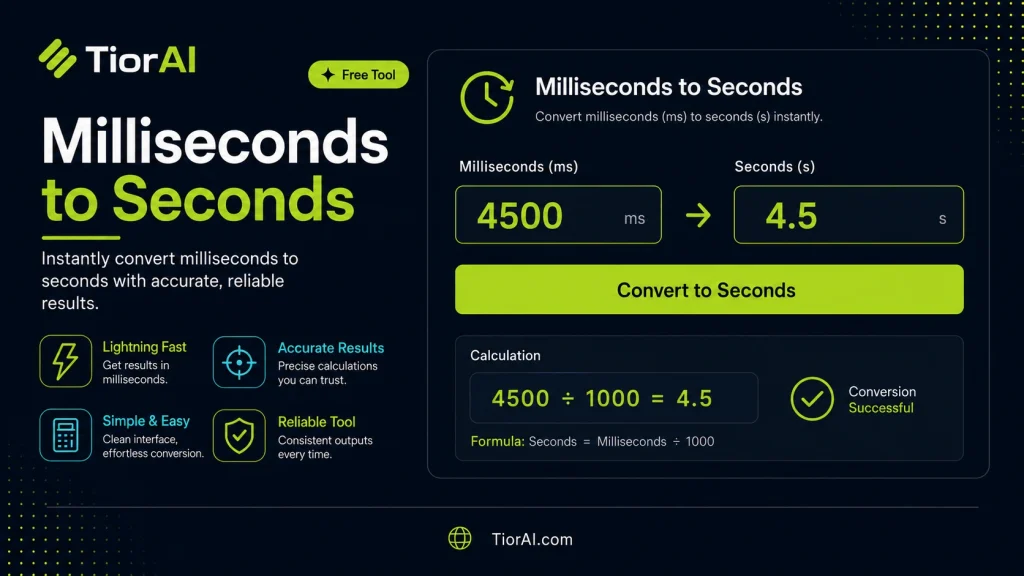
Formula: seconds = milliseconds ÷ 1000
How to use it
- Enter Your Input Value Type or paste the value you want to convert into the input field. The tool accepts any numeric value.
- Select Units and Convert Choose your source and target units from the dropdown menus. The converted result appears instantly.
- Copy or Use the Result Click copy to grab the converted value for use in your project, document, or calculation.
Tip Chain multiple conversions by copying the output and pasting it as the next input - works seamlessly.
Understanding Time Units: Milliseconds and Seconds
Time measurement is fundamental in computing, programming, and everyday life. Two common units for measuring time intervals are milliseconds and seconds. A millisecond (ms) is one thousandth of a second, meaning 1 second equals 1000 milliseconds. Converting between these units is essential when working with time data that requires different levels of precision.
For example, many programming languages and systems record timestamps or durations in milliseconds because it offers finer granularity than seconds. However, humans typically understand and communicate time in seconds or larger units. Therefore, converting milliseconds to seconds helps interpret and display time values in a more readable format.
Common situations where this conversion is needed include:
- Analyzing performance metrics such as response times or execution durations, which are often logged in milliseconds.
- Converting timestamps from APIs or databases that use milliseconds into seconds for easier calculations or display.
- Working with multimedia files or animations where timing is specified in milliseconds but needs to be presented in seconds.
Understanding this conversion also aids in debugging and optimizing code, as developers can quickly switch between units to assess timing accuracy and performance.
What is Milliseconds to Seconds Conversion?
Milliseconds and seconds are units used to measure time intervals, with 1 second equal to 1000 milliseconds. This conversion is necessary because many systems and applications record time in milliseconds for precision, but humans usually interpret time in seconds.
When to Use This Conversion
- When you need to display time durations recorded in milliseconds in a more understandable seconds format.
- When analyzing performance data such as response times or execution durations logged in milliseconds.
- When programming or debugging code that involves timers or delays specified in milliseconds but requires seconds for calculations.
- When working with multimedia or animation timings that are easier to interpret in seconds.
Common Mistakes to Avoid
- Incorrectly converting by not dividing by 1000, which leads to wrong time values.
- Mixing up milliseconds with smaller units like microseconds or nanoseconds, which have different conversion factors.
Understanding the relationship between milliseconds and seconds is fundamental for accurate time measurement and interpretation in many technical and everyday contexts.
Frequently asked questions
Reviews and questions
Whether this tool gave people the answer they needed, and what they asked about it.
Sign in to review this tool.
Sign In to ReviewNo reviews yet
Be the first to say whether this tool gave you what you needed.
Ask how to read the result, or what the tool does with an edge case — or answer someone else.
Sign In to AskNo questions yet
Not sure how to read a result? Be the first to ask.
AI tools related to this topic
Tools from the TiorAI directory that work on the same kind of job.

Wolfram Alpha
Wolfram Alpha is a computational knowledge engine that answers factual queries by performing computations on curated data, offering detailed solutions, visualizations, and an API for developers.

ChatGPT
ChatGPT is an AI chatbot by OpenAI powered by GPT-4o. It handles writing, coding, research, data analysis, and natural conversation. Free tier available, Plus at $20/month.