

ScreenshotAPI - Reliable Website Screenshot API for Developers & Marketers
ScreenshotAPI is a RESTful API service that allows developers and marketers to programmatically capture high-quality screenshots of websites with customizable options such as device type, viewport size, and full page capture.
- Best for
- Automated Website Screenshots
- Key capability
- Customizable Screenshots
Save ScreenshotAPI, follow its updates and vote on it — everything stays in your account.
Sign in or create a free account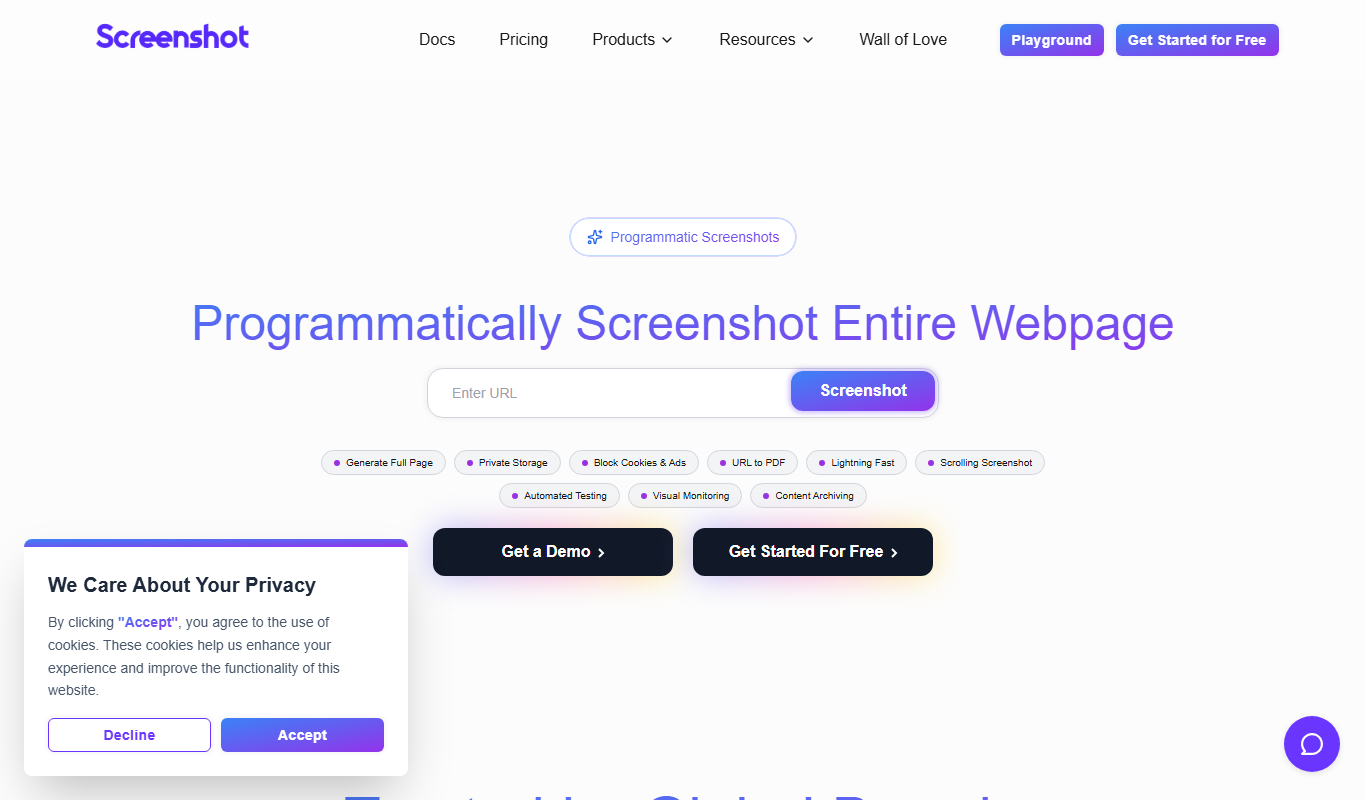
What is ScreenshotAPI?
ScreenshotAPI is a developer-focused API service that enables automated capturing of high-quality website screenshots. It provides a simple RESTful interface to programmatically generate screenshots of any URL with customizable options such as device type, viewport size, full page capture, and image format. This tool is designed for developers, marketers, and businesses needing reliable, scalable web page capture without manual intervention.
Key features of ScreenshotAPI
ScreenshotAPI offers flexible screenshot generation with support for desktop and mobile views, full-page captures, custom delays, and various image formats. It integrates easily via REST API calls and supports authentication and usage analytics. The service is scalable and suitable for integration into monitoring, marketing, and development workflows.
Customizable Screenshots
Set viewport size, device type (desktop/mobile), full page capture, and image format.
Fast and Scalable API
High-performance REST API designed for large-scale automated screenshot generation.
Authentication and Security
Secure API access with API keys and HTTPS encryption.
Multiple Image Formats
Supports PNG, JPEG, and WebP output formats.
Delay and Wait Options
Configure delays to wait for dynamic content or animations before capturing.
Pros and cons of ScreenshotAPI
Pros
- Easy to integrate REST API with clear documentation
- Supports desktop and mobile viewport screenshots
- Flexible customization options for screenshots
- Free tier available for testing and small projects
- Reliable and scalable infrastructure
Cons
- Limited language support (English only)
- No dedicated desktop or mobile app, API only
Key use cases for ScreenshotAPI
Automated Website Screenshots
Capture screenshots of websites programmatically for monitoring, archiving, or reporting.
Marketing and SEO Monitoring
Track visual changes on competitor or client websites to analyze marketing campaigns and SEO results.
Web Development and Testing
Integrate screenshot capture into development workflows to verify UI changes and responsiveness.
Content Generation
Generate website previews for blogs, newsletters, or social media posts automatically.
Compliance and Archiving
Store visual records of web pages for legal compliance or historical archiving.
How ScreenshotAPI works
- 1
Sign Up
Create an account on ScreenshotAPI’s website to obtain API credentials.
- 2
Get API Key
Access your unique API key from the dashboard for authentication.
- 3
Make API Requests
Send HTTP requests with URL and parameters to generate screenshots.
- 4
Receive Screenshot
Download or embed the returned image in your application or workflow.
Who is using ScreenshotAPI
ScreenshotAPI pricing
Free trial
$0 for 7 days
7-day free trial with 100 screenshots; there is no permanent free plan.
Essential
$20/month
Includes 1,000 screenshots per month, 20 requests per minute, unlimited team members and full-page screenshots.
Startup
$35/month
Includes 10,000 screenshots per month, 40 requests per minute, unlimited team members, scrolling screenshots and a custom storage bucket.
Business
$200/month
Includes 100,000 screenshots per month, 80 requests per minute, unlimited team members, custom storage bucket and priority support.
Plans and prices are as published by the vendor and can change. Check the official site before you buy. Open the pricing page (opens in a new tab)
Frequently asked questions about ScreenshotAPI
ScreenshotAPI supports PNG, JPEG, and WebP image formats.
Yes, you can enable full page capture to get screenshots of entire web pages.
No permanent free plan is offered; a 7-day free trial includes 100 screenshots.
You authenticate using your unique API key included in request headers or parameters.
Integration support depends on the tool and its available connectors or API. Check the official documentation or integrations page to confirm what is supported.
Pricing depends on the plan and included features. For the most accurate and up-to-date details, check the official pricing page.
Integration support depends on the tool and its available connectors or API. Check the official documentation or integrations page to confirm what is supported.
Some tools offer a free plan or trial with limited features. Availability can vary, so confirm on the official website.
Conclusion
Requests go to a REST API: after signing up and getting an API key from the dashboard, a developer sends HTTP requests with a URL and parameters and receives the screenshot. Parameters set the viewport size, desktop or mobile device type, full page capture and a delay for dynamic content. Output comes as PNG, JPEG or WebP.
Web developers, digital marketers and QA testers are the audience it is built around. No permanent free plan exists: a 7-day trial includes 100 screenshots, and paid plans run from Essential at $20 through Startup at $35 to Business at $200 per month.
Sources
Sign in to review this tool.
Sign In to ReviewNo reviews yet
Be the first to share how this tool worked for you.
Ask about pricing, limits, or how it compares — or answer someone else.
Sign In to AskNo questions yet
Have a question about using or paying for this tool? Be the first to ask.
Featured on TiorAI



More AI API tools
Other tools in the same category, for when this one is not quite the fit.
BentoML
BentoML is an open-source platform that simplifies packaging, deploying, and managing machine learning models as scalable APIs, supporting multiple ML frameworks and deployment environments.

Datumbox
Datumbox is the official name of this machine learning platform, which provides REST APIs for text analysis such as sentiment analysis, topic detection, language detection and spam filtering.

OpenFaaS
OpenFaaS is an open-source serverless framework that enables developers to deploy, manage, and scale functions on Kubernetes and other container platforms easily.

Fetch.ai
Fetch.ai is a decentralized platform that enables creation and deployment of autonomous economic agents using blockchain and AI to automate tasks and data exchange securely.

DocSpring
DocSpring is a cloud-based platform that automates PDF document creation and form building, offering an API for integration and conditional logic support.

PDFShift
PDFShift is a REST API service that converts HTML content into PDF documents quickly and accurately, supporting advanced styling and customization for developers and businesses.
LinkPreview
LinkPreview is an API service that extracts metadata like title, description, and images from any URL to create rich link previews for websites and social media.
Microlink
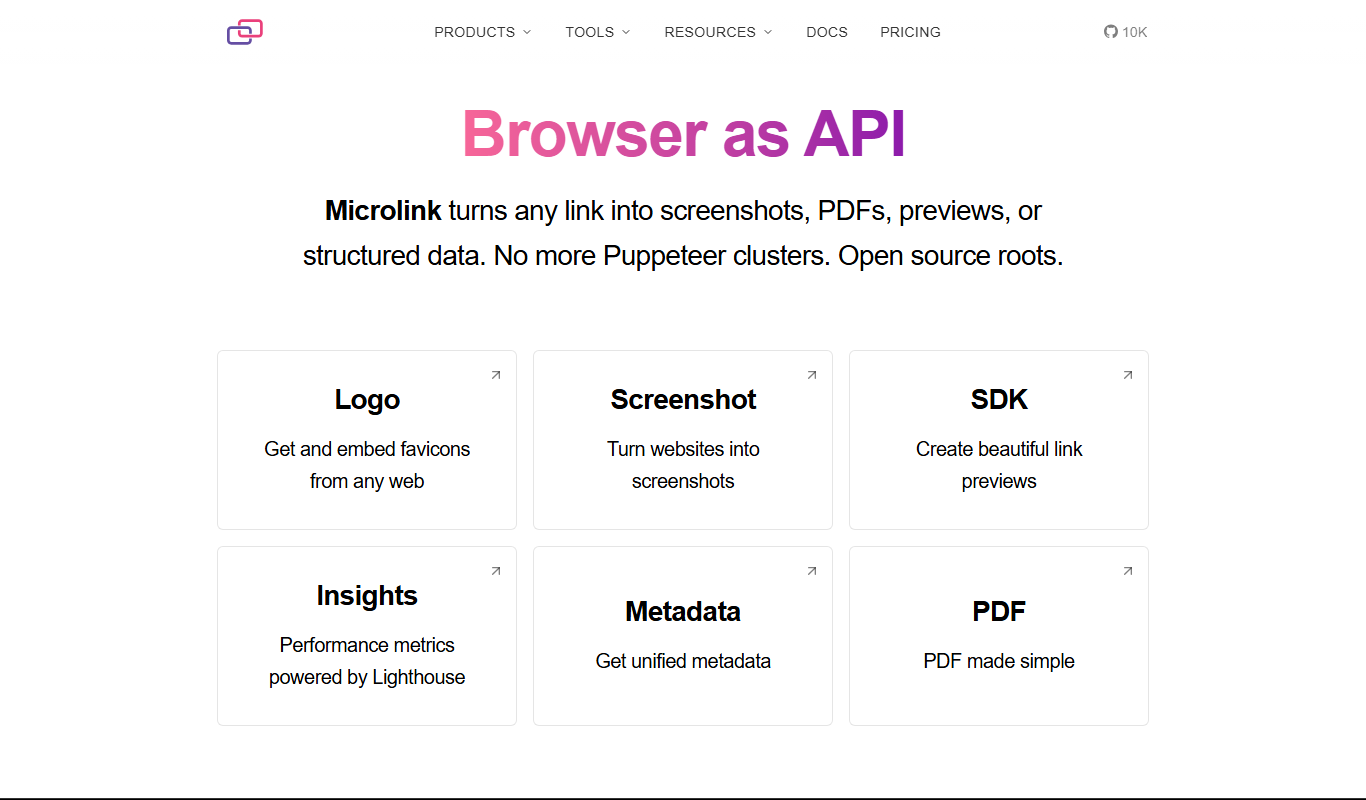
Microlink is a developer-friendly API that extracts structured data and screenshots from any website URL, simplifying web scraping and enabling automation.