

From my experience with phpMyAdmin, it stands out as a reliable and accessible tool for managing MySQL and MariaDB databases through a web interface. Its open-source nature and extensive feature set make it ideal for developers and database administrators who prefer a graphical interface over command-line tools. While setup requires a web server environment and some configuration for security, once running, it simplifies complex database tasks effectively. For anyone managing relational databases, phpMyAdmin offers a practical balance of power and usability.
phpMyAdmin Database Management Tool for MySQL and MariaDB Users
phpMyAdmin is a free, open-source web application that provides a graphical interface to manage MySQL and MariaDB databases, allowing users to perform database administration tasks without command-line knowledge.
- Best for
- Database Administration
- Key capability
- User-Friendly Web Interface
Do you recommend this tool?
What is phpMyAdmin?
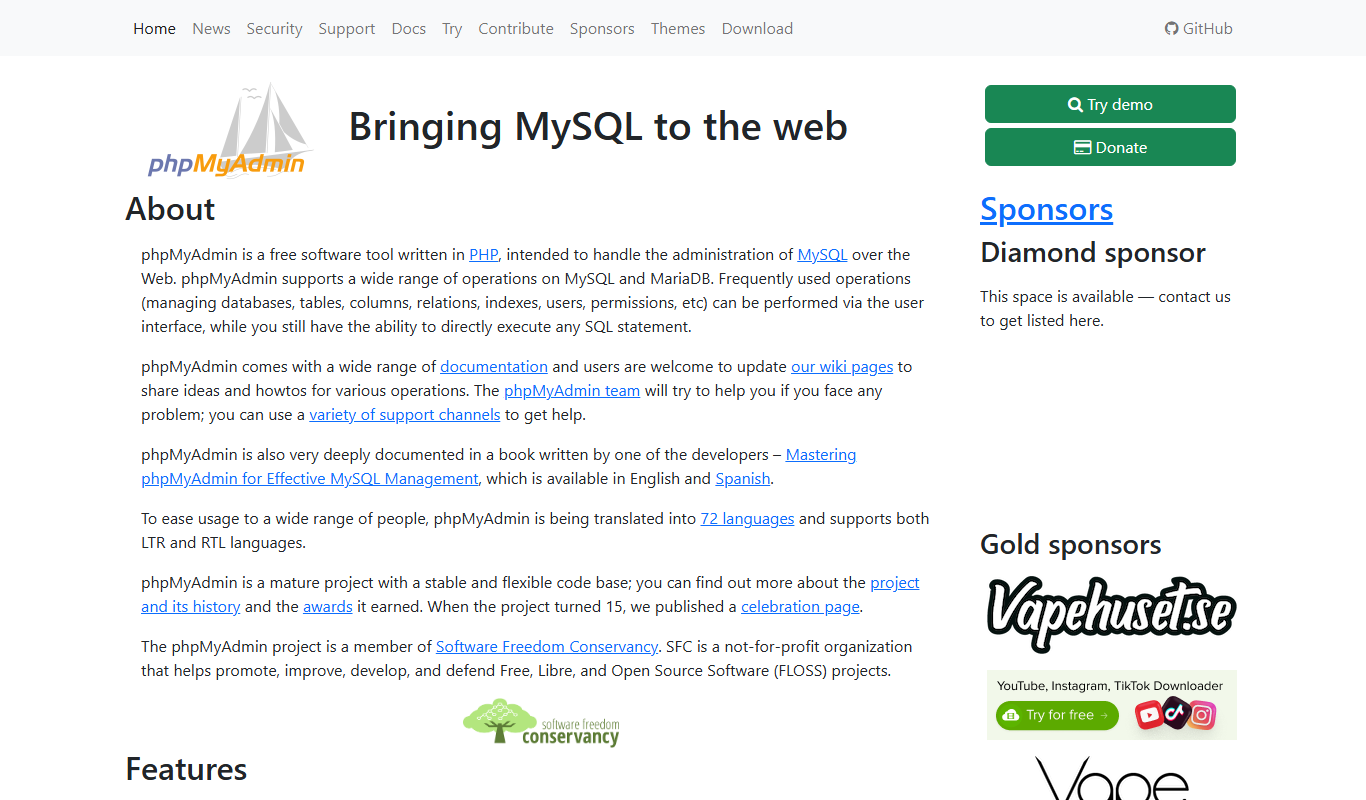
phpMyAdmin is a free and open-source web-based application designed to manage MySQL and MariaDB databases. It provides a graphical user interface to perform database administration tasks such as creating, modifying, and deleting databases, tables, fields, and indexes. It simplifies complex SQL operations, making database management accessible to users without deep command-line expertise.
Key features of phpMyAdmin
phpMyAdmin offers a comprehensive set of features including SQL query execution, database import/export, user management, and visual schema browsing. Its web interface supports multiple languages and is extensible through plugins, making it a versatile tool for developers and database administrators.
User-Friendly Web Interface
Intuitive GUI that simplifies database management tasks without requiring command-line knowledge.
Multi-language Support
Available in over 70 languages, accommodating a global user base.
Import and Export Tools
Supports importing data from CSV, SQL, XML, and exporting in various formats for backups and transfers.
SQL Query Editor
Advanced editor with syntax highlighting and query history to facilitate database querying.
User and Privilege Management
Manage database users and their permissions securely through the interface.
Pros and cons of phpMyAdmin
Pros
- Free and open-source with a large community
- User-friendly web interface for database management
- Supports multiple languages and platforms
- Comprehensive import/export and query tools
- Regular updates and security patches
Cons
- Requires web server and PHP setup
- Interface can be overwhelming for beginners
- Security depends on proper configuration
Key use cases for phpMyAdmin
Database Administration
Manage MySQL and MariaDB databases through a user-friendly web interface without needing command-line skills.
SQL Query Execution
Write, execute, and optimize SQL queries directly within the tool to interact with database data.
Data Import and Export
Easily import data from CSV, SQL, and other formats and export database tables or entire databases for backup or migration.
User and Permission Management
Configure database user accounts and assign granular permissions to control access securely.
Database Structure Visualization
View and modify database schemas, tables, indexes, and relations visually to understand and optimize database design.
How phpMyAdmin works
- 1
Installation
Install phpMyAdmin on a web server with PHP and connect it to your MySQL or MariaDB database.
- 2
Login
Access phpMyAdmin through a web browser and log in using your database credentials.
- 3
Database Selection
Choose the database you want to manage from the sidebar.
- 4
Perform Operations
Use the interface to run SQL queries, manage tables, import/export data, and configure users.
Who is using phpMyAdmin
Database administrators
Web developers
Small to medium businesses
Educational institutions
Open-source enthusiasts
phpMyAdmin pricing
Free
$0
Open-source software available at no cost.
Plans and prices are as published by the vendor and can change. Check the official site before you buy. Open the pricing page (opens in a new tab)
Frequently asked questions about phpMyAdmin
Yes, phpMyAdmin is completely free and open-source software.
phpMyAdmin supports MySQL and MariaDB databases.
Yes, you can manage multiple databases from a single phpMyAdmin installation.
When properly configured with secure authentication and HTTPS, phpMyAdmin is safe for production environments.
This tool is designed to help users accomplish its core tasks more efficiently. It is typically used by individuals or teams looking to improve productivity and workflow.
It depends on your specific needs and how you plan to use the tool. The official website and documentation are the best sources for the latest details.
It depends on your specific needs and how you plan to use the tool. The official website and documentation are the best sources for the latest details.
Data handling and security practices vary by provider. Review the official privacy policy to understand how your data is stored and used.
Sign in to review this tool.
Sign In to ReviewNo reviews yet
Be the first to share how this tool worked for you.
Ask about pricing, limits, or how it compares — or answer someone else.
Sign In to AskNo questions yet
Have a question about using or paying for this tool? Be the first to ask.
Featured on TiorAI



Alternative Tools
Explore similar AI tools that might fit your needs

Donationware
Adminer
Adminer is a lightweight, single PHP file database management tool supporting multiple SQL databases, designed for easy deployment and efficient database administration.

Free
HeidiSQL
HeidiSQL is a free, open-source database client for Windows that supports MySQL, MariaDB, PostgreSQL, and Microsoft SQL Server. It offers an intuitive GUI for managing databases, writing SQL queries, and performing administrative tasks.
More AI Developer Tools tools
Other tools in the same category, for when this one is not quite the fit.

Freemium
Amadeus Travel API
Amadeus Travel API is a developer platform offering RESTful APIs to access global flight, hotel, and travel data for building travel booking and itinerary management applications.

Freemium
Zyte
Zyte is a web scraping platform that enables businesses and developers to extract structured data from websites using smart crawlers, proxy rotation, and API integration to automate data collection at scale.

Enterprise License
NiceLabel
NiceLabel is an enterprise label design and management software that enables businesses to create, manage, and automate barcode and RFID label printing with compliance and integration capabilities.
Perpetual License
Geomagic Design X
Geomagic Design X is a reverse engineering software that converts 3D scan data into editable CAD models, enabling precise product design and manufacturing workflows.
Free
Changelog Generator
GitHub Changelog Generator is a free, open-source Ruby-based CLI tool that automates the creation of changelogs by extracting data from GitHub issues, pull requests, and commits to streamline release note management.

Free
UnoCSS
UnoCSS is an open-source, utility-first atomic CSS engine that generates CSS on-demand based on the classes used in your code, optimizing performance by minimizing CSS bundle size.

Enterprise
CockroachDB
CockroachDB is a distributed SQL database designed for cloud-native applications that require strong consistency, high availability, and horizontal scalability across multiple regions.
Subscription
VividCortex
VividCortex is a cloud-based database monitoring platform that provides real-time insights into SQL query performance and resource usage to help optimize and troubleshoot relational databases.