From my experience with Papercup, I found it excels at automating the complex and time-consuming process of video dubbing with impressive natural-sounding AI voices. The platform’s ability to support many languages and provide API integration makes it a strong choice for content creators and businesses aiming to localize videos efficiently. However, the custom pricing model and some limitations in voice nuance compared to human actors mean it may not suit all budgets or projects requiring highly personalized voiceovers. Overall, if you need fast, scalable multilingual video voiceovers, Papercup delivers solid results.
Papercup AI Dubbing Platform for Automated Video Voiceover and Localization
Papercup is an AI dubbing platform that automates video voiceover and localization by generating natural-sounding AI voices in multiple languages, helping creators and businesses quickly produce multilingual video content.
- Best for
- Video Localization
- Key capability
- Multilingual AI Voiceovers
Do you recommend this tool?
What is Papercup?
Papercup is an AI-powered dubbing platform that automates the process of translating and voiceover for videos. It uses advanced speech synthesis and machine learning to generate natural-sounding voiceovers in multiple languages, enabling content creators and businesses to localize video content quickly and cost-effectively without the need for human voice actors.
Key features of Papercup
Papercup offers automated video dubbing with AI voices, supports multiple languages, provides an easy-to-use web interface and API for integration, and delivers high-quality, natural voice synthesis tailored to the video’s tone and style.
Multilingual AI Voiceovers
Supports dubbing in over 70 languages with natural-sounding AI voices.
Custom Voice Tuning
Ability to customize voice tone and style to match brand or content personality.
API Access
Provides API for seamless integration into video production pipelines.
Fast Turnaround
Automated dubbing significantly reduces time compared to traditional voiceover methods.
Cloud-Based Platform
Accessible via web without need for local software installation.
Pros and cons of Papercup
Pros
- Automates time-consuming dubbing process
- Supports a wide range of languages
- High-quality, natural AI voices
- API available for integration
- Reduces costs compared to traditional dubbing
Cons
- Pricing is custom and may be expensive for small users
- Limited control over voice nuances compared to human actors
- Requires internet connection for cloud platform
Key use cases for Papercup
Video Localization
Automatically translate and dub videos into multiple languages to reach global audiences without manual voiceover recording.
Content Creators
Enable creators to quickly produce multilingual versions of their video content to expand reach and engagement.
E-learning
Localize educational videos with natural-sounding AI voices to provide accessible learning materials worldwide.
Marketing and Advertising
Create localized video ads with AI-generated voiceovers to target different regions efficiently.
Media and Entertainment
Automate dubbing for films, TV shows, and documentaries to reduce time and cost of traditional dubbing processes.
How Papercup works
-
1
Upload Video
Users upload their video content to the Papercup platform.
-
2
Select Target Language
Choose the language(s) for dubbing from a wide range of supported languages.
-
3
AI Translates and Synthesizes Voice
Papercup’s AI translates the spoken content and generates a natural-sounding voiceover.
-
4
Review and Edit
Users can review the dubbed video and make adjustments if necessary.
-
5
Download or Integrate
Final dubbed videos can be downloaded or integrated via API into existing workflows.
Who is using Papercup
Video content creators
Marketing agencies
E-learning platforms
Media and entertainment companies
Localization teams
Papercup pricing
Custom Enterprise
Contact for pricing
Tailored plans based on volume, languages, and features for businesses.
Plans and prices are as published by the vendor and can change. Check the official site before you buy. Open the pricing page (opens in a new tab)
Frequently asked questions about Papercup
Papercup supports dubbing in over 70 languages including English, Spanish, French, German, Chinese, Japanese, and more.
Yes, Papercup allows customization of voice tone and style to better fit your brand or content.
Yes, Papercup offers an API for integration into your existing video workflows.
Papercup uses advanced machine translation combined with human review options to ensure high accuracy.
It depends on your specific needs and how you plan to use the tool. The official website and documentation are the best sources for the latest details.
Yes, it can help with that use case depending on how you configure it and what features are available. You’ll get the best results with clear inputs and a defined goal.
Yes, it can help with that use case depending on how you configure it and what features are available. You’ll get the best results with clear inputs and a defined goal.
It depends on your specific needs and how you plan to use the tool. The official website and documentation are the best sources for the latest details.
Sign in to review this tool.
Sign In to ReviewNo reviews yet
Be the first to share how this tool worked for you.
Ask about pricing, limits, or how it compares — or answer someone else.
Sign In to AskNo questions yet
Have a question about using or paying for this tool? Be the first to ask.
Featured on TiorAI



More AI Dubbing tools
Other tools in the same category, for when this one is not quite the fit.

Free
Substital Subtitle Tool
Substital is a browser extension tool that lets users add and customize subtitles on online videos from platforms like YouTube and Netflix, supporting multiple languages and subtitle formats.
Free
Subly
Subly is an AI-driven web platform that automatically transcribes video audio into subtitles, allows editing and styling of captions, and supports multi-language translation to make videos accessible and shareable worldwide.

Custom Pricing
Interprefy
Interprefy is a cloud-based platform that enables real-time remote simultaneous interpretation for multilingual events, allowing participants to listen to live translations in their preferred language via web or mobile devices.

Freemium
UniDub.co
UniDub.co is an AI-based video dubbing platform that automatically converts video audio into multiple languages using natural-sounding AI voices, enabling fast and affordable video localization.
Free Trial
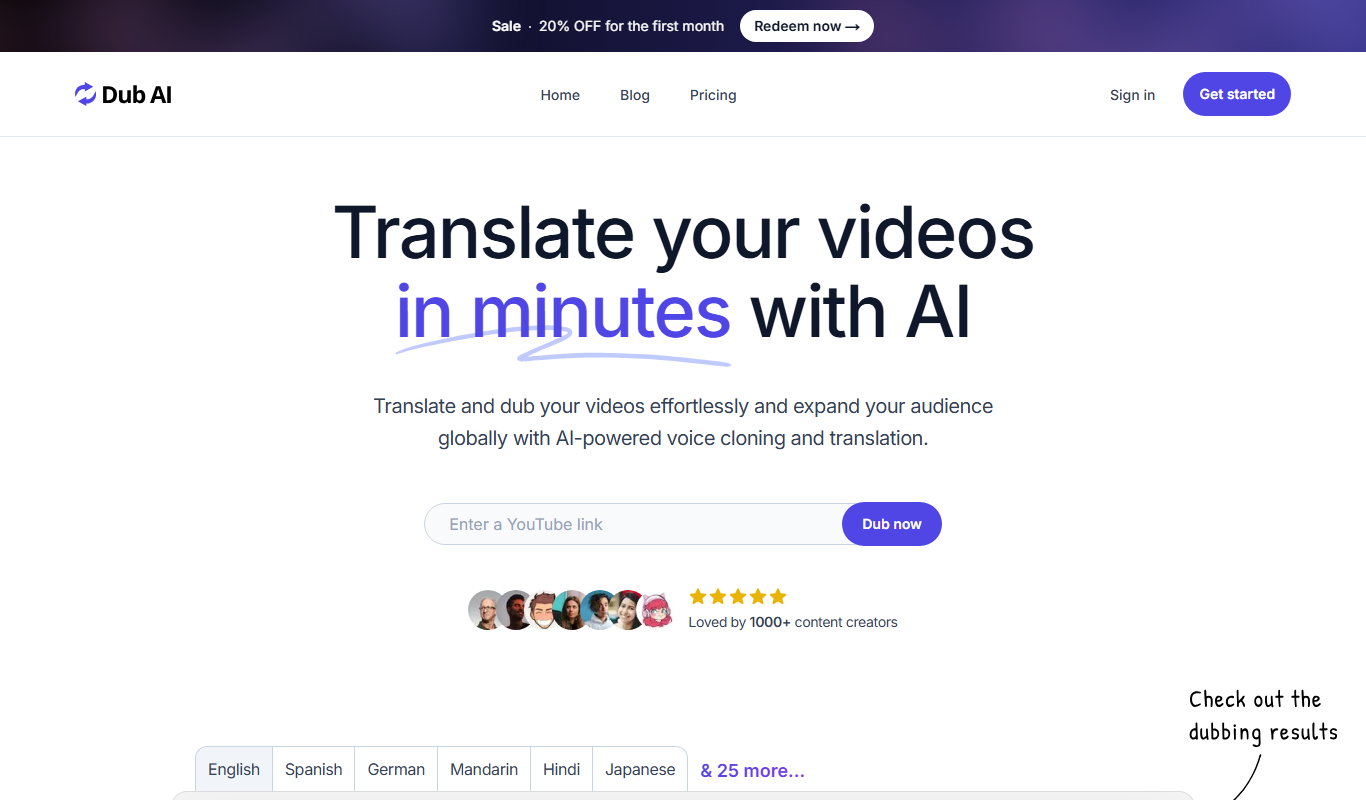
Dub AI
Dub AI is a web-based AI platform that automatically dubs videos into multiple languages using natural-sounding AI-generated voiceovers, enabling easy video localization.

Freemium
Dubverse
Dubverse is an AI-driven video dubbing and translation tool that automatically generates multilingual voiceovers and subtitles to help localize videos efficiently.