

XML Validator
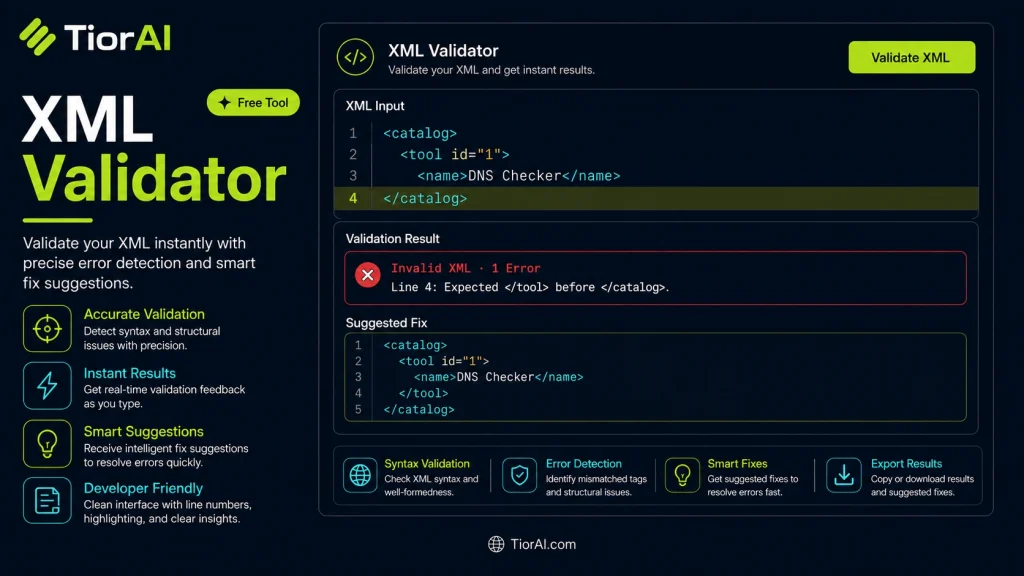
XML validation is the process of verifying that an XML document is both well-formed and conforms to a specific schema or set of rules. This ensures the data structure is correct and can be reliably processed by software systems. XML files are commonly used for…
| Element Count | - |
|---|---|
| Attribute Count | - |
| # | Error |
|---|
How to use it
- Paste or Enter Your Input Paste your code, text, or data into the input field. The tool supports large inputs without performance issues.
- Process and Analyze Click the action button or let the tool auto-process your input. Results appear in real time with highlighted details.
- Copy or Download the Output Review the results and copy the output to clipboard or download as a file for use in your project.
Tip For large inputs, process in sections to validate intermediate results and catch errors early.
Understanding XML Validation
XML (eXtensible Markup Language) is a widely used format for storing and transporting data in a structured, readable way. XML validation is the process of checking an XML document against a defined set of rules or a schema to ensure it is both well-formed and adheres to the expected structure.
Validation is crucial because it guarantees that the XML data can be correctly interpreted by software applications, preventing errors during data exchange or processing. For example, an XML file used for configuration, data feeds, or web services must conform to specific rules so that the receiving system can parse it without issues.
Commonly, XML validation involves checking against a Document Type Definition (DTD) or an XML Schema Definition (XSD). These define the allowed elements, attributes, and their relationships. Without validation, an XML file might have syntax errors, missing required elements, or incorrect data types, leading to failures in applications relying on that data.
People use XML validators in various scenarios, such as:
- Developers testing XML files during software development.
- Data analysts ensuring data feeds are correctly formatted.
- Webmasters validating sitemap files for search engines.
- Anyone working with APIs that exchange XML data.
What is XML Validation?
XML validation is the process of verifying that an XML document is both well-formed and conforms to a specific schema or set of rules. This ensures the data structure is correct and can be reliably processed by software systems. XML files are commonly used for data exchange, configuration, and communication between applications, so validation helps prevent errors caused by malformed or incorrectly structured data.
When to Use an XML Validator
- When developing software that consumes or produces XML data to catch errors early.
- Before submitting XML files to APIs or web services that require strict schema compliance.
- When integrating data feeds from external sources to ensure compatibility.
- For validating sitemap files or configuration files used in web development.
Common Mistakes in XML Validation
- Confusing well-formed XML with valid XML. A file can be syntactically correct but still fail schema validation.
- Overlooking namespace declarations, which can cause validation errors if not properly defined or referenced.
Using an XML validator helps maintain data integrity and interoperability across systems by enforcing the correct structure and syntax. It is an essential step in any workflow involving XML data processing.
Frequently asked questions
Reviews and questions
Whether this tool gave people the answer they needed, and what they asked about it.
Sign in to review this tool.
Sign In to ReviewNo reviews yet
Be the first to say whether this tool gave you what you needed.
Ask how to read the result, or what the tool does with an edge case — or answer someone else.
Sign In to AskNo questions yet
Not sure how to read a result? Be the first to ask.
AI tools related to this topic
Tools from the TiorAI directory that work on the same kind of job.

ChatGPT
ChatGPT is an AI chatbot by OpenAI powered by GPT-4o. It handles writing, coding, research, data analysis, and natural conversation. Free tier available, Plus at $20/month.