

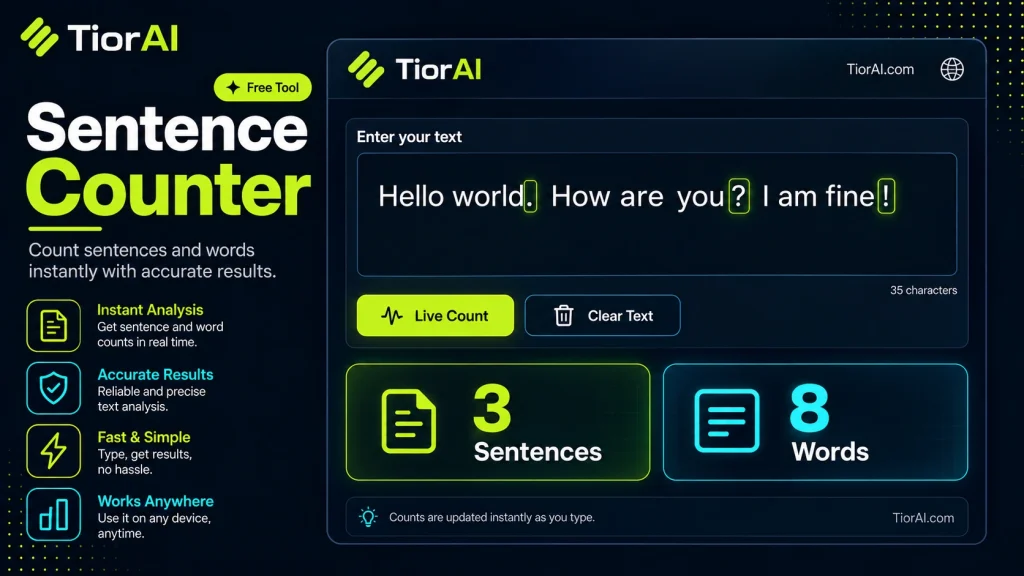
Sentence Counter
Count sentences, words, characters and more, then view the full breakdown in a table.
| Metric | Value |
|---|---|
| Sentences | 0 |
| Words | 0 |
| Characters (with spaces) | 0 |
| Characters (without spaces) | 0 |
| Paragraphs | 0 |
| Avg. words per sentence | 0 |
| Est. reading time | 0s |
How to use it
- Paste Your Text Paste or type your text into the Sentence Counter. The tool handles content of any length with no character limits.
- Apply the Tool Click the action button to process your text. The transformation is applied instantly to your content.
- Copy the Result Review the transformed text and copy it to your clipboard for use in documents, emails, or projects.
Tip Combine the Sentence Counter with other text tools on TiorAI for a complete content processing workflow.
Understanding Sentences and Sentence Counting
A sentence is a fundamental unit of written language that expresses a complete thought. It typically contains a subject and a predicate and ends with a terminal punctuation mark such as a period (.), question mark (?), or exclamation point (!). Sentence counting is the process of identifying and tallying these units within a given text.
Why Count Sentences? Sentence counting is important in various fields such as linguistics, education, content creation, and natural language processing (NLP). It helps evaluate writing style, readability, and complexity. For example, educators may assess student essays by sentence count to ensure sufficient elaboration, while writers might track sentence length and variety to improve flow.
How Sentence Counters Work Technically
At its core, a sentence counter tool analyzes text input and detects sentence boundaries. This involves parsing the text and identifying punctuation marks that typically signal the end of a sentence. However, this is not always straightforward because punctuation marks can appear in other contexts, such as abbreviations (e.g., “Dr.”, “e.g.”), decimal numbers, or quotations.
To address these challenges, sentence counters use algorithms that combine pattern recognition and linguistic rules:
- Delimiter Detection: The tool scans for sentence-ending punctuation like
.,?, and!. - Contextual Analysis: It checks surrounding characters to distinguish between a period ending a sentence and one used in abbreviations or numbers.
- Whitespace and Capitalization: Often, a sentence boundary is confirmed if the punctuation is followed by whitespace and a capital letter, indicating the start of a new sentence.
- Quotation and Parentheses Handling: The tool accounts for sentences ending inside quotes or parentheses, ensuring accurate counts.
More advanced sentence counters may use natural language processing libraries that incorporate machine learning models to improve accuracy, especially in complex texts.
Common Real-World Scenarios
- Academic Writing: Students and researchers use sentence counters to meet assignment requirements or analyze writing style.
- Content Creation: Bloggers and marketers monitor sentence count to maintain reader engagement and optimize readability.
- Editing and Proofreading: Editors assess sentence length and variety to improve clarity and flow.
- Software Development: NLP applications use sentence segmentation as a preprocessing step for tasks like sentiment analysis or machine translation.
What is Sentence Counting?
Sentence counting is the process of identifying and tallying the number of sentences in a given text. Sentences are the building blocks of written communication, each expressing a complete idea or thought. Understanding how many sentences a text contains can provide insights into its complexity, readability, and structure.
How Sentence Counters Work
Sentence counters operate by detecting sentence boundaries, typically marked by punctuation such as periods, question marks, and exclamation points. However, not every period signifies the end of a sentence. For example, abbreviations like “Dr.” or decimal numbers like “3.14” contain periods that do not end sentences. To handle this, sentence counters use contextual rules that analyze surrounding text to differentiate between sentence-ending punctuation and other uses.
More sophisticated tools incorporate natural language processing techniques to improve accuracy, especially when dealing with complex sentences, quotations, or parentheses.
When to Use a Sentence Counter
- When you need to assess the complexity or readability of a text by analyzing sentence length and variety.
- To ensure academic or professional writing meets specific sentence count requirements.
- For content creators aiming to optimize text for online engagement and SEO, where sentence structure matters.
- In software development and NLP projects that require accurate sentence segmentation for further analysis.
Common Mistakes to Avoid
- Assuming every period marks the end of a sentence, which can lead to inaccurate counts due to abbreviations or numbers.
- Overlooking sentence fragments or run-on sentences, which may cause the tool to miscount sentences if the text is poorly structured.
Technical Context
Sentence counting is a foundational task in text processing and natural language understanding. It serves as a prerequisite for more advanced operations such as parsing, sentiment analysis, and machine translation. Accurate sentence segmentation improves the quality of these downstream tasks by ensuring that text is correctly divided into meaningful units.
While simple rule-based methods suffice for many applications, complex texts with irregular punctuation or formatting benefit from machine learning models trained on large corpora to recognize sentence boundaries more reliably.
Worked examples
Counting sentences in a student essay
A student wants to verify their essay meets the minimum sentence count requirement.
Before This is the first sentence. Here is the second one! Is this the third? Yes, it is.After 4Analyzing marketing content readability
A content creator checks sentence count to ensure the text is concise and engaging.
Before Welcome to our site! We offer great deals. Check them out now.After 3
Frequently asked questions
Reviews and questions
Whether this tool gave people the answer they needed, and what they asked about it.
Sign in to review this tool.
Sign In to ReviewNo reviews yet
Be the first to say whether this tool gave you what you needed.
Ask how to read the result, or what the tool does with an edge case — or answer someone else.
Sign In to AskNo questions yet
Not sure how to read a result? Be the first to ask.
AI tools related to this topic
Tools from the TiorAI directory that work on the same kind of job.

Culture Counter
Culture Counter helps organizations measure and improve company culture with anonymous employee surveys and actionable insights based on the Love As A Business Strategy framework.

Prompt Token Counter
Prompt Token Counter is a free online tool that counts tokens in AI prompts for models such as GPT-5, GPT-4.1 and GPT-4o.