

Random XML Generator
Describe the fields each record should hold, then generate an XML document of sample data.
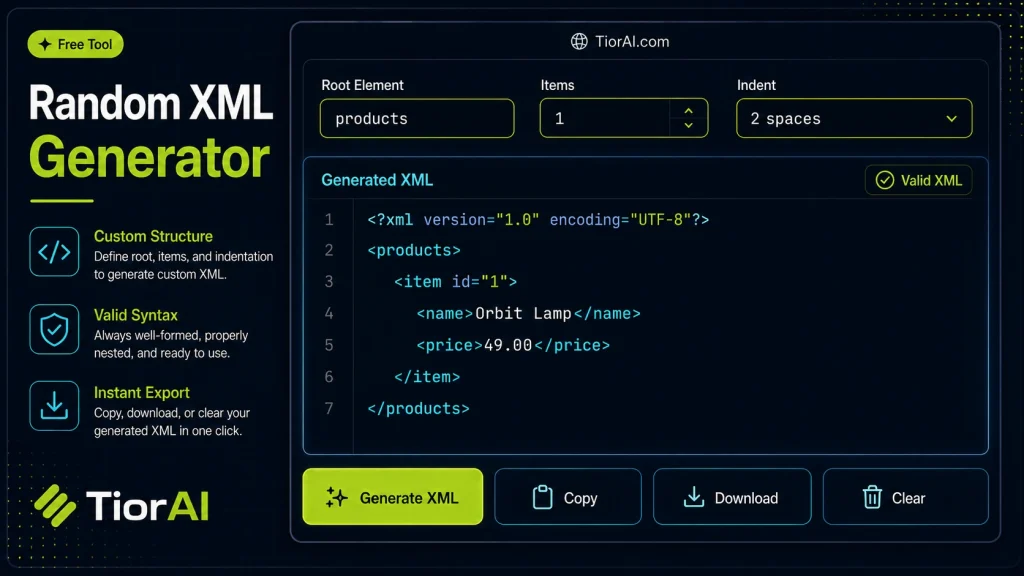
Random XML Generator
1. Add a field
No fields yet — add one above.
| Name | Type | Action |
|---|
How to use it
- Configure Settings Set your preferences and parameters in the Random Xml Generator. Customize the output to match your specific requirements.
- Generate Output Click generate to create your result. The tool processes your settings and produces output instantly.
- Copy or Download Review the generated output, then copy it to your clipboard or download it for immediate use.
Tip Regenerate multiple times with the Random Xml Generator to compare variations and pick the best output for your needs.
About Random XML Generator
XML (Extensible Markup Language) is a widely used format for structuring data in a readable and machine-processable way. A random XML generator is a tool that automatically creates XML documents with randomized elements, attributes, and values. This process helps developers and testers simulate various XML data scenarios without manually writing extensive XML code.
Generating random XML is useful because XML is often used for data exchange between systems, configuration files, or testing APIs that consume XML input. By producing random XML, you can test how software handles different structures, unexpected values, or large datasets. This helps identify bugs, improve robustness, and validate XML parsers.
Common uses of random XML generation include:
- Software testing: Creating diverse XML inputs to test parsing, validation, and error handling.
- Data simulation: Generating sample XML data for development or demonstration purposes.
- Performance benchmarking: Producing large XML files to measure system performance under load.
- Learning and experimentation: Exploring XML structure variations without manual coding.
Random XML generators typically allow customization of element names, attribute presence, nesting depth, and value types to better mimic real-world XML data.
Understanding Random XML Generation
XML is a flexible markup language used to represent structured data. A random XML generator automates the creation of XML documents by producing elements, attributes, and values randomly within defined parameters. This approach is valuable for testing and development, where manually crafting diverse XML inputs would be time-consuming.
Such generators help simulate real-world scenarios where XML data varies in structure and content. They enable developers to test how their applications parse, validate, and handle XML under different conditions, improving software robustness.
When to Use a Random XML Generator
- Testing XML parsers or applications to ensure they handle unexpected or varied XML inputs.
- Generating sample XML data quickly for development or demonstration purposes.
- Benchmarking system performance with large or complex XML files.
- Experimenting with different XML structures to understand parsing behavior.
Common Mistakes to Avoid
- Assuming the generated XML is always valid against a specific schema without proper configuration.
- Creating XML with excessive nesting or size that may cause performance problems in consuming applications.
By understanding these aspects, you can effectively use random XML generators to streamline testing and development workflows involving XML data.
Frequently asked questions
Reviews and questions
Whether this tool gave people the answer they needed, and what they asked about it.
Sign in to review this tool.
Sign In to ReviewNo reviews yet
Be the first to say whether this tool gave you what you needed.
Ask how to read the result, or what the tool does with an edge case — or answer someone else.
Sign In to AskNo questions yet
Not sure how to read a result? Be the first to ask.
AI tools related to this topic
Tools from the TiorAI directory that work on the same kind of job.

Code to Flow: Visualize your code
Code to Flow is a web tool that automatically converts source code into flowcharts, helping developers visualize and understand code logic easily.

Random Movie Generator
Random Movie Generator is a free web tool that instantly suggests random movies to help users decide what to watch without browsing extensive lists.

This Person Does Not Exist – Random Face Generator
This Person Does Not Exist is a free AI tool that instantly generates photorealistic human faces using GANs, creating unique images of people who do not exist.