

How to use it
- Enter Your Input Value Type or paste the value you want to convert into the input field. The tool accepts any numeric value.
- Select Units and Convert Choose your source and target units from the dropdown menus. The converted result appears instantly.
- Copy or Use the Result Click copy to grab the converted value for use in your project, document, or calculation.
Tip Chain multiple conversions by copying the output and pasting it as the next input - works seamlessly.
Understanding Octal to Decimal Conversion
The octal number system is a base-8 numeral system that uses digits from 0 to 7. Each digit in an octal number represents a power of 8, similar to how each digit in the decimal system represents a power of 10. Converting octal to decimal means translating a number expressed in base 8 into its equivalent value in base 10.
This conversion is essential because decimal is the standard number system used in everyday life and most programming contexts. While octal was historically used in computing due to its compact representation of binary data (since 8 is a power of 2), decimal remains the most intuitive for humans.
Why convert octal to decimal?
- Interpreting legacy code or data that uses octal notation.
- Understanding file permissions in Unix-like systems, which are often represented in octal.
- Debugging or analyzing low-level hardware or software outputs.
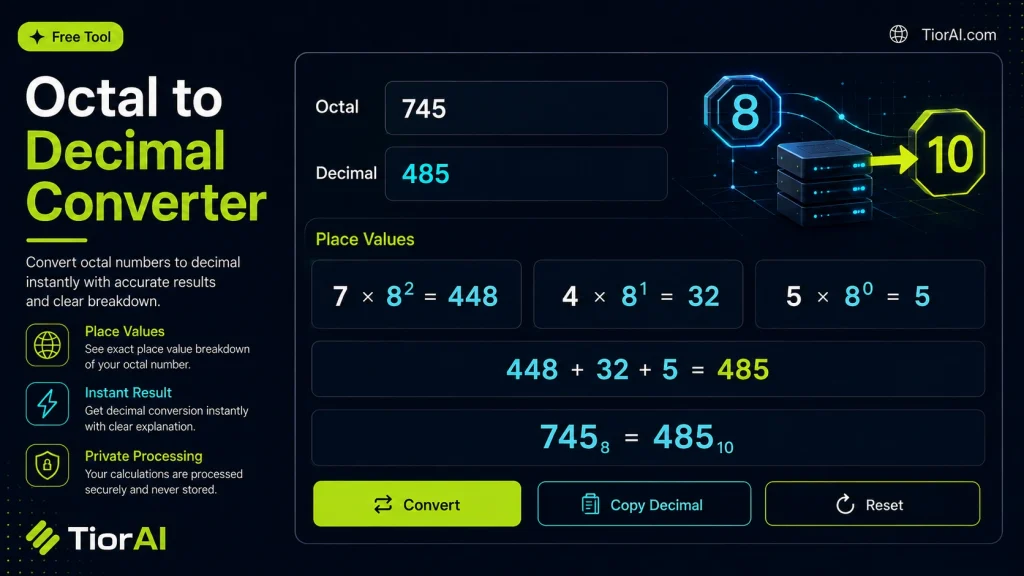
Conversion involves multiplying each octal digit by 8 raised to the power of its position index (counting from right to left starting at zero) and summing the results. For example, the octal number 157 converts to decimal as (1 × 8²) + (5 × 8¹) + (7 × 8⁰) = 64 + 40 + 7 = 111.
What is Octal to Decimal Conversion?
Octal to decimal conversion translates numbers from base 8 to base 10. The octal system uses digits 0 through 7, and each digit represents a power of 8. This conversion is necessary because decimal is the standard numbering system for most human activities and many programming environments.
When to Use Octal to Decimal Conversion
- Interpreting Unix file permissions, which are commonly expressed in octal.
- Working with legacy code or systems that use octal literals.
- Analyzing hardware outputs or memory dumps that display octal values.
Common Mistakes to Avoid
- Using digits outside the valid octal range (0-7), which leads to incorrect conversions.
- Incorrectly applying the positional powers of 8 when converting manually.
Understanding the relationship between octal and decimal helps in debugging, programming, and system administration tasks where octal notation appears. Since octal digits map neatly to groups of three binary bits, octal is still relevant in certain technical fields despite decimal’s dominance in everyday use.
Frequently asked questions
Reviews and questions
Whether this tool gave people the answer they needed, and what they asked about it.
Sign in to review this tool.
Sign In to ReviewNo reviews yet
Be the first to say whether this tool gave you what you needed.
Ask how to read the result, or what the tool does with an edge case — or answer someone else.
Sign In to AskNo questions yet
Not sure how to read a result? Be the first to ask.
AI tools related to this topic
Tools from the TiorAI directory that work on the same kind of job.

Wolfram Alpha
Wolfram Alpha is a computational knowledge engine that answers factual queries by performing computations on curated data, offering detailed solutions, visualizations, and an API for developers.

ChatGPT
ChatGPT is an AI chatbot by OpenAI powered by GPT-4o. It handles writing, coding, research, data analysis, and natural conversation. Free tier available, Plus at $20/month.