

Octal Converter
Octal conversion involves changing numbers between the octal (base-8) system and other number systems such as decimal (base-10) or binary (base-2). Octal numbers use digits from 0 to 7, making them a compact way to represent binary data by grouping bits in sets of three.…
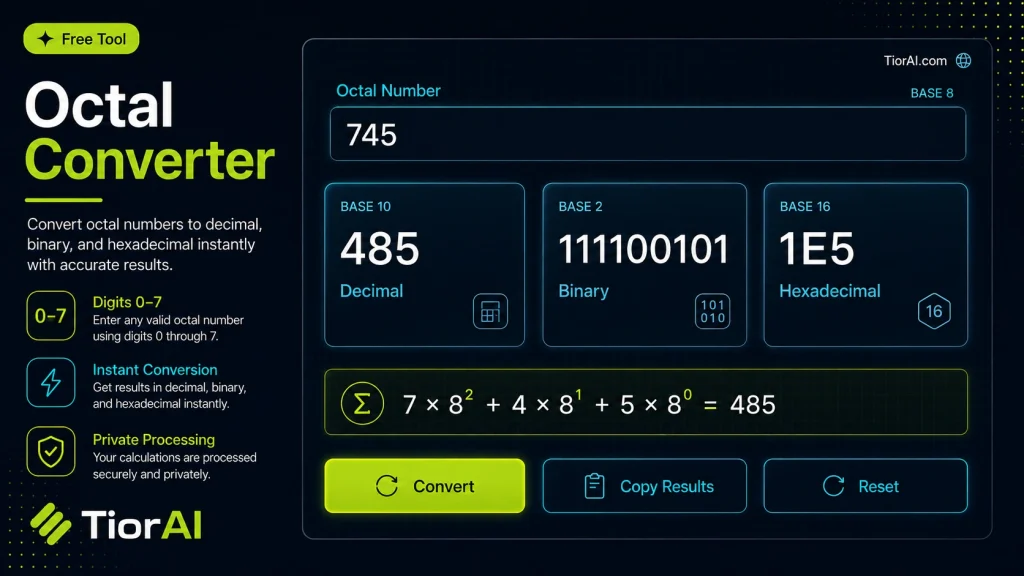
How to use it
- Enter Your Input Value Type or paste the value you want to convert into the input field. The tool accepts any numeric value.
- Select Units and Convert Choose your source and target units from the dropdown menus. The converted result appears instantly.
- Copy or Use the Result Click copy to grab the converted value for use in your project, document, or calculation.
Tip Need the reverse conversion? Swap source and target to convert in the opposite direction instantly.
Understanding Octal Numbers and Conversion
The octal number system is a base-8 numeral system that uses digits from 0 to 7. Unlike the more common decimal system (base-10), octal groups binary digits into sets of three, making it easier to read and interpret binary data in a compact form. This system was historically important in computing because early computers often used 12-, 24-, or 36-bit word lengths, which are multiples of three bits, aligning well with octal representation.
Why convert octal numbers? Conversion between octal and other number systems like decimal or binary is essential for programmers, engineers, and students working with low-level data or legacy systems. Octal conversion helps in debugging, understanding machine-level code, and simplifying binary data representation.
Common use cases include:
- Interpreting file permissions in Unix/Linux systems, which are often represented in octal.
- Converting machine code or memory addresses for embedded systems.
- Educational purposes to understand number systems and their relationships.
What is Octal Conversion?
Octal conversion involves changing numbers between the octal (base-8) system and other number systems such as decimal (base-10) or binary (base-2). Octal numbers use digits from 0 to 7, making them a compact way to represent binary data by grouping bits in sets of three. This is useful because each octal digit directly maps to three binary digits.
When to Use an Octal Converter
- Interpreting or setting file permissions in Unix/Linux, which are commonly expressed in octal.
- Working with legacy or embedded systems that use octal notation for memory addresses or machine code.
- Converting binary data into a more readable form by grouping bits into octal digits.
- Learning or teaching number system conversions involving base-8.
- Debugging low-level code that outputs octal values.
Common Mistakes to Avoid
- Using digits 8 or 9 in octal numbers, which are invalid and cause errors.
- Incorrectly calculating place values during manual conversion, leading to wrong decimal or binary results.
Understanding octal conversion is important for anyone dealing with low-level computing, file permissions, or educational contexts involving number systems. Using an octal converter tool simplifies these tasks by automating the conversion process and reducing errors.
Frequently asked questions
Reviews and questions
Whether this tool gave people the answer they needed, and what they asked about it.
Sign in to review this tool.
Sign In to ReviewNo reviews yet
Be the first to say whether this tool gave you what you needed.
Ask how to read the result, or what the tool does with an edge case — or answer someone else.
Sign In to AskNo questions yet
Not sure how to read a result? Be the first to ask.
AI tools related to this topic
Tools from the TiorAI directory that work on the same kind of job.

Wolfram Alpha
Wolfram Alpha is a computational knowledge engine that answers factual queries by performing computations on curated data, offering detailed solutions, visualizations, and an API for developers.

ChatGPT
ChatGPT is an AI chatbot by OpenAI powered by GPT-4o. It handles writing, coding, research, data analysis, and natural conversation. Free tier available, Plus at $20/month.