

Number System Converter
Number system conversion involves changing a number from one base to another, such as from decimal to binary or hexadecimal. Different number systems use different bases and symbols to represent values. For example, decimal uses base 10 with digits 0-9, binary uses base 2 with…
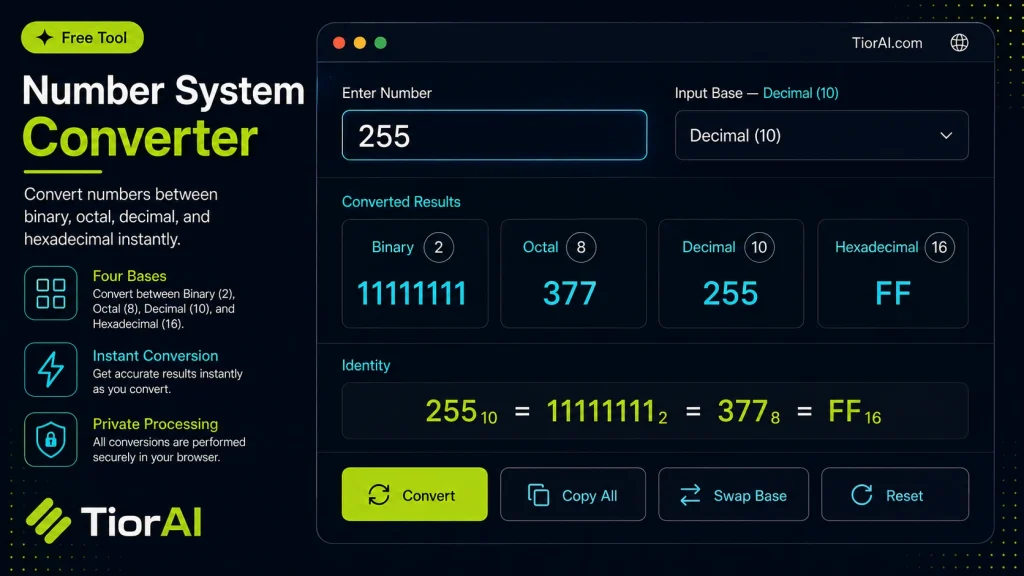
Number System Converter
Conversion Result
| Number System | Base | Value |
|---|---|---|
| Binary | 2 | |
| Octal | 8 | |
| Decimal | 10 | |
| Hexadecimal | 16 |
How to use it
- Enter Your Input Value Type or paste the value you want to convert into the input field. The tool accepts any numeric value.
- Select Units and Convert Choose your source and target units from the dropdown menus. The converted result appears instantly.
- Copy or Use the Result Click copy to grab the converted value for use in your project, document, or calculation.
Tip Bookmark this converter - it handles edge cases like zero values and very large numbers accurately.
Understanding Number Systems and Their Conversion
Number systems are methods for representing numerical values using different bases. The most common systems include decimal (base 10), binary (base 2), octal (base 8), and hexadecimal (base 16). Each system uses a unique set of symbols and place values to represent numbers.
Converting between these systems is essential in computing and digital electronics because computers operate using binary, while humans typically use decimal. For example, programmers often use hexadecimal to represent binary data more compactly, and octal can be useful in certain legacy systems or permissions settings in Unix-like operating systems.
Why conversions are needed:
- To interpret machine-level data in a human-readable form.
- To simplify binary data representation using hexadecimal or octal.
- To perform calculations or debugging in different bases.
Common situations where number system conversion is used include software development, digital circuit design, network addressing, and data encoding. Understanding how to convert numbers between these systems helps in analyzing and manipulating data accurately across different platforms and technologies.
What is Number System Conversion?
Number system conversion involves changing a number from one base to another, such as from decimal to binary or hexadecimal. Different number systems use different bases and symbols to represent values. For example, decimal uses base 10 with digits 0-9, binary uses base 2 with digits 0 and 1, octal uses base 8 with digits 0-7, and hexadecimal uses base 16 with digits 0-9 and letters A-F.
When to Use a Number System Converter
- Debugging or analyzing low-level programming code that uses binary or hexadecimal.
- Converting IP addresses or subnet masks between decimal and binary.
- Working with Unix file permissions, which use octal notation.
- Interpreting memory addresses or color codes represented in hexadecimal.
- Learning or teaching computer science concepts related to data representation.
Common Mistakes to Avoid
- Mixing up place values during manual conversion, which leads to errors.
- Using digits outside the allowed range for a number system, such as 2 in binary.
- Confusing hexadecimal digits (A-F) with decimal digits.
- Forgetting that octal digits only go up to 7.
Understanding number system conversion is fundamental for working with computers and digital systems. It enables accurate interpretation and manipulation of data across different formats and technologies.
Frequently asked questions
Reviews and questions
Whether this tool gave people the answer they needed, and what they asked about it.
Sign in to review this tool.
Sign In to ReviewNo reviews yet
Be the first to say whether this tool gave you what you needed.
Ask how to read the result, or what the tool does with an edge case — or answer someone else.
Sign In to AskNo questions yet
Not sure how to read a result? Be the first to ask.
AI tools related to this topic
Tools from the TiorAI directory that work on the same kind of job.

Wolfram Alpha
Wolfram Alpha is a computational knowledge engine that answers factual queries by performing computations on curated data, offering detailed solutions, visualizations, and an API for developers.

ChatGPT
ChatGPT is an AI chatbot by OpenAI powered by GPT-4o. It handles writing, coding, research, data analysis, and natural conversation. Free tier available, Plus at $20/month.