

MAC Address Generator
Check network details quickly with the mac address generator. This free tool queries multiple databases simultaneously and returns comprehensive results in seconds.
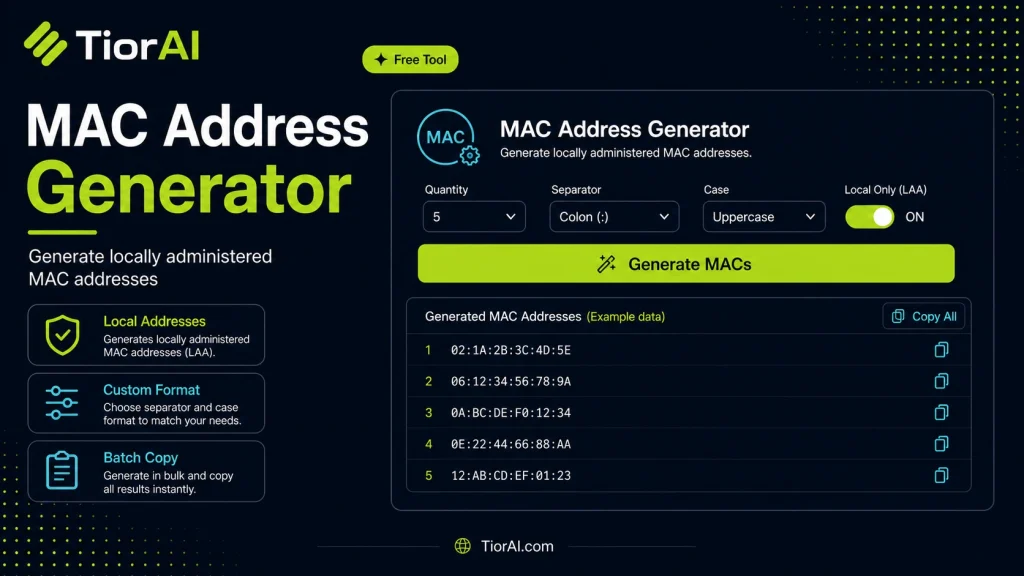
How to use it
- Enter Domain or IP Enter the domain name, IP address, or URL into the Mac Address Generator to start the lookup or analysis.
- Run the Check Click the check button to query the relevant databases. Results are retrieved and displayed in seconds.
- Analyze the Results Review the detailed results including status, records, and diagnostics to troubleshoot or verify your query.
Tip Bookmark the Mac Address Generator for your network troubleshooting toolkit — quick lookups save hours of debugging.
Understanding MAC Addresses
A MAC (Media Access Control) address is a unique identifier assigned to a network interface controller (NIC) for communications at the data link layer of a network segment. It is a 48-bit number usually represented as six groups of two hexadecimal digits, separated by colons or hyphens (e.g., 00:1A:2B:3C:4D:5E).
MAC addresses are essential for network communication within local networks, allowing devices to identify each other uniquely on the same physical or logical network segment. Unlike IP addresses, which can change depending on the network, MAC addresses are typically fixed to the hardware, although they can be spoofed or changed in software.
Technical Standards and Structure
The MAC address format is defined by the IEEE 802 standard. The first 24 bits (the first three octets) represent the Organizationally Unique Identifier (OUI), which identifies the manufacturer of the hardware. The remaining 24 bits are assigned by the manufacturer to uniquely identify the device.
- OUI (Organizationally Unique Identifier): Identifies the vendor or manufacturer.
- NIC Specific: Unique identifier assigned by the vendor.
There are two important bits in the first octet: the Universal/Local (U/L) bit and the Individual/Group (I/G) bit. The U/L bit indicates whether the address is universally or locally administered, and the I/G bit indicates if the address is unicast or multicast.
Why Developers Use MAC Address Generators
Developers and network engineers often need to generate valid MAC addresses for testing, simulation, or development purposes. For example, when setting up virtual machines, containers, or network simulators, unique MAC addresses are required to avoid conflicts.
A MAC address generator automates the creation of valid, properly formatted MAC addresses. It can generate addresses with specific OUIs or locally administered addresses, depending on the use case. This helps ensure that generated addresses conform to standards and avoid collisions with real hardware addresses.
In real projects, generated MAC addresses are used in:
- Network simulation and testing environments
- Virtual machine and container network interface configuration
- Software development for network devices and protocols
- Security research and penetration testing
Using a MAC address generator saves time and reduces errors compared to manual creation, ensuring compliance with IEEE standards.
What is a MAC Address?
A MAC (Media Access Control) address is a unique identifier assigned to network interfaces for communications on the physical network segment. It is a 48-bit hexadecimal number, typically displayed as six pairs of hex digits separated by colons or hyphens. This address is fundamental for devices to communicate within local networks.
The MAC address is structured according to the IEEE 802 standard. The first 24 bits represent the Organizationally Unique Identifier (OUI), which identifies the device manufacturer. The remaining 24 bits are assigned by the manufacturer to uniquely identify the device.
When to Use a MAC Address Generator
- When setting up virtual machines or containers that require unique network interface identifiers.
- During network simulation or testing to assign addresses to virtual devices without conflicts.
- In software development involving network protocols that require unique MAC addresses.
- For security research or penetration testing where device identity spoofing is necessary.
Common Mistakes When Generating MAC Addresses
- Failing to set the locally administered bit, which can cause conflicts with real hardware addresses on the network.
- Generating random MAC addresses without ensuring they conform to the correct format or uniqueness, leading to network issues.
Technical Context
MAC addresses operate at the data link layer (Layer 2) of the OSI model and are essential for local network communication. Unlike IP addresses, which can change depending on the network, MAC addresses are intended to be permanent hardware identifiers. However, software can override or spoof MAC addresses for various purposes.
Developers use MAC address generators to create valid addresses that comply with IEEE standards, ensuring they do not conflict with existing hardware addresses. This is especially important in virtualized environments or testing scenarios where multiple network interfaces need unique identifiers.
By automating MAC address creation, developers avoid manual errors and save time, ensuring network configurations are reliable and standards-compliant.
Common use cases
- Generate a Locally Administered MAC Address for Virtual Machine
- Generate a MAC Address with a Specific OUI
Frequently asked questions
Reviews and questions
Whether this tool gave people the answer they needed, and what they asked about it.
Sign in to review this tool.
Sign In to ReviewNo reviews yet
Be the first to say whether this tool gave you what you needed.
Ask how to read the result, or what the tool does with an edge case — or answer someone else.
Sign In to AskNo questions yet
Not sure how to read a result? Be the first to ask.