

Local Ipv6 Address Generator
IPv6 addresses are 128-bit identifiers used to identify devices on an IPv6 network. Local IPv6 addresses are a subset used exclusively within private or local network environments. They are not routable on the global internet, which helps maintain network security and address management. There are…
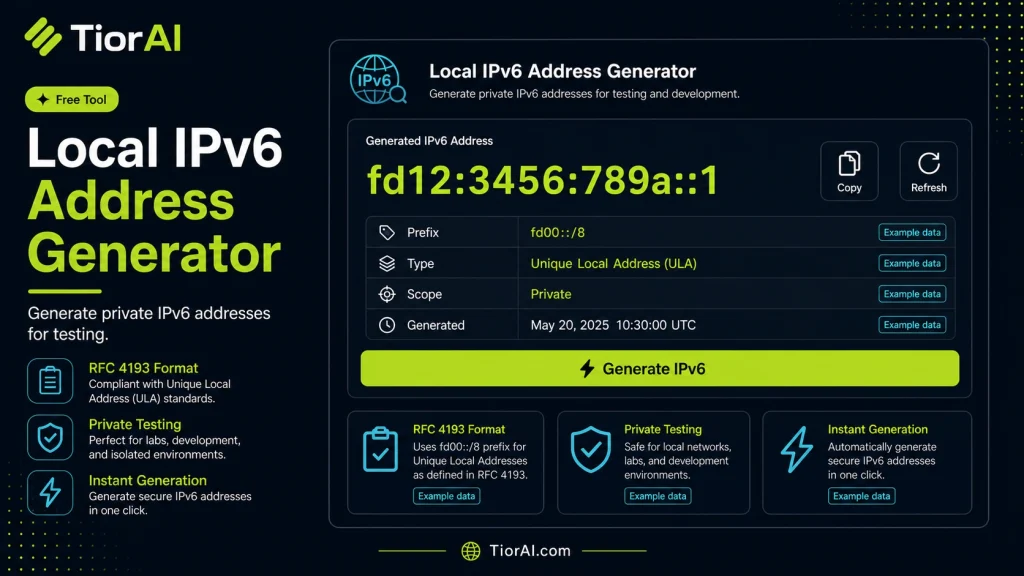
How to use it
- Configure Settings Set your preferences and parameters in the Local Ipv6 Address Generator. Customize the output to match your specific requirements.
- Generate Output Click generate to create your result. The tool processes your settings and produces output instantly.
- Copy or Download Review the generated output, then copy it to your clipboard or download it for immediate use.
Tip The Local Ipv6 Address Generator creates production-ready output — no manual cleanup needed before using the results.
Understanding Local IPv6 Addresses
IPv6 is the latest version of the Internet Protocol designed to replace IPv4, primarily to address the exhaustion of IPv4 addresses. IPv6 addresses are 128-bit identifiers for interfaces and sets of interfaces, allowing for a vastly larger address space. Within IPv6, local addresses refer to those used within private networks and are not routable on the global internet.
Types of Local IPv6 Addresses
Link-Local Addresses: These addresses are automatically configured on all IPv6-enabled interfaces and are used for communication within a single network segment. They always start with the prefixFE80::/10.Unique Local Addresses (ULA): These are similar to IPv4 private addresses (like 192.168.x.x) and are used for local communications within a site or between a limited set of sites. They use the prefixFC00::/7, typicallyFD00::/8for locally assigned addresses.
Local IPv6 addresses solve the problem of internal network communication without requiring globally routable addresses. They allow devices to communicate securely and efficiently within a local environment.
Standards and Specifications
RFC 4291defines the IPv6 addressing architecture, including local addresses.RFC 4193specifies Unique Local Addresses.RFC 4862covers IPv6 Stateless Address Autoconfiguration, which includes link-local address generation.
Developer Use Cases
Developers and network engineers use local IPv6 addresses to configure and test networked applications, simulate network environments, and ensure compatibility with IPv6 protocols. Generating local IPv6 addresses is essential when setting up virtual machines, containers, or isolated test networks where global address assignment is unnecessary or undesirable.
What Are Local IPv6 Addresses?
IPv6 addresses are 128-bit identifiers used to identify devices on an IPv6 network. Local IPv6 addresses are a subset used exclusively within private or local network environments. They are not routable on the global internet, which helps maintain network security and address management.
There are two main types of local IPv6 addresses: link-local and unique local addresses. Link-local addresses are automatically assigned to interfaces and are used for communication on the same physical or logical link. Unique local addresses are intended for private networks and can be routed within an organization but not on the public internet.
When to Use a Local IPv6 Address Generator
- When configuring devices in a private network that requires IPv6 communication without exposing them to the internet.
- During development and testing phases where you need valid IPv6 addresses for isolated environments like virtual machines or containers.
- For network simulations or lab setups where global IPv6 addresses are unnecessary or unavailable.
Common Mistakes to Avoid
- Mixing up link-local and unique local address prefixes, which can cause communication failures or address conflicts.
- Manually creating addresses without adhering to IPv6 standards, resulting in invalid or unusable addresses.
Technical Context
Local IPv6 addresses follow strict standards defined in RFCs such as RFC 4291 and RFC 4193. Link-local addresses always start with the FE80::/10 prefix and typically embed interface identifiers derived from MAC addresses or random values. Unique local addresses use the FD00::/8 prefix and include a 40-bit randomly generated global ID to ensure uniqueness within an organization.
Using a local IPv6 address generator automates the creation of these addresses, ensuring they conform to the correct format and prefix. This is especially useful for developers and network engineers who need to quickly generate valid addresses for testing, configuration, or deployment in local network environments.
Common use cases
- Generating a Link-Local IPv6 Address
- Generating a Unique Local IPv6 Address
Frequently asked questions
Reviews and questions
Whether this tool gave people the answer they needed, and what they asked about it.
Sign in to review this tool.
Sign In to ReviewNo reviews yet
Be the first to say whether this tool gave you what you needed.
Ask how to read the result, or what the tool does with an edge case — or answer someone else.
Sign In to AskNo questions yet
Not sure how to read a result? Be the first to ask.
AI tools related to this topic
Tools from the TiorAI directory that work on the same kind of job.
Property Insights – UK Local Data
Property Insights is a UK-based platform offering detailed local property market data, interactive maps, and neighborhood analytics to support real estate investment and research.

Scraper AI:Get Local Leads with AI
Scraper AI is a web-based tool that uses AI to scrape local business leads and contact data from Google Maps, enabling efficient lead generation and export.