

Ipv6 ULA Generator
Check network details quickly with the ipv6 ula generator. This free tool queries multiple databases simultaneously and returns comprehensive results in seconds.
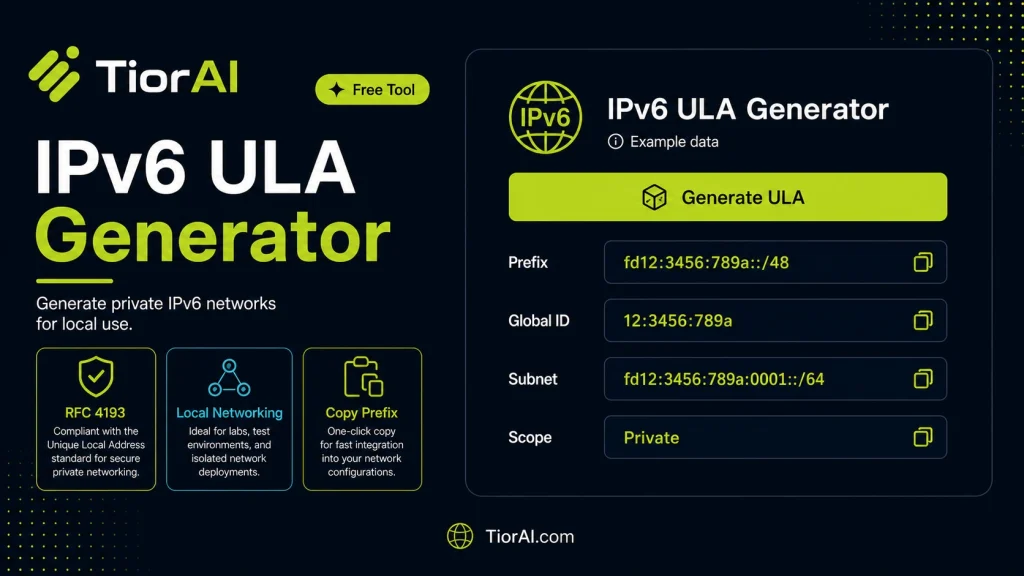
| Segment | Value | Meaning |
|---|
How to use it
- Enter Domain or IP Enter the domain name, IP address, or URL into the Ipv6 Ula Generator to start the lookup or analysis.
- Run the Check Click the check button to query the relevant databases. Results are retrieved and displayed in seconds.
- Analyze the Results Review the detailed results including status, records, and diagnostics to troubleshoot or verify your query.
Tip Run the Ipv6 Ula Generator from different times of day to catch intermittent issues that only appear during peak traffic.
Understanding IPv6 Unique Local Addresses (ULAs)
IPv6 Unique Local Addresses (ULAs) are a type of IPv6 address designed for local communications within a private network. They are analogous to IPv4 private addresses (like 192.168.x.x or 10.x.x.x) but are specifically defined for IPv6 to avoid conflicts with global unicast addresses.
ULAs are defined in RFC 4193 and use the prefix fc00::/7. This means the first seven bits of the address are fixed, and the next bit indicates whether the address is locally assigned or centrally assigned. In practice, most ULAs start with fd (binary 11111101), indicating locally assigned addresses.
The structure of a ULA is as follows:
- Prefix (7 bits): Always
fc00::/7. - L bit (1 bit): Set to 1 for locally assigned addresses.
- Global ID (40 bits): Randomly generated to ensure uniqueness within your local network.
- Subnet ID (16 bits): Used to create subnets within your local network.
- Interface ID (64 bits): Identifies a specific interface on a subnet.
The main problem ULAs solve is providing stable, private IPv6 addresses that do not conflict with global IPv6 addresses. They are useful for internal communication, VPNs, or isolated networks where global routability is not required or desired.
Developers and network administrators use ULAs to design internal network architectures that require IPv6 but want to avoid the complexity or risk of using globally routable addresses. Since ULAs are not routable on the public internet, they provide a safe namespace for internal devices.
Generating a ULA requires creating a random 40-bit Global ID to ensure uniqueness within your network. This is where an IPv6 ULA generator tool becomes valuable. It automates the creation of compliant, random ULAs, reducing the risk of address collisions and manual errors.
In real projects, ULAs are often combined with global unicast addresses on dual-stack devices, allowing internal-only communication alongside internet access. They are also used in containerized environments, virtual machines, and isolated test labs.
What Are IPv6 Unique Local Addresses (ULAs)?
IPv6 Unique Local Addresses (ULAs) are private IPv6 addresses designed for local network use. They provide a way to assign IPv6 addresses within an organization without the risk of conflicts with global IPv6 addresses. ULAs are defined by RFC 4193 and use the prefix fc00::/7, with most locally assigned ULAs starting with fd.
The key feature of ULAs is that they are not routable on the public internet, making them ideal for internal communication, VPNs, and isolated environments. They solve the problem of needing stable IPv6 addresses that remain consistent within a private network but do not interfere with global address space.
When to Use an IPv6 ULA Generator
- Setting up an internal IPv6 network that requires private addressing without internet exposure.
- Configuring VPNs or site-to-site tunnels where private IPv6 addressing is necessary.
- Creating isolated lab or development environments to test IPv6 networking.
Common Mistakes When Working with ULAs
- Reusing the same Global ID across different networks, which can cause address conflicts when networks connect.
- Confusing ULAs with link-local addresses and expecting them to route beyond the local network segment.
Technical Context
ULAs consist of a fixed prefix, a randomly generated 40-bit Global ID, a subnet ID, and an interface ID. The Global ID is critical to ensuring uniqueness within your private network. Manually generating this ID can be error-prone, so tools like IPv6 ULA generators automate this process, producing compliant and unique prefixes.
In practice, ULAs are often used alongside global IPv6 addresses on dual-stack devices, allowing internal-only communication while maintaining internet connectivity. This dual addressing is common in enterprise networks, containerized applications, and virtualized environments.
Common use cases
- Generating a ULA for a small office network
- Creating multiple subnets from a ULA prefix
Frequently asked questions
Reviews and questions
Whether this tool gave people the answer they needed, and what they asked about it.
Sign in to review this tool.
Sign In to ReviewNo reviews yet
Be the first to say whether this tool gave you what you needed.
Ask how to read the result, or what the tool does with an edge case — or answer someone else.
Sign In to AskNo questions yet
Not sure how to read a result? Be the first to ask.