

Ipv6 Expand Tool
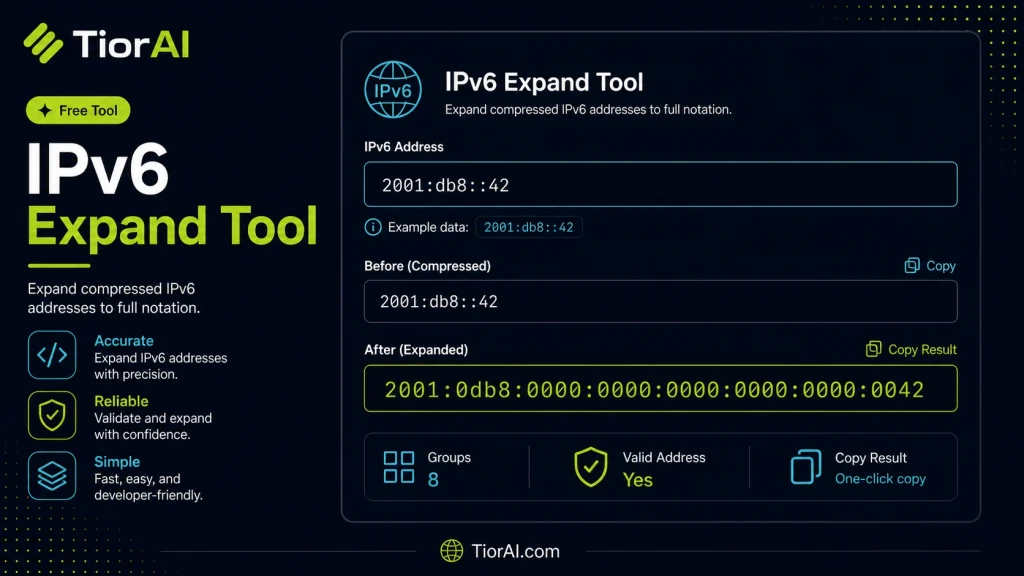
IPv6 addresses are 128-bit identifiers used to locate devices on the internet and local networks. Because these addresses are long, they are often compressed using shorthand notation to make them easier to read and write. This compression involves omitting leading zeros in each 16-bit segment…
How to use it
- Enter Your Input Value Type or paste the value you want to convert into the input field. The tool accepts any numeric value.
- Select Units and Convert Choose your source and target units from the dropdown menus. The converted result appears instantly.
- Copy or Use the Result Click copy to grab the converted value for use in your project, document, or calculation.
Tip Bookmark this converter - it handles edge cases like zero values and very large numbers accurately.
Understanding IPv6 Address Compression and Expansion
IPv6 (Internet Protocol version 6) is the latest version of the Internet Protocol designed to replace IPv4, primarily to address the exhaustion of IPv4 addresses. An IPv6 address consists of 128 bits, typically represented as eight groups of four hexadecimal digits separated by colons, for example: 2001:0db8:0000:0000:0000:ff00:0042:8329.
Because many IPv6 addresses contain long sequences of zeros, a shorthand notation called address compression is used to simplify the representation. This compression follows rules defined in RFC 5952 and RFC 4291. The two main compression techniques are:
- Omitting leading zeros in each 16-bit block (e.g.,
0042becomes42). - Using double colons (::) to replace one or more consecutive groups of zeros (e.g.,
0000:0000:0000becomes::).
While compression makes IPv6 addresses easier to read and write, it can cause confusion or errors in certain contexts, especially in programming, network configuration, or logging, where a fully expanded address is required for consistency, validation, or parsing.
IPv6 expansion is the process of converting a compressed IPv6 address back into its full, uncompressed form by restoring all omitted zeros and expanding the double colon notation to the appropriate number of zero groups. This ensures the address is represented as eight groups of four hexadecimal digits.
Developers and network engineers use IPv6 expansion in various scenarios, such as:
- Validating IPv6 addresses in software applications.
- Configuring firewall rules or routing tables that require full address notation.
- Logging and auditing network traffic with consistent address formats.
- Interoperability between systems that do not support compressed notation.
Standards like inet_pton and inet_ntop in POSIX systems handle IPv6 address parsing and formatting, but manual or tool-assisted expansion is often necessary for clarity or debugging.
What is IPv6 Address Expansion?
IPv6 addresses are 128-bit identifiers used to locate devices on the internet and local networks. Because these addresses are long, they are often compressed using shorthand notation to make them easier to read and write. This compression involves omitting leading zeros in each 16-bit segment and replacing consecutive zero segments with a double colon (::).
IPv6 address expansion is the reverse process: converting a compressed IPv6 address back into its full, uncompressed form. This means restoring all omitted zeros and expanding the double colon to the correct number of zero segments so that the address has exactly eight groups of four hexadecimal digits.
When Should You Use IPv6 Expansion?
- Network Configuration: Some routers, firewalls, and network tools require IPv6 addresses in their full expanded form to avoid misinterpretation.
- Debugging and Logging: Expanded addresses provide a consistent format that makes it easier to compare and analyze logs or network traffic.
- Software Development: When writing code that processes IPv6 addresses, expanded notation helps ensure accurate validation and comparison.
- Documentation: For clarity in technical documents or reports, expanded IPv6 addresses remove ambiguity.
Common Mistakes When Expanding IPv6 Addresses
- Incorrectly Expanding Double Colons: The double colon (::) can only replace one sequence of zero segments. Expanding it incorrectly by adding too many or too few zero groups results in invalid addresses.
- Misplacing Leading Zeros: Leading zeros should only be added to segments that are shorter than four digits. Adding or removing zeros incorrectly can change the address meaning.
Technical Context
IPv6 address formatting rules are defined in RFC 5952 and RFC 4291. These standards specify how to compress and expand IPv6 addresses consistently. Developers often rely on system libraries like inet_pton and inet_ntop for parsing and formatting addresses, but manual expansion is sometimes necessary for clarity or compatibility.
Using an IPv6 expand tool automates this process, ensuring addresses are correctly expanded without errors. This is especially useful when handling multiple addresses or integrating with systems that do not support compressed notation.
Common use cases
- Expanding a compressed IPv6 address with double colon
- Expanding an IPv6 address with omitted leading zeros
Frequently asked questions
Reviews and questions
Whether this tool gave people the answer they needed, and what they asked about it.
Sign in to review this tool.
Sign In to ReviewNo reviews yet
Be the first to say whether this tool gave you what you needed.
Ask how to read the result, or what the tool does with an edge case — or answer someone else.
Sign In to AskNo questions yet
Not sure how to read a result? Be the first to ask.
AI tools related to this topic
Tools from the TiorAI directory that work on the same kind of job.

Wolfram Alpha
Wolfram Alpha is a computational knowledge engine that answers factual queries by performing computations on curated data, offering detailed solutions, visualizations, and an API for developers.

ChatGPT
ChatGPT is an AI chatbot by OpenAI powered by GPT-4o. It handles writing, coding, research, data analysis, and natural conversation. Free tier available, Plus at $20/month.