

Ipv4 to Ipv6 Converter
Understanding IPv4 and IPv6 Conversion IPv4 and IPv6 are fundamental protocols for addressing devices on the internet. IPv4 uses 32-bit addresses, which limits the number of unique addresses available. IPv6 addresses this limitation by using 128-bit addresses, vastly increasing the address space. However, many networks…
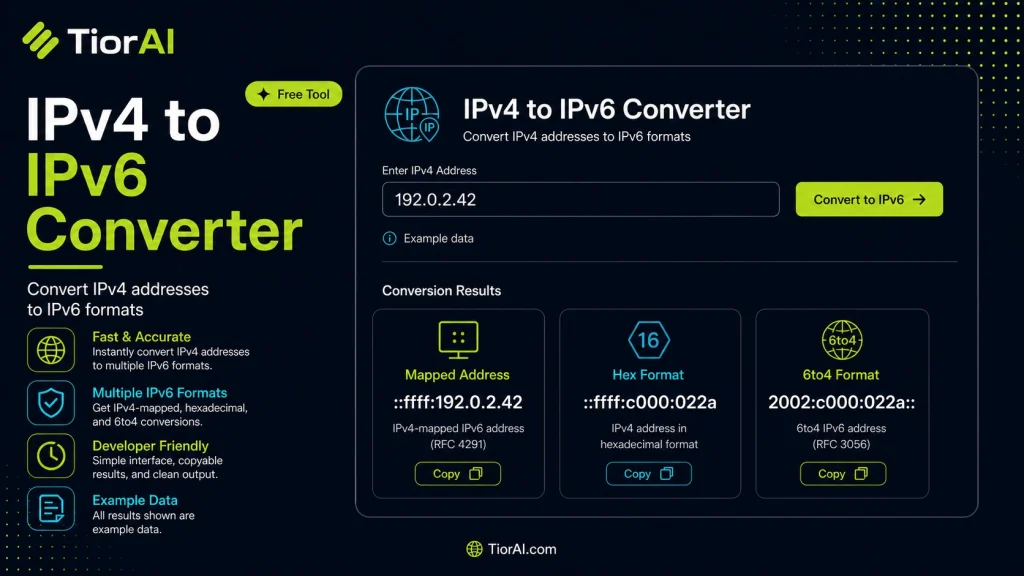
How to use it
- Enter Your Input Value Type or paste the value you want to convert into the input field. The tool accepts any numeric value.
- Select Units and Convert Choose your source and target units from the dropdown menus. The converted result appears instantly.
- Copy or Use the Result Click copy to grab the converted value for use in your project, document, or calculation.
Tip Bookmark this converter - it handles edge cases like zero values and very large numbers accurately.
Understanding IPv4 and IPv6
Internet Protocol version 4 (IPv4) and Internet Protocol version 6 (IPv6) are the two main protocols used for identifying devices on a network through an addressing system. IPv4 uses 32-bit addresses, typically expressed in dotted decimal format (e.g., 192.168.1.1), allowing for approximately 4.3 billion unique addresses. Due to the explosive growth of internet-connected devices, IPv4 address exhaustion became a critical issue.
IPv6 was introduced as the successor to IPv4, defined in RFC 8200, to solve the address exhaustion problem by using 128-bit addresses. These addresses are expressed in hexadecimal and separated by colons (e.g., 2001:0db8:85a3::8a2e:0370:7334), allowing for an almost unlimited number of unique IP addresses.
Why Convert IPv4 to IPv6?
Many networks and applications still rely on IPv4 addresses, but modern infrastructure increasingly supports or requires IPv6. To ensure compatibility and smooth transition, developers and network engineers often need to represent IPv4 addresses within the IPv6 address space. This is done using specific IPv6 address formats that embed IPv4 addresses, such as the IPv4-mapped IPv6 address format.
IPv4-Mapped IPv6 Address Format
The IPv4-mapped IPv6 address format allows an IPv4 address to be represented within an IPv6 address by prefixing it with ::ffff:. For example, the IPv4 address 192.0.2.33 becomes ::ffff:192.0.2.33 or in full hexadecimal notation ::ffff:c000:0221. This format is defined in RFC 4291 and is primarily used to facilitate IPv6 applications communicating with IPv4-only devices.
How Developers Use IPv4 to IPv6 Conversion
Developers working on network applications, APIs, or infrastructure tools often need to handle both IPv4 and IPv6 addresses seamlessly. Converting IPv4 addresses to their IPv6-mapped equivalents allows software to unify address handling, simplify firewall rules, or log addresses consistently. Additionally, some databases and logging systems store IP addresses in IPv6 format for future-proofing.
Conversion can be done programmatically or with online tools that automate the process, ensuring accuracy and saving time. Understanding the underlying format helps developers debug network issues and design systems compatible with both protocols.
Understanding IPv4 and IPv6 Conversion
IPv4 and IPv6 are fundamental protocols for addressing devices on the internet. IPv4 uses 32-bit addresses, which limits the number of unique addresses available. IPv6 addresses this limitation by using 128-bit addresses, vastly increasing the address space. However, many networks and applications still rely on IPv4, so converting IPv4 addresses to IPv6 format is essential for compatibility.
The most common method to represent IPv4 addresses in IPv6 is the IPv4-mapped IPv6 address format. This format embeds the IPv4 address into the IPv6 address space by prefixing it with ::ffff:. This allows IPv6-enabled systems to handle IPv4 addresses without confusion.
When to Use an IPv4 to IPv6 Converter
- Integrating legacy IPv4 systems into IPv6-only environments.
- Storing IP addresses in a unified format for databases or logs.
- Developing applications that must support both IPv4 and IPv6 clients.
- Testing or debugging network configurations involving mixed IP protocols.
Common Mistakes to Avoid
- Confusing IPv4-mapped IPv6 addresses with native IPv6 addresses, which can lead to routing or firewall misconfigurations.
- Inputting invalid IPv4 addresses, such as octets outside the 0-255 range, resulting in failed or incorrect conversions.
Understanding these concepts helps developers and network engineers manage IP addresses effectively during the ongoing transition from IPv4 to IPv6.
Common use cases
- Converting a standard IPv4 address to IPv4-mapped IPv6
- Converting a public IPv4 address
Frequently asked questions
Reviews and questions
Whether this tool gave people the answer they needed, and what they asked about it.
Sign in to review this tool.
Sign In to ReviewNo reviews yet
Be the first to say whether this tool gave you what you needed.
Ask how to read the result, or what the tool does with an edge case — or answer someone else.
Sign In to AskNo questions yet
Not sure how to read a result? Be the first to ask.
AI tools related to this topic
Tools from the TiorAI directory that work on the same kind of job.

Wolfram Alpha
Wolfram Alpha is a computational knowledge engine that answers factual queries by performing computations on curated data, offering detailed solutions, visualizations, and an API for developers.

ChatGPT
ChatGPT is an AI chatbot by OpenAI powered by GPT-4o. It handles writing, coding, research, data analysis, and natural conversation. Free tier available, Plus at $20/month.