

IP Subnet Calculator
Calculate subnet details from an IP address and CIDR prefix or subnet mask.
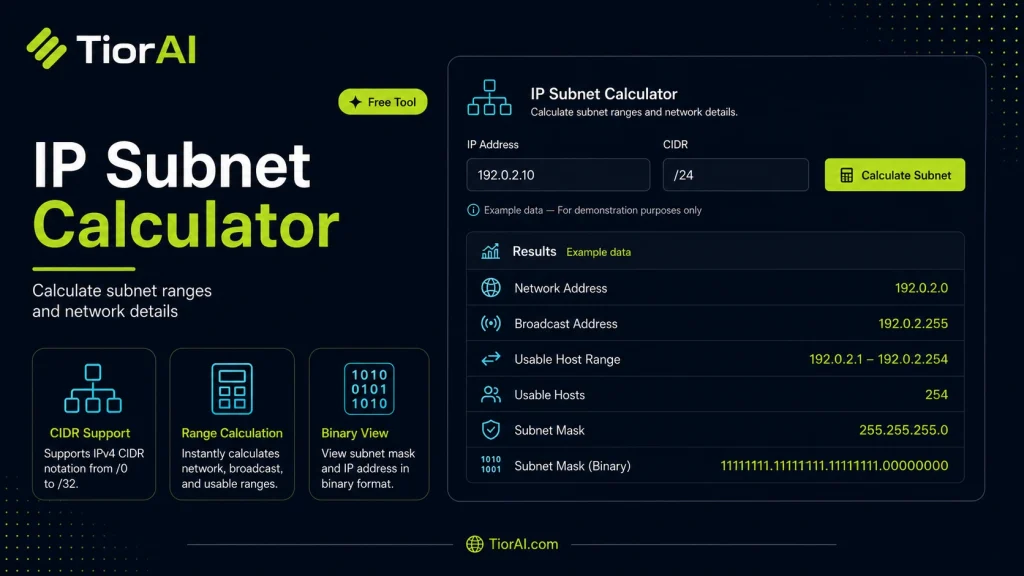
| Network Address | |
| Broadcast Address | |
| First Host | |
| Last Host | |
| Total Hosts | |
| Subnet Mask | |
| Wildcard Mask | |
| CIDR Notation | |
| IP Class | |
| Binary Subnet Mask |
How to use it
- Enter Domain or IP Enter the domain name, IP address, or URL into the Ip Subnet Calculator to start the lookup or analysis.
- Run the Check Click the check button to query the relevant databases. Results are retrieved and displayed in seconds.
- Analyze the Results Review the detailed results including status, records, and diagnostics to troubleshoot or verify your query.
Tip Run the Ip Subnet Calculator from different times of day to catch intermittent issues that only appear during peak traffic.
Understanding IP Subnetting and Its Importance
IP subnetting is a fundamental concept in computer networking that involves dividing a larger IP network into smaller, more manageable subnetworks, or subnets. This process helps optimize network performance, improve security, and simplify management by limiting broadcast domains and organizing IP address allocation.
At its core, an IP address consists of two parts: the network portion and the host portion. Subnetting extends this by borrowing bits from the host portion to create additional network segments. This is defined by the subnet mask, which specifies how many bits are used for the network and subnet identification versus the host identification.
For example, in IPv4, an address like 192.168.1.0 with a default subnet mask of 255.255.255.0 (or /24 in CIDR notation) means the first 24 bits represent the network, and the remaining 8 bits represent hosts within that network. By changing the subnet mask to 255.255.255.192 (/26), you create four smaller subnets, each with fewer hosts.
Subnetting solves several problems:
- Efficient IP address usage: Prevents wasting IP addresses by allocating only what is needed per subnet.
- Improved network performance: Reduces broadcast traffic by limiting broadcast domains.
- Enhanced security: Isolates network segments to control access and contain potential threats.
Developers and network engineers use subnetting when designing and maintaining networks, especially in environments with multiple departments, locations, or services. Standards like RFC 950 and RFC 4632 define subnetting and Classless Inter-Domain Routing (CIDR), which allows flexible subnet masks beyond traditional classful addressing.
Subnet calculators automate the complex binary calculations required to determine subnet ranges, broadcast addresses, and host counts. This reduces errors and speeds up network planning and troubleshooting.
What is IP Subnetting?
IP subnetting is a method used to divide a large IP network into smaller subnetworks, called subnets. This division helps manage IP addresses more efficiently, reduces network congestion, and enhances security by isolating network segments.
Every IP address consists of a network part and a host part. Subnetting works by extending the network portion to include bits from the host part, creating multiple smaller networks within the original one. This is controlled by the subnet mask, which indicates how many bits are allocated to the network.
When to Use an IP Subnet Calculator
- Planning a network that requires multiple subnets for different departments or locations.
- Configuring routers, switches, or firewalls that need precise subnet information.
- Troubleshooting IP address conflicts or verifying subnet boundaries.
- Designing scalable IP addressing schemes for cloud infrastructure or data centers.
- Converting between CIDR notation and subnet masks for documentation or configuration.
Common Mistakes to Avoid
- Mixing up the subnet mask and network address, which leads to incorrect subnet calculations.
- Choosing subnet sizes that are too large or too small for the number of hosts, causing wasted IP addresses or insufficient capacity.
- Forgetting that the network and broadcast addresses in each subnet are reserved and cannot be assigned to hosts.
- Confusing CIDR notation with dotted decimal subnet masks when entering data into tools.
Technical Context
Subnetting is governed by standards such as RFC 950, which introduced subnetting for IPv4, and RFC 4632, which defines Classless Inter-Domain Routing (CIDR). CIDR allows flexible subnet masks that are not limited to traditional classful boundaries, enabling more efficient IP address allocation.
Developers and network engineers rely on subnet calculators to handle the binary math involved in subnetting. These tools quickly provide subnet ranges, broadcast addresses, and host counts, which are essential for configuring network devices and ensuring proper network segmentation.
Common use cases
- Calculating subnets for a /24 network
- Determining subnet details from CIDR notation
Frequently asked questions
Reviews and questions
Whether this tool gave people the answer they needed, and what they asked about it.
Sign in to review this tool.
Sign In to ReviewNo reviews yet
Be the first to say whether this tool gave you what you needed.
Ask how to read the result, or what the tool does with an edge case — or answer someone else.
Sign In to AskNo questions yet
Not sure how to read a result? Be the first to ask.