

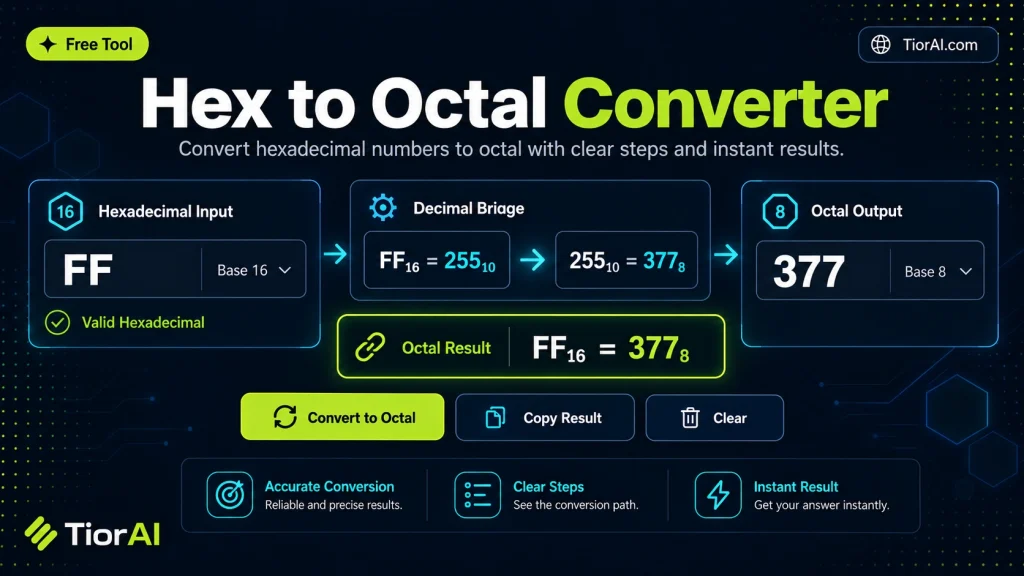
How to use it
- Enter Source Value Type or paste the value you want to convert into the Hex to Octal. The tool accepts a wide range of input formats.
- Select Target Format Choose your desired output format or unit from the available options. The conversion starts automatically.
- Copy the Result Review the converted output and click copy to use it in your project, document, or workflow.
Tip Switch between source and target formats in the Hex to Octal to quickly verify conversions in both directions.
Understanding Hexadecimal and Octal Number Systems
Hexadecimal (base 16) and octal (base 8) are positional numeral systems commonly used in computing and digital electronics. Hexadecimal uses sixteen symbols: 0-9 and A-F, where A through F represent values 10 to 15. Octal uses eight symbols: 0-7. Both systems serve as compact representations of binary data, making them easier for humans to read and interpret.
Converting from hexadecimal to octal involves translating a number from base 16 to base 8. This is often done by first converting the hex number to binary (base 2), then regrouping the binary digits into groups of three (since 2^3 = 8) to form octal digits. This conversion is useful because octal can represent binary data more compactly than decimal, and hexadecimal is widely used in programming and memory addressing.
Why convert hex to octal? Some legacy systems and certain programming environments prefer octal notation. Additionally, octal is sometimes used in Unix file permissions and other specialized contexts. Converting between these bases helps developers and engineers interpret and manipulate data across different systems.
Common use cases include:
- Interpreting memory addresses or machine code in different numeral systems.
- Working with file permissions in Unix/Linux systems.
- Debugging low-level code where octal or hex representations are used.
What is Hexadecimal to Octal Conversion?
Hexadecimal and octal are two numeral systems frequently used in computing to represent binary data more compactly. Hexadecimal (base 16) uses digits 0-9 and letters A-F, while octal (base 8) uses digits 0-7. Converting from hex to octal means changing a number from base 16 to base 8, which is useful in various programming and system contexts.
When Should You Use Hex to Octal Conversion?
- When working with legacy systems or software that require octal input but you have data in hexadecimal.
- When interpreting Unix/Linux file permissions, which are often represented in octal but may originate from hex values.
- When debugging or analyzing low-level machine data where switching between numeral systems helps clarify the information.
Common Mistakes to Avoid
- Inputting invalid characters outside the hexadecimal range (0-9, A-F).
- Trying to convert hex directly to octal without using binary as an intermediate step, which can cause errors.
- Ignoring leading zeros or case sensitivity, which can affect the accuracy of the conversion.
Understanding the relationship between these numeral systems and using binary as a bridge makes conversions straightforward and reliable. This knowledge is essential for developers, engineers, and anyone working with low-level data representations.
Frequently asked questions
Reviews and questions
Whether this tool gave people the answer they needed, and what they asked about it.
Sign in to review this tool.
Sign In to ReviewNo reviews yet
Be the first to say whether this tool gave you what you needed.
Ask how to read the result, or what the tool does with an edge case — or answer someone else.
Sign In to AskNo questions yet
Not sure how to read a result? Be the first to ask.
AI tools related to this topic
Tools from the TiorAI directory that work on the same kind of job.

Any Video Converter
Any Video Converter is a multimedia software that converts video files between numerous formats, downloads online videos, and offers basic editing and DVD burning features.

Bank Statement Converter
Bank Statement Converter is an online tool that converts PDF bank statements into Excel and CSV formats, enabling easy data extraction and financial management.