

Syllable Counter
A syllable is the smallest unit of sound in a word that can be pronounced in one uninterrupted vocalization. It usually contains a vowel sound and may include surrounding consonants. Understanding syllables is crucial for grasping how language sounds and flows. Syllables influence rhythm, stress…
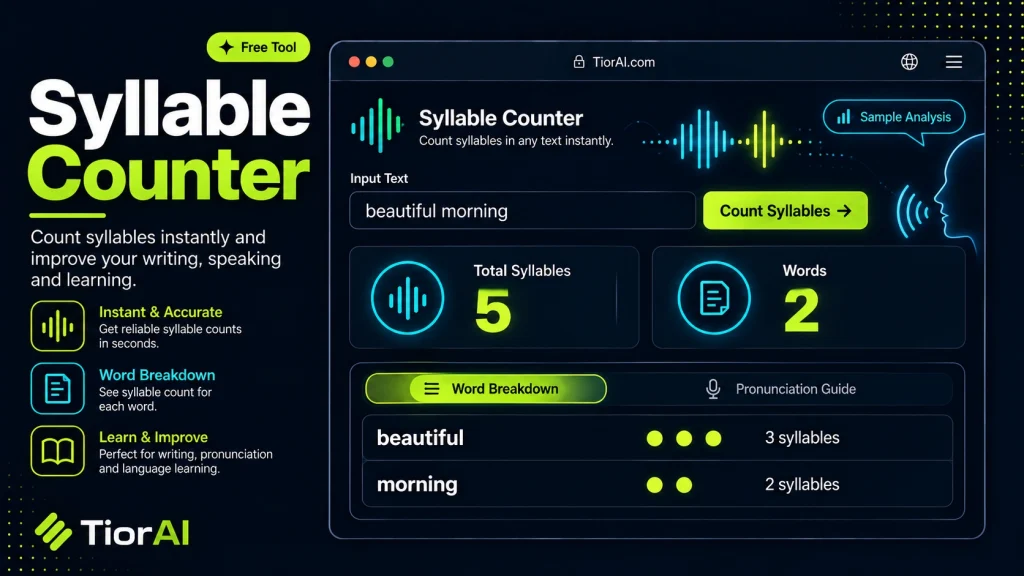
| Total Syllables | - |
|---|---|
| Word Count | - |
| Average Syllables/Word | - |
How to use it
- Paste Your Text Paste or type your text into the Syllable Counter. The tool handles content of any length with no character limits.
- Apply the Tool Click the action button to process your text. The transformation is applied instantly to your content.
- Copy the Result Review the transformed text and copy it to your clipboard for use in documents, emails, or projects.
Tip The Syllable Counter is perfect for content creators who need quick text transformations without installing software.
Understanding Syllables and Their Role in Language
A syllable is a unit of pronunciation that forms the building blocks of words. It typically consists of a vowel sound, with or without surrounding consonants, that is pronounced as a single, uninterrupted sound. For example, the word computer has three syllables: com-pu-ter. Syllables are fundamental to the rhythm, meter, and phonetic structure of language.
Counting syllables manually can be challenging, especially in complex or unfamiliar words. This is where syllable counters come into play. A syllable counter is a tool designed to analyze text and determine the number of syllables in each word or phrase. It helps writers, educators, linguists, and language learners understand the phonetic composition of text.
Why Syllable Counting Exists
Syllable counting is essential in various fields:
- Poetry and songwriting: Many poetic forms and songs require a specific syllable count per line or verse to maintain rhythm and meter.
- Language education: Teaching pronunciation and phonetics often involves breaking words into syllables.
- Speech therapy: Therapists use syllable segmentation to help clients improve articulation and fluency.
- Readability analysis: Some readability formulas incorporate syllable counts to estimate text complexity.
How Syllable Counters Work Technically
At a technical level, syllable counters use algorithms that analyze the spelling and phonetic patterns of words. Since English spelling does not always directly correspond to pronunciation, syllable counting algorithms rely on heuristic rules and dictionaries.
- Rule-based approaches: These use patterns such as vowel groups, silent vowels, diphthongs, and consonant clusters to estimate syllable boundaries. For example, consecutive vowels might count as one syllable if they form a diphthong.
- Dictionary lookup: Some tools reference comprehensive pronunciation dictionaries (like CMU Pronouncing Dictionary) that provide phonetic transcriptions and explicit syllable counts.
- Hybrid methods: Many tools combine dictionary data with heuristic rules to handle unknown words or proper nouns.
Despite these methods, syllable counting is not always perfectly accurate due to irregular pronunciations, regional accents, and homographs. However, modern syllable counters achieve high accuracy for most standard English text.
Common Real-World Scenarios
You will encounter syllable counting in:
- Writing and editing poetry: Ensuring each line fits a meter like haiku (5-7-5 syllables) or sonnets.
- Language learning apps: Helping learners break down words for better pronunciation.
- Speech synthesis and recognition: Improving naturalness by understanding syllable timing.
- Readability tools: Calculating syllable counts to assess text difficulty.
What is a Syllable and Why Does It Matter?
A syllable is the smallest unit of sound in a word that can be pronounced in one uninterrupted vocalization. It usually contains a vowel sound and may include surrounding consonants. Understanding syllables is crucial for grasping how language sounds and flows. Syllables influence rhythm, stress patterns, and pronunciation, which are essential in poetry, speech, and language learning.
How Syllable Counting Works
Syllable counting involves breaking words into these sound units. Since English spelling does not always directly reflect pronunciation, syllable counters rely on a combination of linguistic rules and pronunciation data. They detect vowel groups, silent letters, diphthongs, and consonant clusters to estimate syllable boundaries. Some tools also use pronunciation dictionaries to improve accuracy.
For example, the word beautiful is broken down into three syllables: beau-ti-ful. The tool identifies vowel sounds and applies rules to segment the word accordingly.
When to Use a Syllable Counter
- Poetry and Songwriting: To ensure lines meet specific syllable counts required by forms like haiku or limericks.
- Language Education: To help learners understand word pronunciation and practice speaking.
- Speech Therapy: To assist in exercises that focus on syllable segmentation and articulation.
- Readability Analysis: To evaluate text complexity based on syllable counts per word.
Common Mistakes to Avoid
- Overreliance on Accuracy: Assuming the syllable counter is flawless can lead to errors, especially with slang, proper nouns, or irregular pronunciations.
- Improper Input: Including punctuation or formatting that the tool cannot interpret may cause incorrect syllable counts.
Technical Context
Technically, syllable counters combine phonetic rules with dictionary lookups. English has many exceptions and irregularities, so no algorithm is perfect. However, modern tools achieve high accuracy by using hybrid methods. They are invaluable for anyone working with language rhythm, pronunciation, or text complexity.
Worked examples
Counting syllables in a poem line
Used by poets to ensure lines fit a specific meter or syllable pattern.
Before The quick brown fox jumps over the lazy dogAfter The (1) quick (1) brown (1) fox (1) jumps (1) over (2) the (1) lazy (2) dog (1) — Total syllables: 11Breaking down complex words for language learners
Helps learners pronounce and understand multi-syllable words.
Before unbelievableAfter un-be-liev-a-ble (5 syllables)
Frequently asked questions
Reviews and questions
Whether this tool gave people the answer they needed, and what they asked about it.
Sign in to review this tool.
Sign In to ReviewNo reviews yet
Be the first to say whether this tool gave you what you needed.
Ask how to read the result, or what the tool does with an edge case — or answer someone else.
Sign In to AskNo questions yet
Not sure how to read a result? Be the first to ask.
AI tools related to this topic
Tools from the TiorAI directory that work on the same kind of job.

Culture Counter
Culture Counter is a web app that enables organizations to measure, track, and improve workplace diversity and inclusion through customizable metrics, data visualization, and benchmarking tools.

Prompt Token Counter
Prompt Token Counter is a free online tool that counts tokens in AI prompts for models such as GPT-5, GPT-4.1 and GPT-4o.