

HTTP Status Codes
HTTP status codes are three-digit responses sent by web servers to indicate the outcome of a client's request. They help communicate whether a request was successful, redirected, or encountered an error. These codes are essential for understanding how web servers and browsers interact. When to…
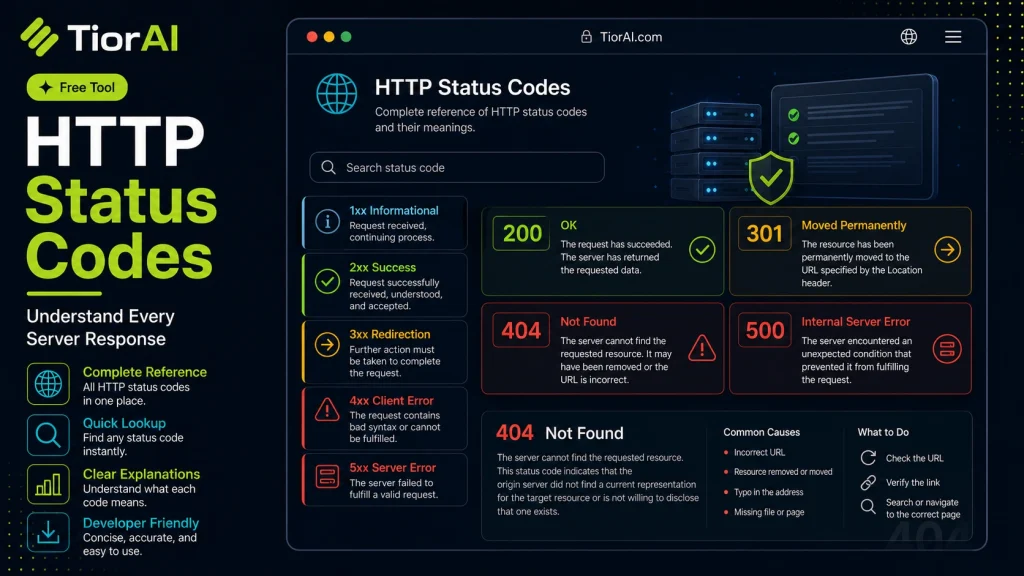
| Code | Name | Description |
|---|
How to use it
- Paste or Enter Your Input Paste your code, text, or data into the input field. The tool supports large inputs without performance issues.
- Process and Analyze Click the action button or let the tool auto-process your input. Results appear in real time with highlighted details.
- Copy or Download the Output Review the results and copy the output to clipboard or download as a file for use in your project.
Tip For large inputs, process in sections to validate intermediate results and catch errors early.
Understanding HTTP Status Codes
HTTP status codes are standardized codes sent by a web server in response to a client’s request made to the server. They indicate whether a request has been successfully completed, redirected, resulted in an error, or requires further action. These codes are part of the HTTP protocol, which governs communication between web browsers and servers.
Each status code is a three-digit number grouped into five classes based on their first digit:
1xx: Informational responses, indicating that the request was received and is continuing.2xx: Success codes, meaning the request was successfully received, understood, and accepted.3xx: Redirection codes, indicating that further action is needed to complete the request.4xx: Client error codes, showing that the request contains bad syntax or cannot be fulfilled.5xx: Server error codes, meaning the server failed to fulfill a valid request.
Understanding these codes is essential for web developers, system administrators, and SEO specialists to diagnose issues, optimize website performance, and ensure proper communication between clients and servers.
What Are HTTP Status Codes?
HTTP status codes are three-digit responses sent by web servers to indicate the outcome of a client’s request. They help communicate whether a request was successful, redirected, or encountered an error. These codes are essential for understanding how web servers and browsers interact.
When to Use HTTP Status Codes
- Diagnosing website errors to determine if problems are client-side or server-side.
- Verifying URL redirects after site changes or migrations.
- Monitoring API endpoints to ensure they respond correctly.
- Checking if resources like images or scripts load properly.
Common Mistakes with HTTP Status Codes
- Mixing up similar codes such as 301 and 302 redirects, which can affect SEO and user experience.
- Assuming a 200 status code always means the content is correct, ignoring possible errors within the page content.
Understanding HTTP status codes is crucial for web development, troubleshooting, and maintaining healthy website performance. They provide clear signals about the state of web requests and help identify issues quickly.
Frequently asked questions
Reviews and questions
Whether this tool gave people the answer they needed, and what they asked about it.
Sign in to review this tool.
Sign In to ReviewNo reviews yet
Be the first to say whether this tool gave you what you needed.
Ask how to read the result, or what the tool does with an edge case — or answer someone else.
Sign In to AskNo questions yet
Not sure how to read a result? Be the first to ask.
AI tools related to this topic
Tools from the TiorAI directory that work on the same kind of job.

ChatGPT
ChatGPT is an AI chatbot by OpenAI powered by GPT-4o. It handles writing, coding, research, data analysis, and natural conversation. Free tier available, Plus at $20/month.