

Scientific Notation Converter
Scientific notation is a standardized way to write very large or very small numbers. Instead of writing out all the zeros, it expresses numbers as a decimal multiplied by a power of ten. This makes numbers easier to read, compare, and calculate with, especially in…
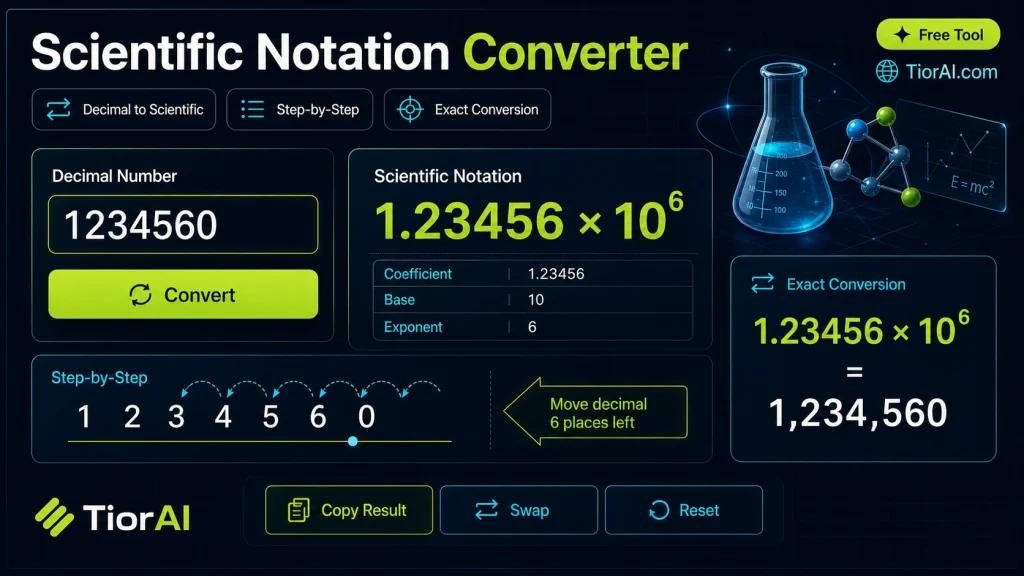
—How to use it
- Enter Your Input Value Type or paste the value you want to convert into the input field. The tool accepts any numeric value.
- Select Units and Convert Choose your source and target units from the dropdown menus. The converted result appears instantly.
- Copy or Use the Result Click copy to grab the converted value for use in your project, document, or calculation.
Tip Chain multiple conversions by copying the output and pasting it as the next input - works seamlessly.
Understanding Scientific Notation
Scientific notation is a method of expressing very large or very small numbers in a compact form. It represents numbers as a product of a decimal number between 1 and 10 and a power of 10. For example, 4,500 can be written as 4.5 × 10³, and 0.00032 as 3.2 × 10⁻⁴.
This notation is essential in fields like science, engineering, and computer science where dealing with extremely large or tiny values is common. It simplifies calculations, improves readability, and reduces errors when handling such numbers.
Why use scientific notation?
- It makes it easier to compare magnitudes of numbers quickly.
- It helps in performing multiplication and division by adding or subtracting exponents.
- It reduces the chance of miscounting zeros in very large or small numbers.
Common situations where scientific notation is used include representing distances in astronomy, sizes of microscopic particles, or values in physics and chemistry experiments. Converting between standard decimal form and scientific notation is a fundamental skill for students and professionals alike.
What is Scientific Notation?
Scientific notation is a standardized way to write very large or very small numbers. Instead of writing out all the zeros, it expresses numbers as a decimal multiplied by a power of ten. This makes numbers easier to read, compare, and calculate with, especially in scientific and engineering contexts.
When to Use Scientific Notation
- Handling astronomical distances or sizes of microscopic particles.
- Performing scientific calculations requiring precision and clarity.
- Preparing data for programming or computational analysis.
- Working with measurements in physics, chemistry, or engineering.
Common Mistakes to Avoid
- Incorrectly placing the decimal point during conversion, which changes the value.
- Mixing up positive and negative exponents, especially for small numbers.
- Entering numbers without the proper format, such as missing the multiplication sign or exponent.
Understanding scientific notation helps you work efficiently with a wide range of numerical data. This converter simplifies the process by accurately transforming numbers between decimal and scientific notation formats, reducing errors and saving time.
Frequently asked questions
Reviews and questions
Whether this tool gave people the answer they needed, and what they asked about it.
Sign in to review this tool.
Sign In to ReviewNo reviews yet
Be the first to say whether this tool gave you what you needed.
Ask how to read the result, or what the tool does with an edge case — or answer someone else.
Sign In to AskNo questions yet
Not sure how to read a result? Be the first to ask.
AI tools related to this topic
Tools from the TiorAI directory that work on the same kind of job.

Wolfram Alpha
Wolfram Alpha is a computational knowledge engine that answers factual queries by performing computations on curated data, offering detailed solutions, visualizations, and an API for developers.

ChatGPT
ChatGPT is an AI chatbot by OpenAI powered by GPT-4o. It handles writing, coding, research, data analysis, and natural conversation. Free tier available, Plus at $20/month.