

Parts per Converter
Parts per units express very small ratios or concentrations, such as parts per million (ppm), parts per billion (ppb), and parts per trillion (ppt). These units are essential when dealing with trace amounts of substances in fields like chemistry, environmental monitoring, and manufacturing quality control.…
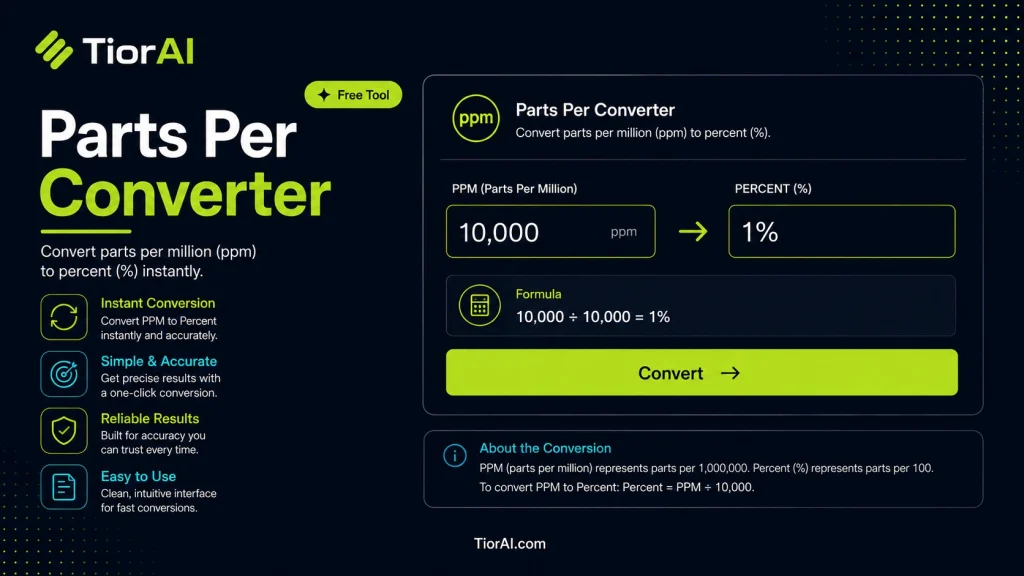
How to use it
- Enter Your Input Value Type or paste the value you want to convert into the input field. The tool accepts any numeric value.
- Select Units and Convert Choose your source and target units from the dropdown menus. The converted result appears instantly.
- Copy or Use the Result Click copy to grab the converted value for use in your project, document, or calculation.
Tip Bookmark this converter - it handles edge cases like zero values and very large numbers accurately.
Understanding Parts Per Units and Their Conversion
Parts per units are a set of measurements used to express very small concentrations or ratios, commonly in fields like chemistry, environmental science, and engineering. These units include parts per million (ppm), parts per billion (ppb), parts per trillion (ppt), and others. They quantify the amount of one substance relative to another, often in terms of mass, volume, or mole fraction.
Why convert between parts per units? Different industries and scientific disciplines prefer different units depending on the scale of measurement and precision required. For example, air quality measurements might be reported in ppm, while trace contaminants in water could be in ppb or ppt.
Common situations for using parts per conversions include:
- Analyzing pollutant concentrations in environmental samples.
- Measuring trace elements in chemical solutions.
- Quality control in manufacturing processes where impurities must be tightly controlled.
- Converting data between units for reporting or regulatory compliance.
Understanding how to convert accurately between these units ensures clear communication and proper interpretation of data across different contexts.
What Are Parts Per Units and Why Convert Them?
Parts per units express very small ratios or concentrations, such as parts per million (ppm), parts per billion (ppb), and parts per trillion (ppt). These units are essential when dealing with trace amounts of substances in fields like chemistry, environmental monitoring, and manufacturing quality control.
Converting between these units is necessary because different contexts require different scales. For example, air pollutant levels might be reported in ppm, while water contaminants are often measured in ppb or ppt. Accurate conversion ensures consistent communication and compliance with regulations.
When to Use a Parts Per Converter
- Converting pollutant concentration data from ppm to ppb for environmental reports.
- Comparing scientific data that uses different parts per units.
- Expressing impurity levels in chemical manufacturing in the required unit.
- Meeting regulatory requirements that specify limits in a particular parts per unit.
Common Mistakes to Avoid
- Mixing up ppm with percent (%) and miscalculating by a factor of 10,000.
- Attempting to convert between mass-based and volume-based parts per units without necessary density or molar mass data.
Understanding the context and basis of the parts per units you are working with is crucial for accurate conversion and interpretation.
Frequently asked questions
Reviews and questions
Whether this tool gave people the answer they needed, and what they asked about it.
Sign in to review this tool.
Sign In to ReviewNo reviews yet
Be the first to say whether this tool gave you what you needed.
Ask how to read the result, or what the tool does with an edge case — or answer someone else.
Sign In to AskNo questions yet
Not sure how to read a result? Be the first to ask.
AI tools related to this topic
Tools from the TiorAI directory that work on the same kind of job.

Wolfram Alpha
Wolfram Alpha is a computational knowledge engine that answers factual queries by performing computations on curated data, offering detailed solutions, visualizations, and an API for developers.

ChatGPT
ChatGPT is an AI chatbot by OpenAI powered by GPT-4o. It handles writing, coding, research, data analysis, and natural conversation. Free tier available, Plus at $20/month.