

Ipv6 to Ipv4
Understanding IPv6 and IPv4 Addressing IPv4 and IPv6 are two versions of the Internet Protocol used to assign addresses to devices on a network. IPv4 uses 32-bit addresses, which limits the number of unique addresses to around 4.3 billion. Due to the growth of internet-connected…
How to use it
- Enter Your Input Value Type or paste the value you want to convert into the input field. The tool accepts any numeric value.
- Select Units and Convert Choose your source and target units from the dropdown menus. The converted result appears instantly.
- Copy or Use the Result Click copy to grab the converted value for use in your project, document, or calculation.
Tip Need the reverse conversion? Swap source and target to convert in the opposite direction instantly.
Understanding IPv4 and IPv6
Internet Protocol version 4 (IPv4) and Internet Protocol version 6 (IPv6) are two standards for IP addressing used to identify devices on a network. IPv4 uses 32-bit addresses, typically represented in dotted decimal format (e.g., 192.168.1.1), allowing for about 4.3 billion unique addresses. Due to the explosive growth of internet-connected devices, IPv4 address exhaustion became a critical issue.
IPv6 was introduced as the successor to IPv4 to solve this limitation. It uses 128-bit addresses, represented as eight groups of four hexadecimal digits separated by colons (e.g., 2001:0db8:85a3:0000:0000:8a2e:0370:7334), providing a vastly larger address space.
Why Convert IPv6 to IPv4?
Despite IPv6 adoption increasing, many networks and applications still rely on IPv4. Some legacy systems, firewalls, or software only support IPv4 addresses. In these cases, converting or mapping an IPv6 address to an IPv4 address becomes necessary for compatibility, troubleshooting, or network configuration.
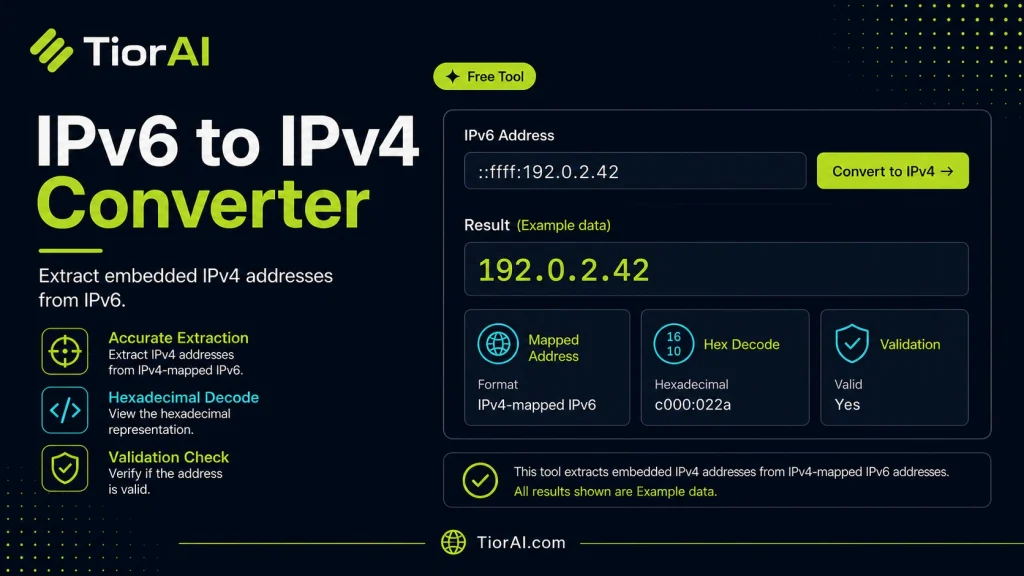
However, direct conversion is not always straightforward because IPv6 addresses are longer and more complex. Certain IPv6 addresses embed IPv4 addresses within them, such as IPv4-mapped IPv6 addresses (::ffff:192.168.1.1), which allow IPv6 systems to represent IPv4 addresses. Tools that convert IPv6 to IPv4 typically extract these embedded IPv4 parts or perform mappings based on specific standards.
Relevant Standards and Specifications
- RFC 4291: Defines the IPv6 addressing architecture, including IPv4-mapped IPv6 addresses.
- RFC 6052: Specifies IPv6 address prefixes for IPv4/IPv6 translation.
- RFC 7915: Discusses mechanisms for IPv6 transition and coexistence with IPv4.
How Developers Use IPv6 to IPv4 Conversion
Developers working on network applications, migration tools, or dual-stack environments often need to handle both IPv4 and IPv6 addresses. Conversion tools help in:
- Parsing IPv6 addresses to extract embedded IPv4 addresses for compatibility.
- Testing network configurations that involve IPv4-only components.
- Debugging connectivity issues in mixed IP environments.
- Implementing address translation or tunneling mechanisms.
Understanding the relationship between IPv4 and IPv6 addresses and how to convert between them is essential for maintaining interoperability during the ongoing transition to IPv6.
Understanding IPv6 and IPv4 Addressing
IPv4 and IPv6 are two versions of the Internet Protocol used to assign addresses to devices on a network. IPv4 uses 32-bit addresses, which limits the number of unique addresses to around 4.3 billion. Due to the growth of internet-connected devices, this address space became insufficient, leading to the development of IPv6, which uses 128-bit addresses and supports a vastly larger number of unique addresses.
IPv6 addresses are represented as eight groups of four hexadecimal digits separated by colons, while IPv4 addresses use four decimal numbers separated by dots. This difference in format and size means that IPv6 and IPv4 addresses are not directly interchangeable.
When to Use IPv6 to IPv4 Conversion
- When working with legacy systems or applications that only support IPv4 but need to interact with IPv6 networks.
- During network troubleshooting to extract IPv4 addresses embedded within IPv6 addresses for logging or access control.
- In migration projects where IPv4 infrastructure coexists with IPv6, requiring address translation or mapping.
- For developers testing dual-stack applications that must handle both IPv4 and IPv6 addresses.
Common Mistakes to Avoid
- Assuming all IPv6 addresses can be converted to IPv4 addresses. Only specific IPv6 addresses, such as IPv4-mapped IPv6 addresses, contain embedded IPv4 addresses.
- Confusing IPv4-mapped IPv6 addresses with general IPv6 addresses, which leads to invalid conversion attempts.
- Using conversion tools without understanding the address type, resulting in incorrect or meaningless outputs.
Technical Context
IPv4-mapped IPv6 addresses are defined in RFC 4291 and have the format ::ffff:x.x.x.x, where x.x.x.x is the embedded IPv4 address. These addresses allow IPv6-enabled systems to represent IPv4 addresses and facilitate communication between IPv4 and IPv6 networks.
Other standards like RFC 6052 define mechanisms for translating between IPv4 and IPv6 addresses, which are essential for interoperability during the transition period where both protocols coexist.
Developers working with IP addresses need to understand these standards and the limitations of address conversion to build robust, compatible network applications and tools.
Common use cases
- Extracting IPv4 from an IPv4-mapped IPv6 address
- Attempting conversion of a general IPv6 address without embedded IPv4
Frequently asked questions
::ffff:. It allows IPv6 systems to represent IPv4 addresses for compatibility.Reviews and questions
Whether this tool gave people the answer they needed, and what they asked about it.
Sign in to review this tool.
Sign In to ReviewNo reviews yet
Be the first to say whether this tool gave you what you needed.
Ask how to read the result, or what the tool does with an edge case — or answer someone else.
Sign In to AskNo questions yet
Not sure how to read a result? Be the first to ask.
AI tools related to this topic
Tools from the TiorAI directory that work on the same kind of job.

Wolfram Alpha
Wolfram Alpha is a computational knowledge engine that answers factual queries by performing computations on curated data, offering detailed solutions, visualizations, and an API for developers.

ChatGPT
ChatGPT is an AI chatbot by OpenAI powered by GPT-4o. It handles writing, coding, research, data analysis, and natural conversation. Free tier available, Plus at $20/month.