

Ipv6 Range to CIDR
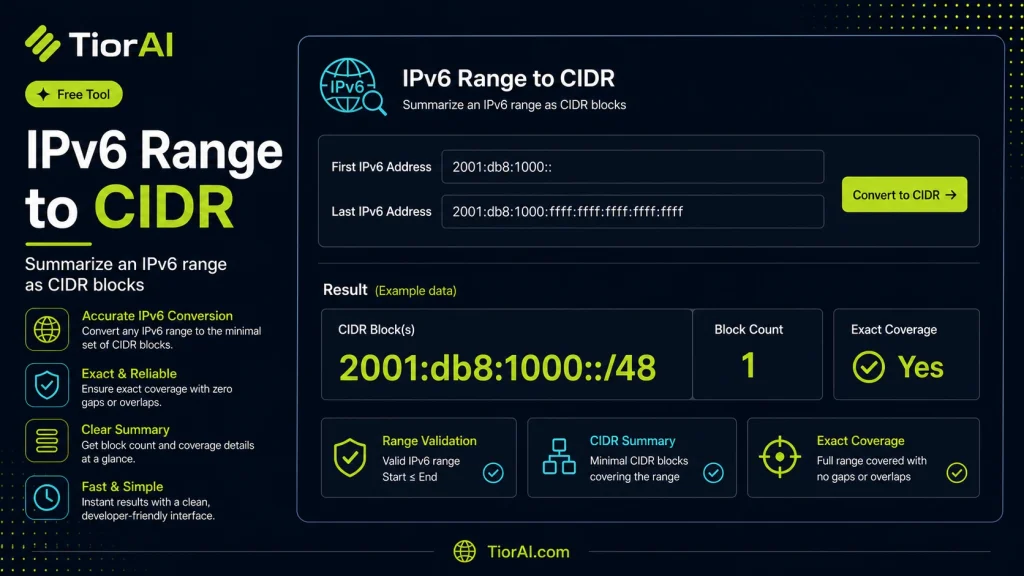
IPv6 is the modern Internet Protocol version designed to replace IPv4, providing a vastly larger address space. IPv6 addresses are 128 bits long and written in hexadecimal format. Managing these addresses efficiently requires a system to represent groups of addresses compactly. CIDR (Classless Inter-Domain Routing)…
How to use it
- Enter Your Input Value Type or paste the value you want to convert into the input field. The tool accepts any numeric value.
- Select Units and Convert Choose your source and target units from the dropdown menus. The converted result appears instantly.
- Copy or Use the Result Click copy to grab the converted value for use in your project, document, or calculation.
Tip Chain multiple conversions by copying the output and pasting it as the next input - works seamlessly.
Understanding IPv6 Addressing and CIDR Notation
IPv6 is the latest version of the Internet Protocol designed to replace IPv4, primarily to address the exhaustion of available IP addresses. An IPv6 address is 128 bits long, represented as eight groups of four hexadecimal digits separated by colons (e.g., 2001:0db8:85a3::8a2e:0370:7334). Because of the vast address space, managing and allocating IPv6 addresses efficiently is critical.
CIDR (Classless Inter-Domain Routing) notation is a method used to represent IP address ranges compactly. Instead of listing every individual IP address, CIDR uses a base address and a prefix length to specify a block of addresses. For IPv6, the prefix length ranges from 0 to 128, indicating how many leading bits are fixed in the address block.
For example, the CIDR notation 2001:db8::/32 represents all IPv6 addresses where the first 32 bits match 2001:0db8. This notation is essential for routing, subnetting, and address allocation because it simplifies the representation of large address blocks.
Why convert an IPv6 range to CIDR? Sometimes, you have a start and end IPv6 address defining a range, but network configurations and routing tables require CIDR blocks. Converting a range to the minimal set of CIDR blocks helps optimize routing entries and firewall rules, reducing complexity and improving performance.
Developers and network engineers use this conversion in real projects such as:
- Configuring firewall rules that accept or block traffic from specific IPv6 ranges.
- Allocating address space to different departments or services within an organization.
- Optimizing routing tables in IPv6-enabled networks.
- Automating network provisioning scripts that require CIDR input.
The relevant standards include RFC 4291 for IPv6 addressing architecture and RFC 4632 for CIDR notation. Understanding these helps ensure correct interpretation and usage of IPv6 CIDR blocks.
What is IPv6 and CIDR Notation?
IPv6 is the modern Internet Protocol version designed to replace IPv4, providing a vastly larger address space. IPv6 addresses are 128 bits long and written in hexadecimal format. Managing these addresses efficiently requires a system to represent groups of addresses compactly.
CIDR (Classless Inter-Domain Routing) notation is a method to represent IP address blocks by specifying a base address and a prefix length. The prefix length indicates how many bits of the address are fixed, defining the size of the block. For IPv6, prefix lengths range from 0 to 128.
When to Use IPv6 Range to CIDR Conversion
- When you have a start and end IPv6 address and need to configure network devices that accept CIDR blocks.
- When subnetting a large IPv6 allocation into smaller blocks for organizational or security purposes.
- When optimizing firewall or routing rules to reduce the number of entries by using CIDR notation.
Common Mistakes to Avoid
- Assuming a single CIDR block can always represent an IPv6 range; often multiple CIDR blocks are necessary.
- Confusing prefix length with the number of addresses, which can lead to incorrect subnet sizes and misconfigurations.
Technical Context
IPv6 addressing and CIDR are defined in standards such as RFC 4291 and RFC 4632. Understanding these helps ensure correct use of CIDR blocks in network design and configuration. CIDR notation is fundamental for routing efficiency and address management in IPv6 networks.
Common use cases
- Converting a small IPv6 range to CIDR blocks
- Converting a non-contiguous IPv6 range requiring multiple CIDR blocks
Frequently asked questions
2001:db8::1/128.Reviews and questions
Whether this tool gave people the answer they needed, and what they asked about it.
Sign in to review this tool.
Sign In to ReviewNo reviews yet
Be the first to say whether this tool gave you what you needed.
Ask how to read the result, or what the tool does with an edge case — or answer someone else.
Sign In to AskNo questions yet
Not sure how to read a result? Be the first to ask.
AI tools related to this topic
Tools from the TiorAI directory that work on the same kind of job.

Wolfram Alpha
Wolfram Alpha is a computational knowledge engine that answers factual queries by performing computations on curated data, offering detailed solutions, visualizations, and an API for developers.

ChatGPT
ChatGPT is an AI chatbot by OpenAI powered by GPT-4o. It handles writing, coding, research, data analysis, and natural conversation. Free tier available, Plus at $20/month.