

Ipv6 Compression Tool
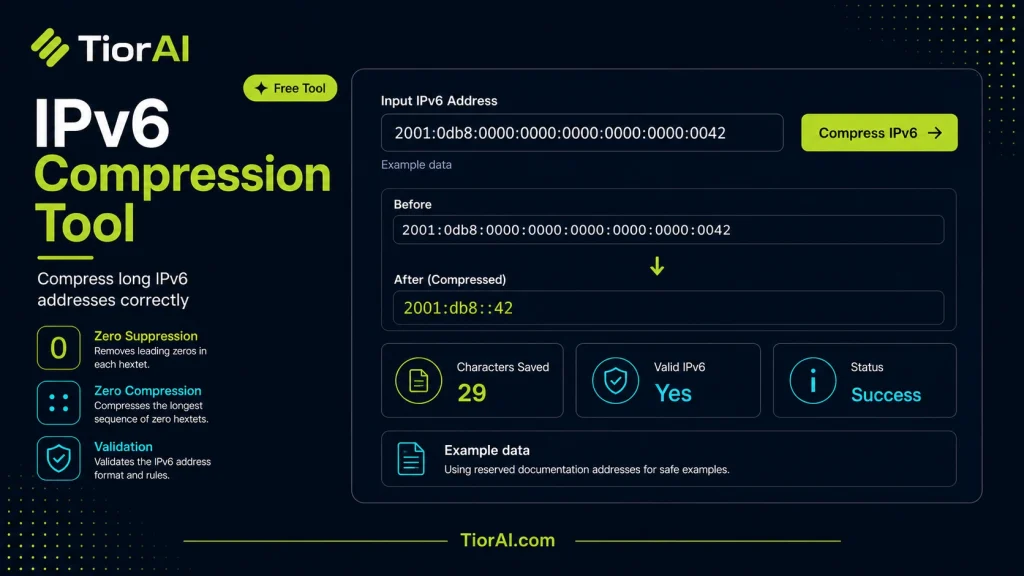
IPv6 addresses are long 128-bit identifiers used to uniquely identify devices on modern networks. They are typically written as eight groups of four hexadecimal digits separated by colons. Because of their length, these addresses can be difficult to read and prone to errors when typed…
How to use it
- Enter Your Input Value Type or paste the value you want to convert into the input field. The tool accepts any numeric value.
- Select Units and Convert Choose your source and target units from the dropdown menus. The converted result appears instantly.
- Copy or Use the Result Click copy to grab the converted value for use in your project, document, or calculation.
Tip Need the reverse conversion? Swap source and target to convert in the opposite direction instantly.
Understanding IPv6 Address Compression
IPv6 addresses are 128-bit identifiers used to uniquely identify devices on an IPv6 network. They are typically represented as eight groups of four hexadecimal digits, separated by colons, for example: 2001:0db8:0000:0000:0000:ff00:0042:8329. Due to their length, these addresses can be cumbersome to read, write, and communicate.
IPv6 address compression is a technique defined in RFC 5952 and earlier standards like RFC 4291 to shorten the textual representation of IPv6 addresses without losing information. The compression rules allow developers and network engineers to represent addresses more succinctly, improving readability and reducing errors.
How IPv6 Compression Works
- Leading zeros suppression: Within each 16-bit block, leading zeros can be omitted. For example,
0042becomes42. - Zero blocks compression: One contiguous sequence of one or more 16-bit blocks set to zero can be replaced by a double colon
::. This can only be used once per address to avoid ambiguity.
For example, the address 2001:0db8:0000:0000:0000:ff00:0042:8329 can be compressed to 2001:db8::ff00:42:8329.
Why IPv6 Compression Matters for Developers
Developers working with networking, cloud infrastructure, or embedded systems often need to handle IPv6 addresses. Using compressed addresses:
- Improves readability in logs, configuration files, and code.
- Reduces the chance of transcription errors.
- Facilitates easier comparison and validation of addresses.
However, it is important to maintain consistency and follow standards to ensure interoperability across systems and tools.
Relevant Standards
- RFC 4291: Defines the IPv6 addressing architecture.
- RFC 5952: Provides recommendations for text representation of IPv6 addresses, including compression rules.
What is IPv6 Address Compression?
IPv6 addresses are long 128-bit identifiers used to uniquely identify devices on modern networks. They are typically written as eight groups of four hexadecimal digits separated by colons. Because of their length, these addresses can be difficult to read and prone to errors when typed or copied.
IPv6 address compression is a standardized method to shorten these addresses while preserving their meaning. It involves two main techniques: removing leading zeros in each 16-bit block and replacing one contiguous sequence of zero blocks with a double colon (::). This makes addresses easier to handle in code, configuration files, and documentation.
When to Use IPv6 Compression
- When logging or displaying IPv6 addresses to improve readability.
- In configuration files where concise notation reduces clutter.
- During software development involving network addresses to simplify parsing and comparison.
- When manually entering IPv6 addresses in command-line tools or interfaces to save time and reduce errors.
Common Mistakes with IPv6 Compression
- Using multiple double colons (::) in one address, which is invalid and causes ambiguity.
- Not removing leading zeros within blocks, resulting in unnecessarily long addresses.
Technical Context and Standards
The IPv6 addressing architecture is defined in RFC 4291, while the recommended text representation and compression rules are specified in RFC 5952. These standards ensure that compressed addresses are unambiguous and interoperable across different systems and tools.
Understanding and applying these compression rules correctly is important for developers working with IPv6 to maintain consistency and avoid errors in network configurations and software.
Common use cases
- Compressing a typical IPv6 address with zero blocks
- Compressing an IPv6 address with a single zero block
Frequently asked questions
0042 becomes 42. This is part of the standard compression rules.Reviews and questions
Whether this tool gave people the answer they needed, and what they asked about it.
Sign in to review this tool.
Sign In to ReviewNo reviews yet
Be the first to say whether this tool gave you what you needed.
Ask how to read the result, or what the tool does with an edge case — or answer someone else.
Sign In to AskNo questions yet
Not sure how to read a result? Be the first to ask.
AI tools related to this topic
Tools from the TiorAI directory that work on the same kind of job.

Wolfram Alpha
Wolfram Alpha is a computational knowledge engine that answers factual queries by performing computations on curated data, offering detailed solutions, visualizations, and an API for developers.

ChatGPT
ChatGPT is an AI chatbot by OpenAI powered by GPT-4o. It handles writing, coding, research, data analysis, and natural conversation. Free tier available, Plus at $20/month.