

From my experience with TimescaleDB, I found it excels at managing and querying large volumes of time-series data with the familiarity and power of PostgreSQL. Its hypertable abstraction and continuous aggregates simplify complex time-series analytics, making it a strong choice for IoT and real-time monitoring projects. However, users new to PostgreSQL might face a learning curve, and advanced scaling features require enterprise plans. Overall, if you need a robust, scalable time-series database that integrates well with existing SQL tools, TimescaleDB delivers reliable and efficient performance.
TimescaleDB: Scalable Time-Series Database for Developers and Enterprises
TimescaleDB is an open-source time-series database built on PostgreSQL that enables efficient storage, querying, and analysis of time-stamped data for applications like IoT, monitoring, and financial analytics.
- Best for
- IoT Data Management
- Key capability
- Hypertables
Your actions
Do you recommend this tool?
What is TimescaleDB?
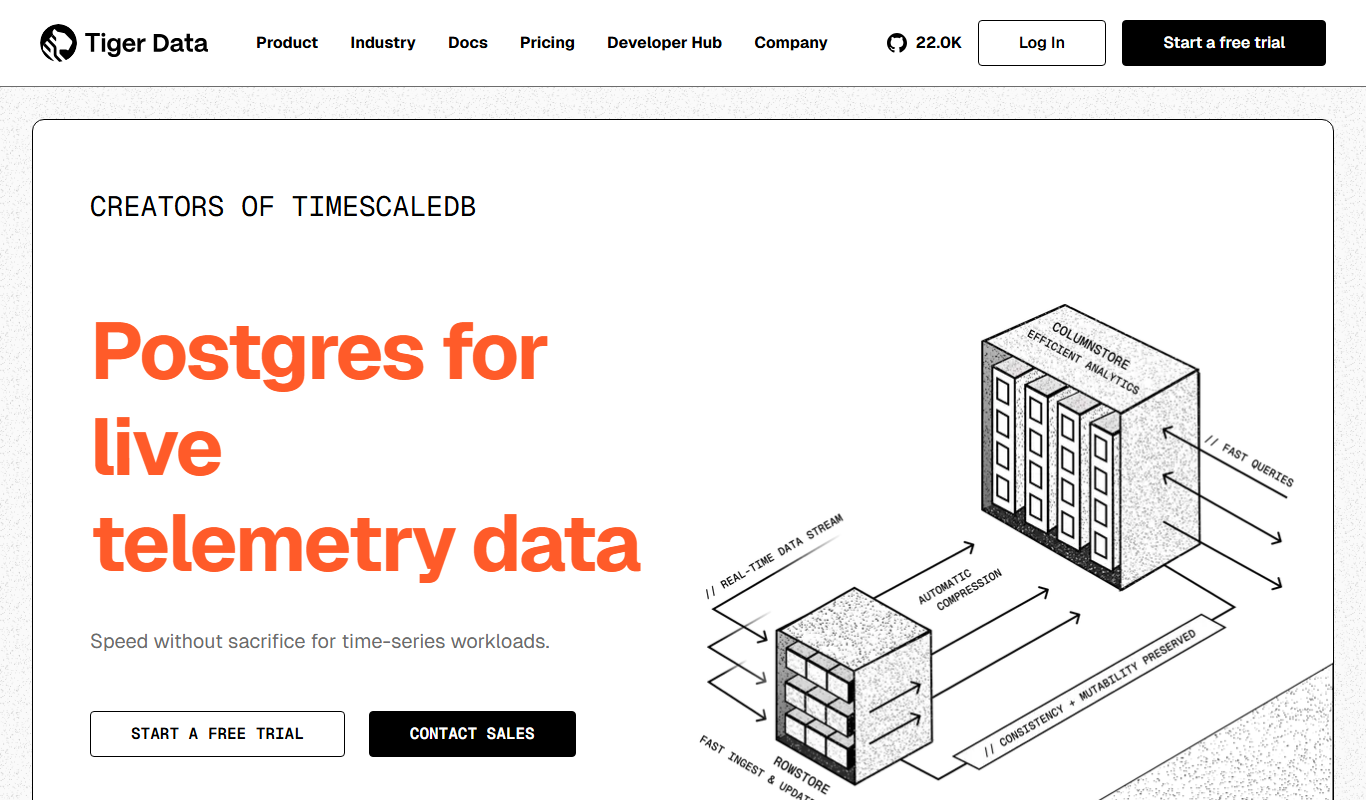
TimescaleDB is an open-source time-series database built on PostgreSQL, designed to handle large-scale time-series data with high performance and scalability. It extends PostgreSQL capabilities to efficiently ingest, store, and query time-stamped data, making it ideal for IoT, monitoring, financial, and analytics applications.
Key features of TimescaleDB
TimescaleDB offers seamless integration with PostgreSQL, automatic data partitioning (hypertables), advanced time-series functions, real-time analytics, compression, and scalability across distributed environments.
Hypertables
Automatically partition data across time and space dimensions for efficient querying and storage.
PostgreSQL Compatibility
Full SQL support and compatibility with PostgreSQL ecosystem and tools.
Real-Time Analytics
Perform fast aggregations and queries on streaming data with continuous aggregates.
Data Compression
Reduce storage costs by compressing historical time-series data without sacrificing query performance.
Multi-Node Clustering
Scale horizontally across multiple nodes for high availability and distributed workloads.
Pros and cons of TimescaleDB
Pros
- Seamless PostgreSQL integration
- Efficient handling of large time-series datasets
- Advanced time-series functions and analytics
- Flexible deployment options (cloud, on-premises)
- Open-source with active community
Cons
- Steeper learning curve for beginners unfamiliar with PostgreSQL
- Enterprise features require paid plans
- Scaling multi-node clusters can be complex
Key use cases for TimescaleDB
IoT Data Management
Efficiently store and analyze large volumes of time-series data generated by IoT devices.
Real-Time Analytics
Perform real-time queries and analytics on streaming data for monitoring and alerting.
Financial Market Data
Manage and analyze high-frequency financial data with scalability and low latency.
DevOps Monitoring
Store and analyze metrics from infrastructure and applications to optimize performance.
Industrial Automation
Handle sensor data from manufacturing and industrial processes for predictive maintenance.
How TimescaleDB works
- 1
Install TimescaleDB
Add TimescaleDB extension to your existing PostgreSQL database or install it as a standalone service.
- 2
Create Hypertables
Convert regular tables into hypertables that automatically partition data by time and space.
- 3
Ingest Data
Stream or batch insert time-series data into hypertables for efficient storage.
- 4
Query and Analyze
Use SQL with time-series functions to perform complex queries, aggregations, and analytics.
- 5
Scale and Optimize
Leverage compression, continuous aggregates, and multi-node clustering for performance and scalability.
Who is using TimescaleDB
IoT developers and engineers
Data analysts and scientists
DevOps and infrastructure teams
Financial services firms
Industrial automation professionals
TimescaleDB pricing
Community Edition
$0/month
Open-source version with core time-series features and PostgreSQL compatibility.
Cloud Basic
Starts at $0.25/hour
Managed cloud service with additional features, support, and scalability.
Enterprise
Custom pricing
Advanced features, dedicated support, and deployment options for large organizations.
Plans and prices are as published by the vendor and can change. Check the official site before you buy. Open the pricing page (opens in a new tab)
Frequently asked questions about TimescaleDB
TimescaleDB is used to store and analyze time-series data efficiently, suitable for IoT, monitoring, financial data, and real-time analytics.
Yes, TimescaleDB is built as an extension of PostgreSQL, maintaining full compatibility with its features and tools.
Yes, it supports automatic partitioning, compression, and multi-node clustering to scale for large datasets.
Yes, Timescale offers a managed cloud service with additional features and support.
Data handling and security practices vary by provider. Review the official privacy policy to understand how your data is stored and used.
Data handling and security practices vary by provider. Review the official privacy policy to understand how your data is stored and used.
It depends on your specific needs and how you plan to use the tool. The official website and documentation are the best sources for the latest details.
Yes, it can help with that use case depending on how you configure it and what features are available. You’ll get the best results with clear inputs and a defined goal.
Sign in to review this tool.
Sign In to ReviewNo reviews yet
Be the first to share how this tool worked for you.
Ask about pricing, limits, or how it compares — or answer someone else.
Sign In to AskNo questions yet
Have a question about using or paying for this tool? Be the first to ask.
Featured on TiorAI


Alternative Tools
Explore similar AI tools that might fit your needs

Free
InfluxDB
InfluxDB is a specialized time series database designed to efficiently store and analyze real-time timestamped data from applications, IoT devices, and infrastructure monitoring.
More AI Developer Tools tools
Other tools in the same category, for when this one is not quite the fit.

Freemium
Amadeus Travel API
Amadeus Travel API is a developer platform offering RESTful APIs to access global flight, hotel, and travel data for building travel booking and itinerary management applications.

Freemium
Zyte
Zyte is a web scraping platform that enables businesses and developers to extract structured data from websites using smart crawlers, proxy rotation, and API integration to automate data collection at scale.

Enterprise License
NiceLabel
NiceLabel is an enterprise label design and management software that enables businesses to create, manage, and automate barcode and RFID label printing with compliance and integration capabilities.
Perpetual License
Geomagic Design X
Geomagic Design X is a reverse engineering software that converts 3D scan data into editable CAD models, enabling precise product design and manufacturing workflows.
Free
Changelog Generator
GitHub Changelog Generator is a free, open-source Ruby-based CLI tool that automates the creation of changelogs by extracting data from GitHub issues, pull requests, and commits to streamline release note management.

Free
UnoCSS
UnoCSS is an open-source, utility-first atomic CSS engine that generates CSS on-demand based on the classes used in your code, optimizing performance by minimizing CSS bundle size.

Enterprise
CockroachDB
CockroachDB is a distributed SQL database designed for cloud-native applications that require strong consistency, high availability, and horizontal scalability across multiple regions.
Subscription
VividCortex
VividCortex is a cloud-based database monitoring platform that provides real-time insights into SQL query performance and resource usage to help optimize and troubleshoot relational databases.