

From my experience with Postman, I found it excels at simplifying complex API development workflows by combining request building, automated testing, and collaboration in one platform. After spending time with Postman, I can say it’s particularly well-suited for developers and QA engineers who need to streamline API testing and documentation. However, there is a trade-off: some advanced features require paid plans, which might be a consideration for smaller teams. Overall, if you need a reliable, user-friendly tool to manage the entire API lifecycle, Postman delivers solid results.
Postman API Platform for Efficient Development and Testing Tools
Postman is a comprehensive API platform that helps developers design, test, automate, document, and monitor APIs efficiently with collaboration tools.
- Best for
- API Development
- Key capability
- API Request Builder
Your actions
Save Postman, follow its updates and vote on it — everything stays in your account.
Sign in or create a free account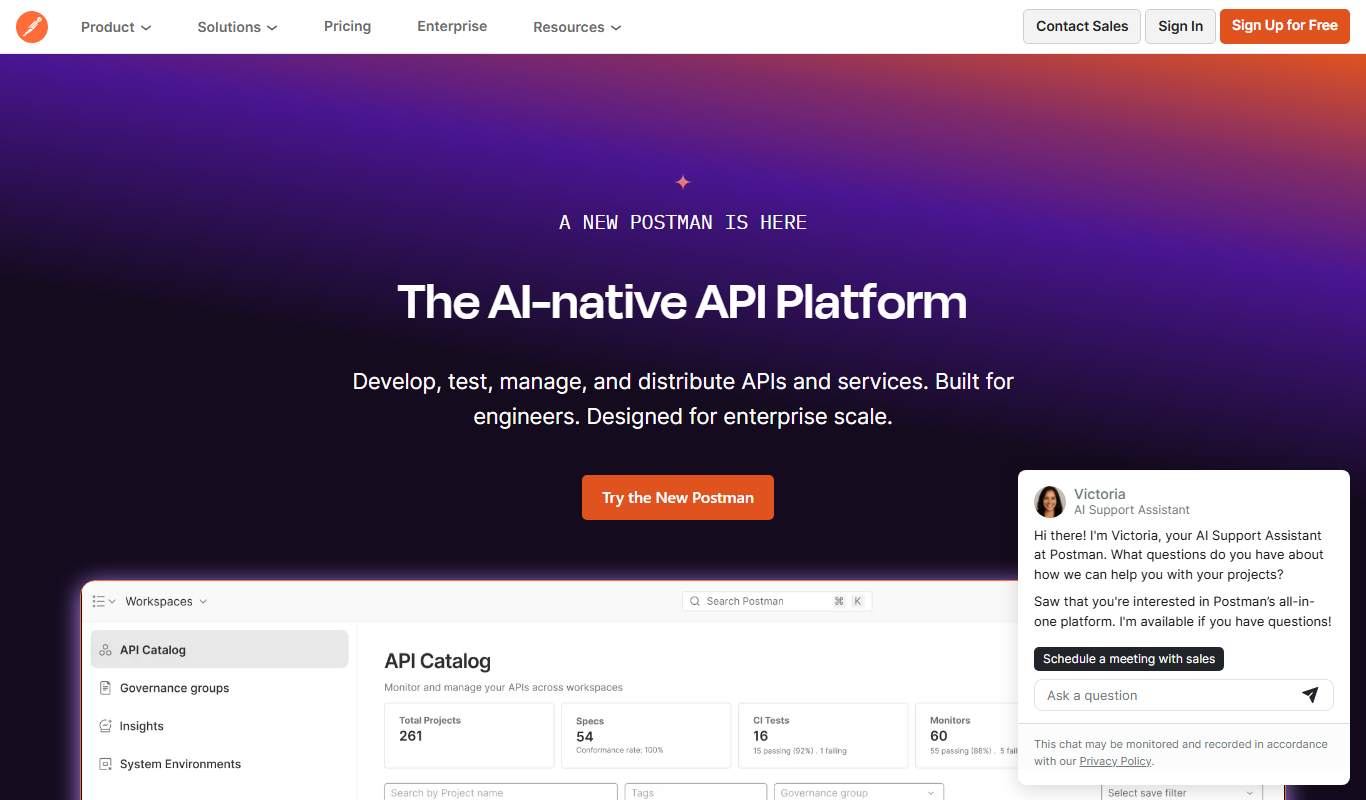
What is Postman?
Postman is a comprehensive API platform that enables developers to design, test, document, and monitor APIs efficiently. It provides an intuitive interface for sending requests, automating tests, and collaborating with teams to streamline API development workflows.
Key features of Postman
Postman offers features such as API request building, automated testing, mock servers, monitoring, collaboration tools, and auto-generated documentation, making it a versatile platform for all stages of API lifecycle management.
API Request Builder
Intuitive interface to create and send HTTP requests with support for various methods and authentication.
Automated Testing
Write JavaScript-based test scripts to validate API responses and automate testing.
Collaboration & Version Control
Share API collections and track changes with team workspaces and versioning.
Mock Servers
Simulate API endpoints to test client applications before backend development is complete.
API Monitoring
Schedule tests to monitor API uptime and performance with real-time alerts.
Auto-generated Documentation
Generate and publish interactive API documentation for easy consumption by developers.
Pros and cons of Postman
Pros
- User-friendly interface for building and testing APIs
- Robust collaboration features for teams
- Comprehensive automation and monitoring capabilities
- Supports a wide range of API protocols and authentication methods
- Extensive documentation and community support
Cons
- Advanced features require paid subscription
- Can be resource-intensive on older machines
- Learning curve for complex automation scripting
Key use cases for Postman
API Development
Design, build, and test APIs efficiently using Postman’s comprehensive tools.
API Testing & Automation
Create automated tests and run them to ensure API reliability and performance.
Collaboration
Share API collections and documentation with team members to streamline development workflows.
API Monitoring
Monitor API uptime and performance with scheduled tests and alerts.
Documentation
Generate and publish interactive API documentation for easier consumption by developers.
How Postman works
- 1
Create an Account
Sign up on Postman’s platform to access the API tools and collaboration features.
- 2
Build API Requests
Use the Postman interface to construct and send HTTP requests to your APIs.
- 3
Automate Tests
Write test scripts to validate API responses and automate testing workflows.
- 4
Collaborate with Teams
Share collections and environments with team members for synchronized development.
- 5
Monitor APIs
Set up monitors to track API health and receive alerts on issues.
Who is using Postman
API developers
QA engineers
Software development teams
DevOps professionals
Technical product managers
Postman pricing
Free
$0/month
Basic features including API request building, testing, and limited collaboration.
Team
$15/user/month
Enhanced collaboration, extended history, and shared workspaces.
Business
$29/user/month
Advanced security, monitoring, and governance features for larger teams.
Enterprise
Custom pricing
Tailored solutions with dedicated support, compliance, and advanced integrations.
Plans and prices are as published by the vendor and can change. Check the official site before you buy. Open the pricing page (opens in a new tab)
Frequently asked questions about Postman
Yes, Postman offers a free tier with essential API development and testing features.
Yes, Postman provides team workspaces and collaboration tools in paid plans.
Yes, you can write test scripts and automate tests within Postman.
Yes, Postman includes monitoring features to track API uptime and response times.
This tool is designed to help users accomplish its core tasks more efficiently. It is typically used by individuals or teams looking to improve productivity and workflow.
Some tools offer a free plan or trial with limited features. Availability can vary, so confirm on the official website.
Integration support depends on the tool and its available connectors or API. Check the official documentation or integrations page to confirm what is supported.
Yes, it can help with that use case depending on how you configure it and what features are available. You’ll get the best results with clear inputs and a defined goal.
Sign in to review this tool.
Sign In to ReviewNo reviews yet
Be the first to share how this tool worked for you.
Ask about pricing, limits, or how it compares — or answer someone else.
Sign In to AskNo questions yet
Have a question about using or paying for this tool? Be the first to ask.
Featured on TiorAI



Alternative Tools
Explore similar AI tools that might fit your needs

Free
Swagger
Swagger is a set of tools for designing, documenting, testing, and mocking RESTful APIs using the OpenAPI Specification, widely used by developers and teams to streamline API development.

Free
Insomnia
Insomnia is a desktop API client that helps developers design, debug, and test REST, GraphQL, and gRPC APIs with features like environment management and team collaboration.
More AI API tools
Other tools in the same category, for when this one is not quite the fit.

Free
Hasura
Hasura is the creator of the GraphQL Engine, DDN and PromptQL; its engine generates instant GraphQL APIs over databases such as Postgres, MS SQL Server, BigQuery and MongoDB.

Free
Supabase
Supabase is an open source backend platform that provides developers with a hosted PostgreSQL database, real-time subscriptions, authentication, storage, and auto-generated APIs to build scalable applications quickly.

Enterprise
Airbyte
Airbyte is an open-source data integration platform that enables building and managing ETL and ELT pipelines with a large catalog of connectors and customizable options.

Enterprise
Milvus
Milvus is an open-source vector database designed for efficient similarity search and management of large-scale unstructured data, widely used in AI and machine learning applications.
Freemium
RapidAPI
RapidAPI is a platform that allows developers to find, test, and connect to thousands of APIs from a single interface, offering unified SDKs, API analytics, and monetization options.
Custom Pricing
Travelport API
Travelport API is a global travel technology platform that provides access to flights, hotels, car rentals, and other travel services through a unified API, enabling travel agencies and corporations to integrate comprehensive booking and management capabilities.

Freemium
Amadeus Travel API
Amadeus Travel API is a developer platform offering RESTful APIs to access global flight, hotel, and travel data for building travel booking and itinerary management applications.

Freemium
Zyte
Zyte is a web scraping platform that enables businesses and developers to extract structured data from websites using smart crawlers, proxy rotation, and API integration to automate data collection at scale.