

From my experience with OpenRouter, I found it excels at simplifying access to multiple open-source large language models through a single API. The platform removes the complexity of hosting and scaling these models, which is a significant advantage for developers and businesses wanting to leverage open-source AI without heavy infrastructure overhead. It’s particularly well-suited for startups, researchers, and AI enthusiasts looking for cost-effective and flexible AI API solutions. However, the platform currently focuses mainly on English language models and offers limited pricing details, which might be a consideration for enterprise users. Overall, OpenRouter provides a practical gateway to open-source LLMs that balances ease of use with flexibility.
OpenRouter AI Platform for Open-Source Large Language Model API Access
OpenRouter is a platform that provides API access to various open-source large language models, enabling developers to integrate these models into applications without managing infrastructure.
- Best for
- Access Open-Source Large Language Models
- Key capability
- Unified API Access
Save OpenRouter, follow its updates and vote on it — everything stays in your account.
Sign in or create a free account
What is OpenRouter?
OpenRouter is a platform that provides a unified API gateway to access multiple open-source large language models (LLMs). It simplifies the process of using open-source AI models by handling the infrastructure and API management, enabling developers to integrate these models into their applications without the complexity of hosting or maintaining them.
Key features of OpenRouter
OpenRouter offers seamless API access to various open-source LLMs, supports multiple models, provides usage analytics, and offers flexible pricing plans including a free tier. It acts as a bridge between developers and the open-source AI ecosystem, facilitating easy experimentation and deployment.
Unified API Access
Access multiple open-source LLMs through a single, consistent API interface.
Open-Source Model Support
Supports popular open-source language models, enabling flexibility and transparency.
Scalable Infrastructure
Handles hosting and scaling of models, removing the need for users to manage backend infrastructure.
Usage Analytics
Provides detailed insights into API usage and performance.
Flexible Pricing
Offers free and paid subscription plans to accommodate different usage levels.
Pros and cons of OpenRouter
Pros
- Simplifies access to multiple open-source LLMs
- No infrastructure management required
- Flexible pricing including a free tier
- Supports experimentation and production use
- Unified API reduces integration complexity
Cons
- Limited information on tech stack and languages supported
- Currently focused on English language models
- Pricing details are minimal and may lack enterprise options
Key use cases for OpenRouter
Access Open-Source Large Language Models
Developers and businesses can easily access various open-source LLMs through a unified API without managing infrastructure.
Custom AI Application Development
Use OpenRouter to integrate open-source LLMs into chatbots, content generation tools, and other AI-powered applications.
Cost-Effective AI API Usage
Leverage open-source models to reduce dependency on proprietary APIs and lower operational costs.
Experimentation and Research
Researchers and developers can test and compare different open-source LLMs conveniently via OpenRouter’s platform.
How OpenRouter works
- 1
Sign Up
Create an account on OpenRouter’s website to get API credentials.
- 2
Choose a Model
Select from a range of supported open-source large language models available through the platform.
- 3
Integrate API
Use the provided API keys and documentation to integrate OpenRouter’s API into your application.
- 4
Monitor Usage
Track your API usage and manage your subscription through the OpenRouter dashboard.
Who is using OpenRouter
OpenRouter pricing
Free
$0/month
Limited API calls per month to test and develop with open-source models.
Pro
$20/month
Higher API usage limits and priority support for production applications.
Plans and prices are as published by the vendor and can change. Check the official site before you buy. Open the pricing page (opens in a new tab)
Frequently asked questions about OpenRouter
OpenRouter is a platform providing API access to multiple open-source large language models.
No, OpenRouter manages the hosting and scaling of the models for you.
OpenRouter supports a variety of popular open-source LLMs; check their website for the current list.
Yes, OpenRouter offers a free plan with limited API usage for testing and development.
This tool is designed to help users accomplish its core tasks more efficiently. It is typically used by individuals or teams looking to improve productivity and workflow.
Integration support depends on the tool and its available connectors or API. Check the official documentation or integrations page to confirm what is supported.
Yes, it can help with that use case depending on how you configure it and what features are available. You’ll get the best results with clear inputs and a defined goal.
Sign in to review this tool.
Sign In to ReviewNo reviews yet
Be the first to share how this tool worked for you.
Ask about pricing, limits, or how it compares — or answer someone else.
Sign In to AskNo questions yet
Have a question about using or paying for this tool? Be the first to ask.
Featured on TiorAI



More AI Api Tools tools
Other tools in the same category, for when this one is not quite the fit.
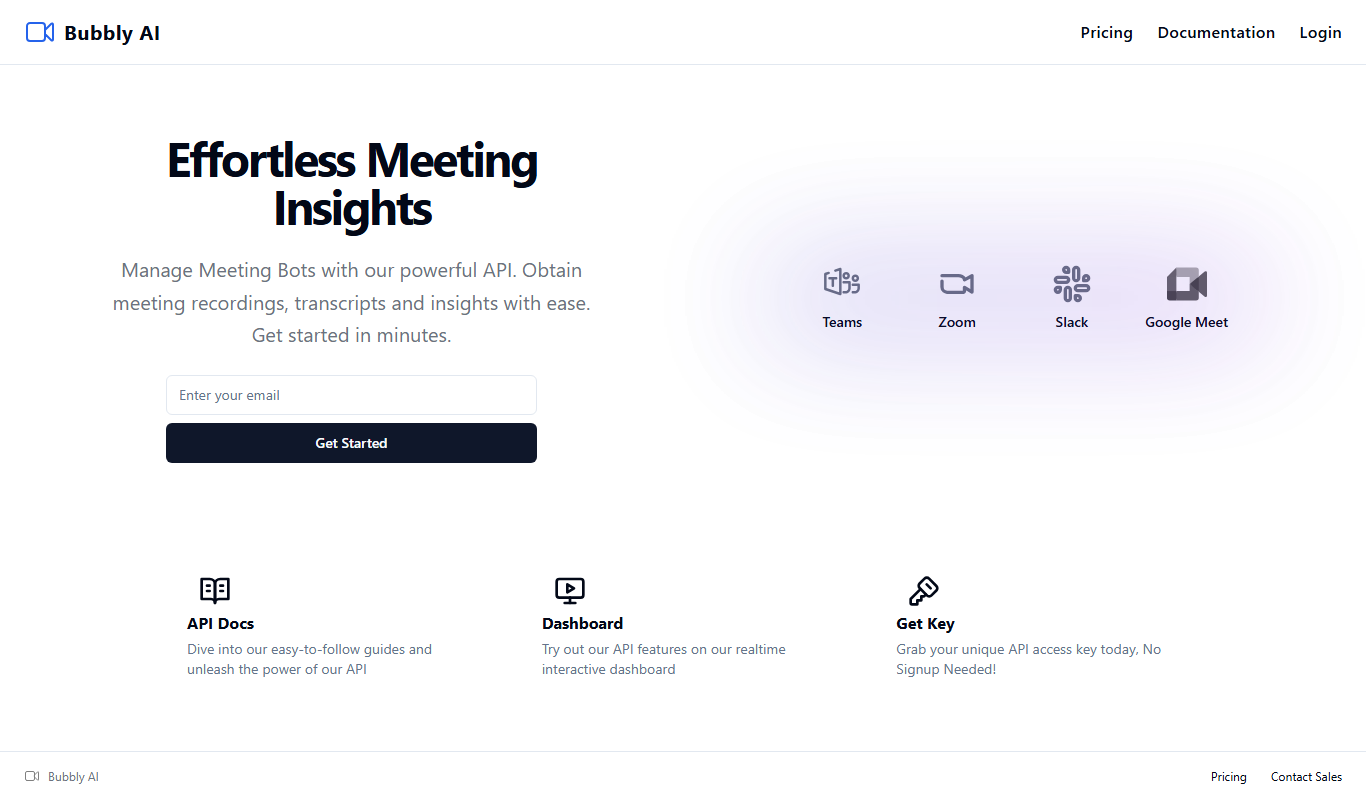
Bubbly Meeting Api
Bubbly Meeting API lets developers manage meeting bots through an API to obtain meeting recordings, transcripts and insights.

Ares
Ares is an AI-powered natural language processing API by Traversa AI that provides semantic search, entity recognition, sentiment analysis, and text classification through a RESTful API.

linkshieldapi.com
LinkShieldAPI is an API service that scans URLs in real time to detect malware, phishing, and other threats, helping developers secure links before users access them.

Kie.ai: Most Affordable & Reliable Veo 3 API
Kie.ai Veo 3 API is an affordable and reliable AI video analysis API designed for real-time sports and video content analytics, offering customizable event detection and multi-object tracking.

Tinq.ai – NLP API
Tinq.ai is a cloud-based NLP API platform providing sentiment analysis, entity recognition, intent detection, and text classification to help developers integrate advanced language understanding into applications.

RemoveBG.sh — Background Removal API
RemoveBG.sh is an API service that automates background removal from images, enabling easy integration into apps and workflows for fast, accurate results.

Linq API for RAG
Linq API for RAG is a scalable API platform that enables developers to build AI applications combining vector-based document retrieval with large language model generation, improving response relevance and accuracy.

SpeechFlow – Advanced Speech-to-Text API
SpeechFlow is a powerful speech-to-text API that provides real-time, accurate transcription with multi-language support and speaker diarization, ideal for developers and businesses needing voice-to-text solutions.