

From my experience with Alchemy, I found it excels at providing reliable and scalable blockchain node infrastructure that significantly reduces the complexity of building decentralized applications. The platform’s multi-chain support and enhanced APIs make it easier for developers to interact with blockchain networks like Ethereum and Polygon without managing nodes themselves. However, the pricing details for advanced plans are not fully transparent, which can be a consideration for startups budgeting their development costs. Overall, if you are developing Web3 applications or NFTs and need robust backend infrastructure, Alchemy delivers a solid, developer-friendly solution.
Alchemy Blockchain Developer Platform for Web3 APIs and Infrastructure
Alchemy is a blockchain developer platform providing APIs and scalable node infrastructure to build, monitor, and scale decentralized applications on Ethereum and other blockchains.
- Best for
- Blockchain Application Development
- Key capability
- Multi-Chain Support
Your actions
Save Alchemy, follow its updates and vote on it — everything stays in your account.
Sign in or create a free account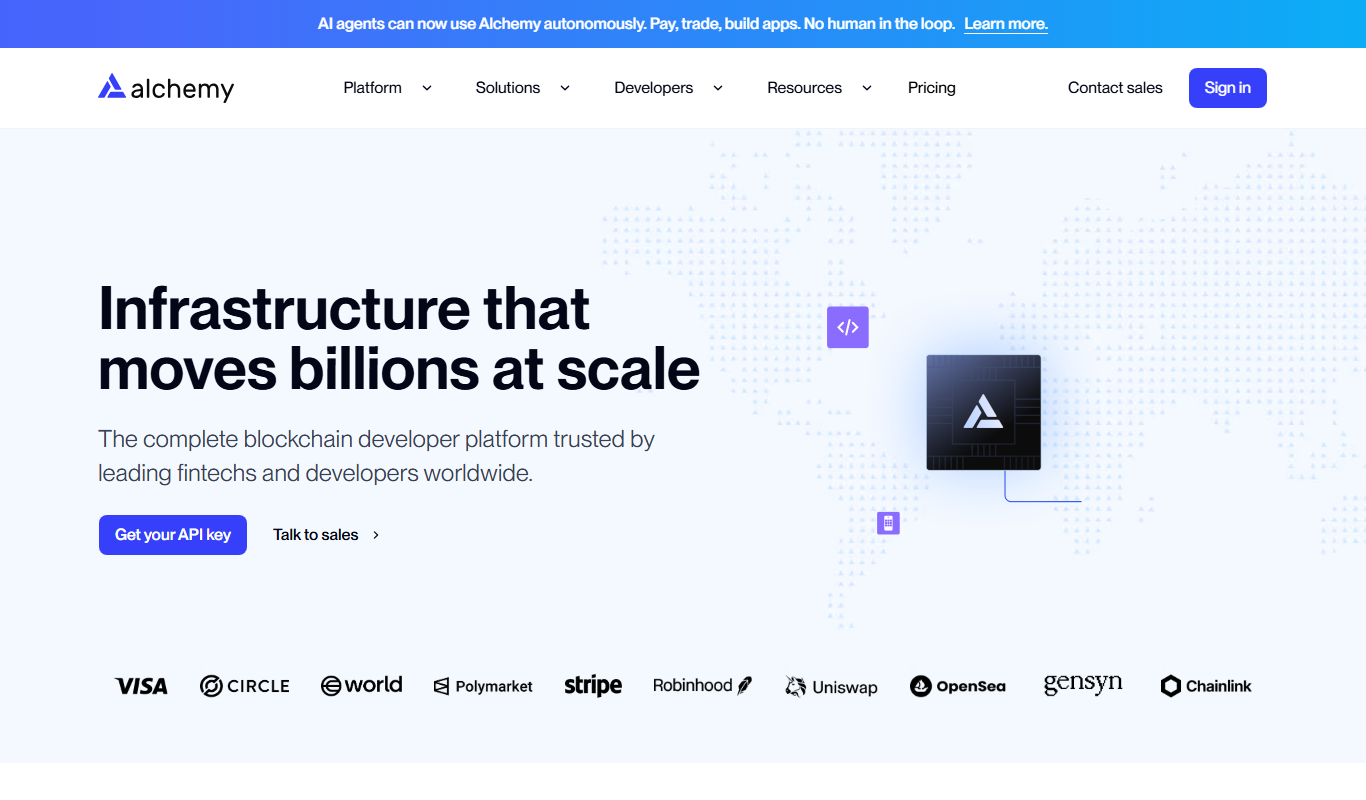
What is Alchemy?
Alchemy is a comprehensive blockchain developer platform that provides powerful APIs and node infrastructure to build, monitor, and scale decentralized applications (dApps) on multiple blockchain networks. It simplifies blockchain development by offering reliable access to blockchain data, real-time notifications, and enhanced developer tools.
Key features of Alchemy
Alchemy’s main features include scalable blockchain node infrastructure, enhanced APIs for interacting with smart contracts and transactions, real-time event monitoring, analytics dashboards, and developer tools designed to improve productivity and application reliability.
Multi-Chain Support
Supports Ethereum, Polygon, Optimism, Arbitrum, and other popular blockchain networks.
Enhanced APIs
Provides advanced APIs that simplify complex blockchain interactions and improve developer experience.
Scalable Node Infrastructure
Offers reliable and scalable blockchain node hosting to handle high throughput and reduce downtime.
Real-Time Event Notifications
Enables developers to receive instant updates on blockchain events and transactions.
Developer Dashboard
Includes tools for monitoring API usage, debugging, and managing applications.
Pros and cons of Alchemy
Pros
- Reliable and scalable blockchain node infrastructure
- Supports multiple popular blockchain networks
- Comprehensive developer tools and dashboards
- Real-time event monitoring and notifications
- Free tier available for easy onboarding
Cons
- Pricing for growth and enterprise plans is not publicly listed
- Primarily focused on EVM-compatible blockchains
Key use cases for Alchemy
Blockchain Application Development
Developers can build decentralized applications (dApps) using Alchemy’s APIs and infrastructure.
Node Infrastructure Management
Alchemy provides scalable and reliable blockchain node infrastructure to simplify backend operations.
Real-time Data and Analytics
Access real-time blockchain data and analytics to monitor transactions, blocks, and smart contract events.
NFT and DeFi Projects
Supports development and scaling of NFT marketplaces and decentralized finance applications.
Web3 API Integration
Integrate Web3 APIs easily into existing applications to interact with Ethereum, Polygon, Optimism, and other blockchains.
How Alchemy works
- 1
Sign Up
Create an account on Alchemy’s platform to access the developer dashboard.
- 2
Create an App
Set up a new blockchain application by selecting the desired network and configuration.
- 3
Use APIs
Integrate Alchemy’s Web3 APIs into your application code to interact with blockchain data and smart contracts.
- 4
Monitor and Scale
Use Alchemy’s analytics and monitoring tools to track application performance and scale infrastructure as needed.
Who is using Alchemy
Blockchain developers
Web3 startups
NFT marketplaces
DeFi projects
Enterprise blockchain teams
Alchemy pricing
Free
$0/month
Basic access with limited API calls and features suitable for development and testing.
Growth
Custom pricing
Higher API limits and additional features for growing projects and startups.
Enterprise
Custom pricing
Tailored solutions with dedicated support and SLA for large-scale applications.
Plans and prices are as published by the vendor and can change. Check the official site before you buy. Open the pricing page (opens in a new tab)
Frequently asked questions about Alchemy
Alchemy supports Ethereum, Polygon, Optimism, Arbitrum, and other major EVM-compatible blockchains.
Yes, Alchemy offers a free tier with limited API calls suitable for development and testing.
Yes, the platform includes dashboards and tools to monitor application performance and blockchain data.
Yes, Alchemy offers enterprise plans with custom features, dedicated support, and SLAs.
This tool is designed to help users accomplish its core tasks more efficiently. It is typically used by individuals or teams looking to improve productivity and workflow.
It depends on your specific needs and how you plan to use the tool. The official website and documentation are the best sources for the latest details.
Yes, it can help with that use case depending on how you configure it and what features are available. You’ll get the best results with clear inputs and a defined goal.
Pricing depends on the plan and included features. For the most accurate and up-to-date details, check the official pricing page.
Sign in to review this tool.
Sign In to ReviewNo reviews yet
Be the first to share how this tool worked for you.
Ask about pricing, limits, or how it compares — or answer someone else.
Sign In to AskNo questions yet
Have a question about using or paying for this tool? Be the first to ask.
Featured on TiorAI



More AI API tools
Other tools in the same category, for when this one is not quite the fit.

Free
n8n
n8n is a workflow automation platform that combines AI capabilities with business process automation, giving technical teams the flexibility of code with the speed of no-code, with self-hosted and cloud deployment.

Free
API Layer
API Layer is a platform that provides developers and businesses with easy access to a wide range of APIs for data validation, real-time information, and automation through a unified interface.

Enterprise
Kong
Kong is an open-source API gateway and microservices platform that enables organizations to manage, secure, and monitor APIs and microservices with cloud-native support and extensibility.

Free
MongoDB Atlas
MongoDB Atlas is a fully managed cloud database service that simplifies deploying, managing, and scaling MongoDB databases across multiple cloud providers with built-in security and global distribution.

Free
Apollo Auto
Apollo Auto is an open-source autonomous driving software platform providing a full software stack for self-driving vehicles, including perception, planning, control, and simulation tools.

Pay As You Go
Plivo
Plivo is a cloud communications platform for building voice AI agents with a no-code builder or APIs, alongside voice and SMS APIs and phone numbers for adding calls and messaging to applications.

Pay As You Go
Twilio
Twilio is a cloud communications platform providing APIs for SMS, voice, video, and authentication services to integrate programmable communication into applications.

Free
Appwrite
Appwrite is an open-source backend-as-a-service platform that provides developers with APIs and SDKs to manage authentication, databases, storage, and serverless functions, enabling faster app development without managing backend infrastructure.