

WebP to TGA
Convert WEBP images to TGA format quickly and free with our online converter. Upload your WEBP file and download the converted TGA image instantly – no software installation required, works on all devices.
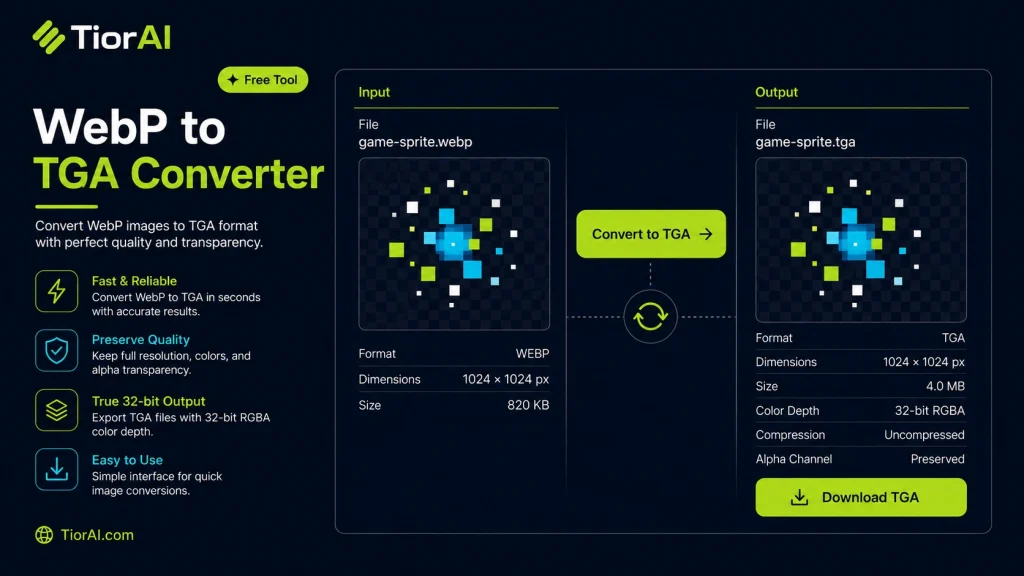
WEBP to TGA Converter
Your files never leave your browser.
Conversion settings
Uses balanced quality, original dimensions, preserved transparency, browser auto-orientation, high-quality resizing, and removes metadata.
Advanced Settings
Conversion results
How to use it
- Upload Your Image Upload or drag and drop your image into the Webp to Tga. Supports PNG, JPG, WebP, and other common formats.
- Process the Image Configure your desired settings and click process. The tool applies changes to your image in seconds.
- Download the Result Preview the processed image and download it in your preferred format, ready for use.
Tip The Webp to Tga preserves image quality while optimizing — your photos stay sharp even after processing.
Understanding WEBP and TGA Image Formats
WEBP is a modern image format developed by Google that provides superior compression for web images, supporting both lossy and lossless compression. It is widely used for web graphics because it reduces file size while maintaining quality, which helps pages load faster.
TGA (Targa) is an older raster graphics file format commonly used in professional graphics and video applications. It supports high color depths and alpha channels, making it suitable for detailed images and textures in game development and 3D rendering.
Converting from WEBP to TGA involves decoding the compressed WEBP image and re-encoding it into the TGA format. This conversion is necessary when working with software or workflows that require TGA files, such as game engines, 3D modeling tools, or legacy systems that do not support WEBP.
Common situations for this conversion include preparing textures for game assets, importing images into professional editing software that prefers TGA, or archiving images in a format that preserves quality without compression artifacts.
Because WEBP is optimized for web use and TGA is designed for high-quality image processing, converting between these formats bridges the gap between web-optimized images and professional graphics workflows.
What is WEBP to TGA Conversion?
WEBP is a modern image format optimized for web use, offering efficient compression and smaller file sizes. TGA, on the other hand, is a format favored in professional graphics and game development for its support of high color depth and alpha transparency. Converting WEBP images to TGA involves decoding the compressed WEBP and saving it in the TGA format, which is often uncompressed or lightly compressed.
When Should You Use WEBP to TGA Conversion?
- When you need to import web images into game engines or 3D software that require TGA textures.
- When working with professional editing tools that do not support WEBP but accept TGA files.
- When archiving images in a lossless format that preserves transparency for future editing.
- When dealing with legacy systems or workflows that only recognize TGA files.
Common Mistakes to Avoid
- Assuming the conversion will reduce file size; TGA files are typically larger due to minimal compression.
- Expecting all TGA viewers to correctly display transparency from WEBP alpha channels without verifying software support.
Understanding the differences between WEBP and TGA formats helps you choose the right format for your project and ensures smooth integration into your workflow.
Frequently asked questions
Reviews and questions
Whether this tool gave people the answer they needed, and what they asked about it.
Sign in to review this tool.
Sign In to ReviewNo reviews yet
Be the first to say whether this tool gave you what you needed.
Ask how to read the result, or what the tool does with an edge case — or answer someone else.
Sign In to AskNo questions yet
Not sure how to read a result? Be the first to ask.
AI tools related to this topic
Tools from the TiorAI directory that work on the same kind of job.

Any Video Converter
Any Video Converter is a multimedia software that converts video files between numerous formats, downloads online videos, and offers basic editing and DVD burning features.

Bank Statement Converter
Bank Statement Converter is an online tool that converts PDF bank statements into Excel and CSV formats, enabling easy data extraction and financial management.

Code Language Converter
Code Language Converter is a free web-based tool that translates code snippets between multiple programming languages, helping developers convert syntax quickly and learn language differences.

Conversion Blitz
Conversion Blitz is a web-based landing page builder that helps marketers create optimized pages with drag-and-drop tools and A/B testing to increase conversions.