

Reverse List
List reversal is a fundamental operation in data manipulation where the order of elements in a list is inverted. This means the first element becomes the last, the second becomes the second last, and so forth. Lists are ordered collections of items, and reversing them…
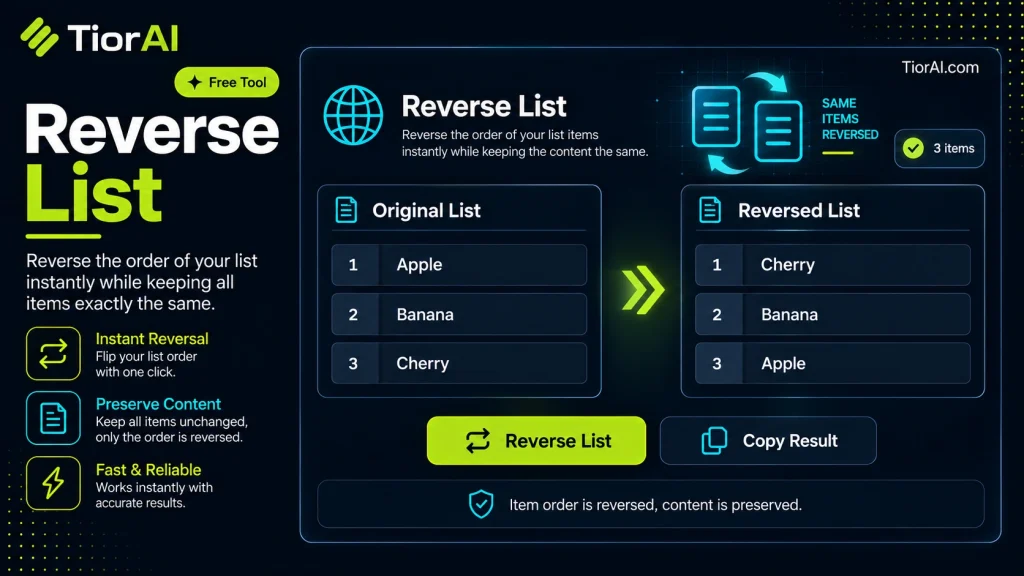
How to use it
- Paste Your Text Paste or type your text into the Reverse List. The tool handles content of any length with no character limits.
- Apply the Tool Click the action button to process your text. The transformation is applied instantly to your content.
- Copy the Result Review the transformed text and copy it to your clipboard for use in documents, emails, or projects.
Tip The Reverse List is perfect for content creators who need quick text transformations without installing software.
Understanding Lists and Their Reversal
A list is a fundamental data structure used in programming and everyday computing to organize multiple items sequentially. Lists can contain elements such as numbers, words, or complex objects, arranged in a specific order. The order of elements in a list is crucial because it defines how the data is accessed, processed, or displayed.
The concept of reversing a list involves changing the order of its elements so that the first element becomes the last, the second becomes the second last, and so on. This operation is simple in theory but has practical significance in many computing and data manipulation scenarios.
Why Reverse a List?
- Data processing: Sometimes algorithms require processing data in the opposite order, such as undoing operations or traversing data backward.
- User interface: Displaying items in reverse chronological order, like recent messages or logs.
- Algorithm design: Certain algorithms, like those in sorting or searching, may use reversed lists as intermediate steps.
How List Reversal Works Technically
Technically, reversing a list means creating a new sequence where the element at index i in the original list moves to index n - 1 - i in the reversed list, where n is the total number of elements. This can be done in-place (modifying the original list) or by creating a new list.
For example, consider the list [A, B, C, D]. Its reversed form is [D, C, B, A]. The reversal algorithm swaps elements from the start and end moving towards the center:
- Swap element 0 and element 3
- Swap element 1 and element 2
This process continues until the middle of the list is reached.
Common Real-World Scenarios
- Text processing: Reversing lines or words in a paragraph to analyze or display content differently.
- Data analysis: Working with time series data where reversing the order can help in comparing trends backward.
- Programming: Debugging or testing by reversing input sequences.
- Web development: Displaying user comments or posts in reverse order to show the latest first.
Understanding the concept of list reversal is essential for developers, data analysts, and anyone working with ordered data sequences.
What is List Reversal?
List reversal is a fundamental operation in data manipulation where the order of elements in a list is inverted. This means the first element becomes the last, the second becomes the second last, and so forth. Lists are ordered collections of items, and reversing them changes the sequence without altering the individual elements.
How Does List Reversal Work?
Technically, reversing a list involves swapping elements from the start and end moving towards the center. For example, in a list of five elements, the first and fifth elements swap places, then the second and fourth, leaving the middle element unchanged. This can be done in-place or by creating a new list with the reversed order.
When to Use a Reverse List Tool
- Displaying recent items first: For example, showing the latest messages or posts at the top of a list.
- Data analysis: When you need to analyze or process data backward, such as reversing time series data.
- Algorithm requirements: Some algorithms require input data in reverse order for correct processing.
- Undo operations: Reversing a list of actions to undo them in the correct sequence.
Common Mistakes When Using Reverse List Tools
- Misunderstanding the operation: Expecting the tool to sort the list rather than just reverse the order.
- Handling nested lists incorrectly: Trying to reverse complex nested lists without flattening them first can lead to unexpected results.
- Ignoring element relationships: Reversing lists where element order is tied to other data can cause logical errors if not handled carefully.
Technical Context
Reversing a list is a simple yet powerful operation used across programming languages and tools. It is often implemented as a built-in function or method, such as reverse() in Python or JavaScript. Understanding how reversal works helps in debugging, data processing, and designing algorithms that depend on order manipulation.
In web tools, reversing a list typically involves parsing the input string into elements, reversing the sequence, and outputting the result in the same format. This process must handle different delimiters and data types gracefully to be effective.
Worked examples
Reversing a list of names
Displaying a list of participants in reverse order for a leaderboard
Before Alice, Bob, Charlie, DianaAfter Diana, Charlie, Bob, AliceReversing a list of numbers
Processing numerical data backward for a calculation
Before 1, 2, 3, 4, 5After 5, 4, 3, 2, 1Reversing a mixed content list
Reordering a list containing different data types for display
Before apple, 42, true, bananaAfter banana, true, 42, apple
Frequently asked questions
Reviews and questions
Whether this tool gave people the answer they needed, and what they asked about it.
Sign in to review this tool.
Sign In to ReviewNo reviews yet
Be the first to say whether this tool gave you what you needed.
Ask how to read the result, or what the tool does with an edge case — or answer someone else.
Sign In to AskNo questions yet
Not sure how to read a result? Be the first to ask.