

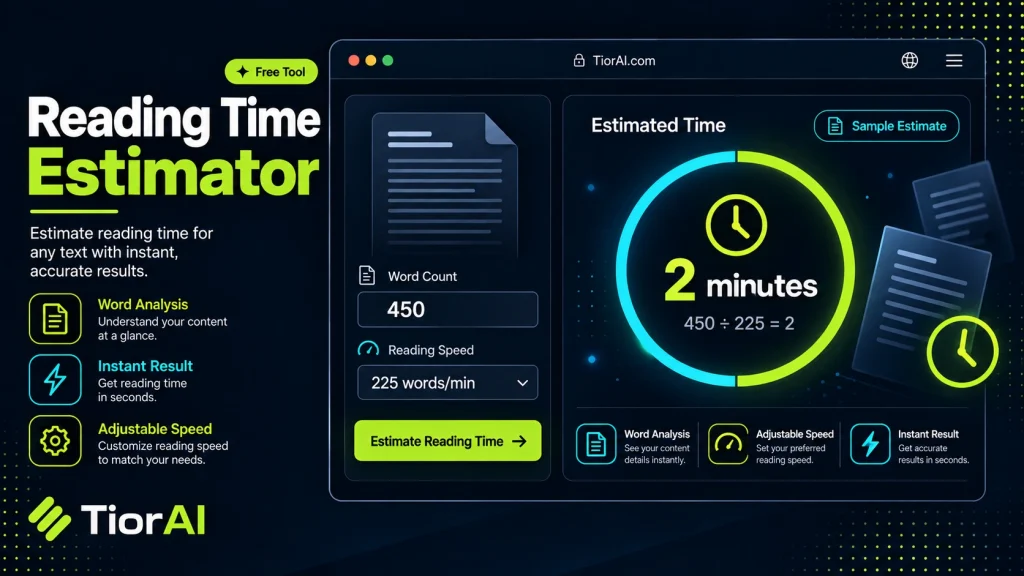
| Word Count | 0 |
|---|---|
| Character Count | 0 |
| Reading Speed | 200 WPM |
| Estimated Reading Time | 0m 0s |
How to use it
- Paste Your Text Paste or type your text into the Reading Time Estimator. The tool handles content of any length with no character limits.
- Apply the Tool Click the action button to process your text. The transformation is applied instantly to your content.
- Copy the Result Review the transformed text and copy it to your clipboard for use in documents, emails, or projects.
Tip Combine the Reading Time Estimator with other text tools on TiorAI for a complete content processing workflow.
Understanding Reading Time Estimation
Reading time estimation is a method used to approximate how long it will take an average reader to read a given text. This concept exists because readers and content creators alike benefit from knowing the time commitment required to consume written material. For example, blog readers often prefer to know if an article will take 2 minutes or 20 minutes to read before deciding to engage with it.
Technically, reading time is calculated by dividing the total word count of the text by an average reading speed, which is typically expressed in words per minute (wpm). The average adult reading speed is generally considered to be between 200 and 250 words per minute for non-technical content. This average varies depending on factors such as language complexity, reader familiarity with the topic, and reading purpose (skimming vs. deep reading).
To perform the calculation, the process is:
- Count the words: The text is parsed to count all words, ignoring formatting tags or non-text elements.
- Divide by average speed: The total word count is divided by the chosen average reading speed (e.g., 200 wpm).
- Format the result: The quotient is rounded to a suitable unit, often minutes, sometimes including seconds for precision.
For example, a 600-word article divided by 200 wpm results in an estimated reading time of 3 minutes.
Reading time estimators are commonly used in digital publishing platforms, blogs, eBooks, and educational materials. They help set reader expectations, improve user experience, and assist content creators in structuring their work. Additionally, some platforms use reading time to optimize content delivery or recommend articles based on user preferences.
In more advanced implementations, reading time estimators may adjust for factors like text difficulty, presence of images or multimedia, or user-specific reading speeds. However, the core principle remains a simple ratio of word count to reading speed.
What is Reading Time Estimation?
Reading time estimation is a technique used to approximate how long it will take an average person to read a piece of text. It is based on the principle that people read at a relatively consistent speed, usually measured in words per minute (wpm). By knowing the total number of words in a text and dividing by this average speed, we can estimate the time required to read it.
This concept is important because it helps readers decide whether they have enough time to engage with content and helps content creators design their material to fit typical reading sessions.
How Does Reading Time Estimation Work?
The process begins with counting the total words in the text. This count excludes formatting tags, images, and other non-text elements. Then, the total word count is divided by an average reading speed. For most general content, this speed is around 200 words per minute, but it can vary depending on the audience and text complexity.
The result is rounded to the nearest minute or fraction thereof to provide a user-friendly estimate. For example, a 900-word article divided by 200 wpm results in a 4.5-minute reading time, often rounded to 5 minutes.
When to Use a Reading Time Estimator
- When publishing blog posts or articles to inform readers about the time commitment.
- In educational settings to help students plan their reading and study time.
- For newsletters and emails to set expectations about message length.
- When creating summaries or abstracts to indicate how long a quick read will take.
Common Mistakes to Avoid
- Assuming a single fixed reading speed applies to all readers and all types of content. Reading speeds vary widely based on individual skills and text difficulty.
- Including non-text elements such as code snippets, captions, or embedded media in the word count, which can distort the estimated reading time.
Technical Context
Reading time estimation is a simple yet effective application of text analysis. It relies on accurate word counting algorithms that parse the text and exclude markup or non-readable elements. Some advanced tools may also adjust estimates based on text complexity metrics or user-specific reading speeds.
Overall, reading time estimation is a practical utility that enhances content consumption by providing clear expectations and helping manage time effectively.
Worked examples
Estimating reading time for a blog post
Used by bloggers to display reading time at the top of posts.
Before A 1200-word article about web development trends.After Estimated reading time: 6 minutes (assuming 200 wpm).Calculating reading time for an email newsletter
Helps recipients decide when to read the newsletter.
Before An email containing approximately 400 words of content.After Estimated reading time: 2 minutes.
Frequently asked questions
Reviews and questions
Whether this tool gave people the answer they needed, and what they asked about it.
Sign in to review this tool.
Sign In to ReviewNo reviews yet
Be the first to say whether this tool gave you what you needed.
Ask how to read the result, or what the tool does with an edge case — or answer someone else.
Sign In to AskNo questions yet
Not sure how to read a result? Be the first to ask.
AI tools related to this topic
Tools from the TiorAI directory that work on the same kind of job.

AI Psychic Reading by Tarotoo
AI Psychic Reading by Tarotoo provides free, instant tarot card readings generated by artificial intelligence to offer personal insights and guidance.

Height Estimator
Height Estimator is a free online tool that predicts an individual's adult height using current age, gender, and height data based on scientific formulas.