

Probability Calculator
Compute basic probability, complement, and combined event probabilities.
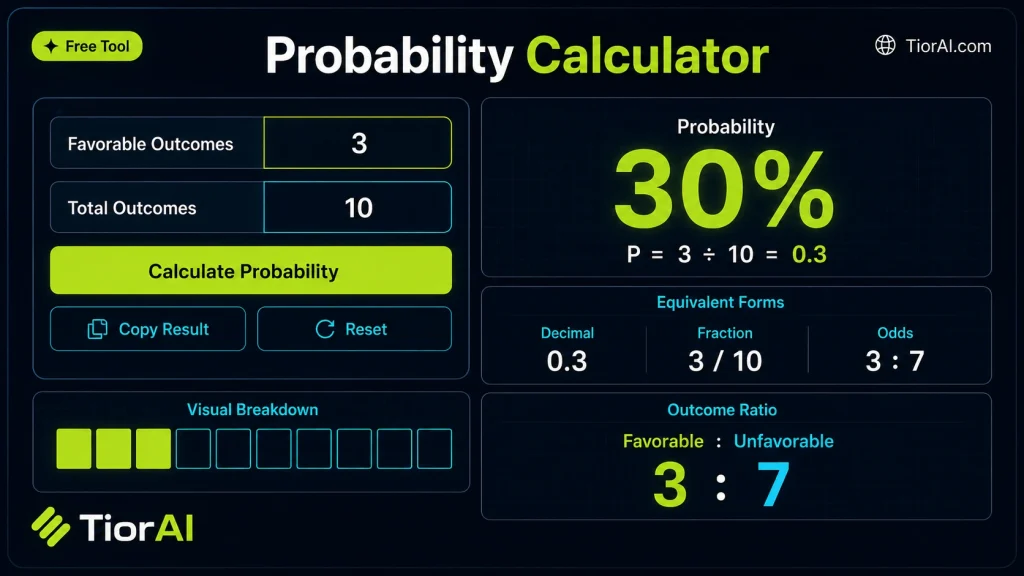
| Calculating | P(A) |
|---|---|
| Probability | 0 |
| As Percentage | 0% |
| As Fraction | - |
| Odds (for : against) | - |
| Complement | - |
| Formula | - |
How to use it
- Enter Your Values Input your numbers or parameters into the Probability Calculator. Fill in all required fields for an accurate calculation.
- Calculate Results Click the calculate button to process your inputs. The Probability Calculator delivers instant, accurate results.
- Review and Use Review your calculated results, explore the breakdown, and copy or share the output for your needs.
Tip Bookmark the Probability Calculator page for quick access whenever you need to run calculations on the go.
Understanding Probability Calculations
Probability is a branch of mathematics that measures the likelihood of an event occurring. It is expressed as a number between 0 and 1, where 0 means the event cannot happen and 1 means it is certain. Calculating probability involves analyzing all possible outcomes and determining how many of those outcomes satisfy the event in question.
Why calculate probability? Probability calculations help in decision-making under uncertainty. They are used in fields like statistics, finance, insurance, gaming, and everyday situations such as predicting weather or assessing risks.
Common scenarios for probability calculations include:
- Determining the chance of drawing a specific card from a deck.
- Estimating the likelihood of winning a game or contest.
- Calculating risk factors in health or finance.
- Analyzing outcomes in experiments or surveys.
Probability calculators automate these computations by taking input values such as the number of favorable outcomes and total possible outcomes, then outputting the probability. They can also handle more complex cases involving multiple events, conditional probabilities, or combinations and permutations.
What is Probability and Why Calculate It?
Probability measures how likely an event is to happen, expressed as a number between 0 and 1. Calculating probability helps us make informed decisions in uncertain situations, from simple games to complex risk assessments.
When to Use a Probability Calculator
- To quickly find the chance of a single event occurring based on known outcomes.
- To analyze combined probabilities involving multiple events.
- To assess risks in everyday decisions like weather predictions or financial planning.
- To verify manual calculations and avoid errors.
Common Mistakes to Avoid
- Mixing up independent and dependent events and applying incorrect formulas.
- Entering wrong values for total or favorable outcomes, which leads to invalid results.
- Assuming probabilities always sum to 1 without considering event exclusivity.
Understanding these concepts ensures you use probability calculators effectively and interpret their results correctly.
Frequently asked questions
Reviews and questions
Whether this tool gave people the answer they needed, and what they asked about it.
Sign in to review this tool.
Sign In to ReviewNo reviews yet
Be the first to say whether this tool gave you what you needed.
Ask how to read the result, or what the tool does with an edge case — or answer someone else.
Sign In to AskNo questions yet
Not sure how to read a result? Be the first to ask.