

Fraction to Decimal Converter
Convert a fraction or mixed number to decimal and detect repeating decimals.
Decimal Result: 0
Repeating Decimal: No
How to use it
- Enter Source Value Type or paste the value you want to convert into the Fraction to Decimal Converter. The tool accepts a wide range of input formats.
- Select Target Format Choose your desired output format or unit from the available options. The conversion starts automatically.
- Copy the Result Review the converted output and click copy to use it in your project, document, or workflow.
Tip Chain the Fraction to Decimal Converter with other conversion tools on TiorAI to handle multi-step format transformations.
Understanding Fraction to Decimal Conversion
Fractions and decimals are two common ways to represent numbers that are not whole. A fraction expresses a part of a whole as numerator/denominator, while a decimal expresses the same value in base-10 notation. Converting fractions to decimals involves dividing the numerator by the denominator to get a decimal number.
This conversion is essential because decimals are often easier to use in calculations, measurements, and digital systems. For example, decimals are standard in financial calculations, scientific measurements, and computer programming, where precise numeric values are required.
Why convert fractions to decimals?
- Decimals simplify arithmetic operations like addition, subtraction, multiplication, and division.
- Many calculators and software tools work primarily with decimals.
- Decimals are easier to compare and sort than fractions.
There are two main types of decimal results from fractions: terminating decimals, which end after a finite number of digits, and repeating decimals, which have one or more digits repeating infinitely. For example, 1/4 = 0.25 (terminating), while 1/3 = 0.333… (repeating).
What is Fraction to Decimal Conversion?
Fraction to decimal conversion is the process of expressing a fraction as a decimal number by dividing its numerator by its denominator. This conversion is fundamental in mathematics and practical applications because decimals are easier to use in many calculations and digital systems.
Decimals provide a base-10 representation that aligns with most calculators and computer systems, making arithmetic operations and comparisons more straightforward. For example, converting 3/4 to 0.75 allows you to quickly add or compare it with other decimal numbers.
When to Use a Fraction to Decimal Converter
- When performing calculations that require decimal inputs, such as in finance or engineering.
- When entering numbers into software or calculators that do not accept fractions.
- When comparing fractions quickly without finding a common denominator.
- When converting measurements from fractional units to decimal units for precision.
Common Mistakes to Avoid
- Swapping the numerator and denominator, which leads to incorrect decimal values.
- Expecting all fractions to convert into terminating decimals; some result in repeating decimals.
- Not simplifying fractions before conversion, which can produce unnecessarily long decimal expansions.
Understanding these basics helps you use fraction to decimal converters effectively and interpret their results correctly in real-world scenarios.
Frequently asked questions
Reviews and questions
Whether this tool gave people the answer they needed, and what they asked about it.
Sign in to review this tool.
No reviews yet
Be the first to say whether this tool gave you what you needed.
Ask how to read the result, or what the tool does with an edge case — or answer someone else.
No questions yet
Not sure how to read a result? Be the first to ask.
AI tools related to this topic
Tools from the TiorAI directory that work on the same kind of job.

Math.now: Free Math AI Solver powered by math GPT
Math.now is a free web-based AI math solver that uses GPT technology to provide instant, detailed solutions and explanations for a wide range of math problems.

AI Math Solver Powered by Math GPT Free Online
AI Math Solver Powered by Math GPT is a free online tool that instantly solves math problems across various topics with detailed step-by-step explanations, accessible via web browser without registration.
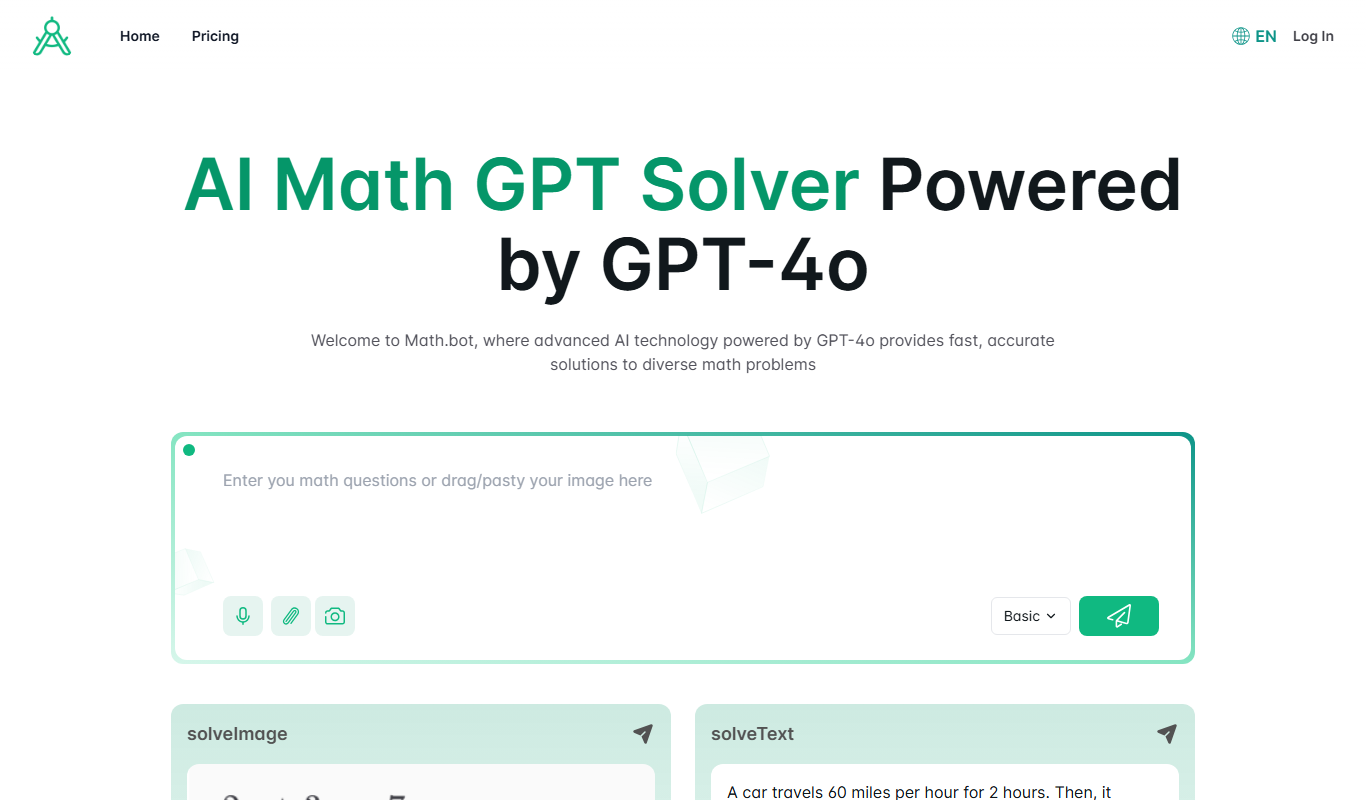
Math.bot: AI Math Solver by GPT-4o
Math.bot is an AI-powered math solver using GPT-4o that provides detailed step-by-step solutions to a wide range of math problems via a web interface.


Any Video Converter
Any Video Converter is a multimedia software that converts video files between numerous formats, downloads online videos, and offers basic editing and DVD burning features.