

Bubble Text Generator
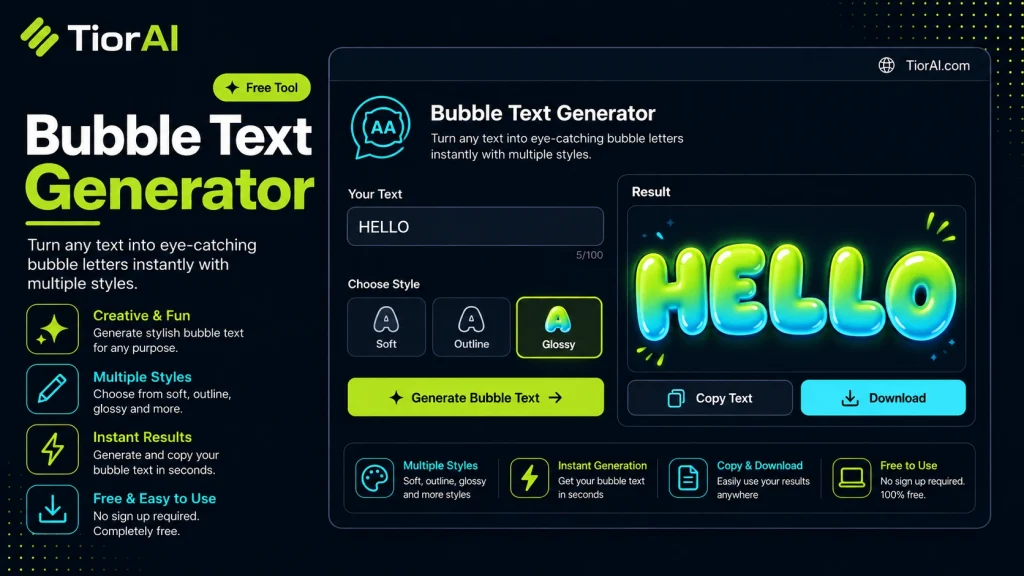
Bubble text is a unique way of displaying characters where each letter or number appears inside a rounded shape, resembling a bubble. This effect is achieved by substituting standard characters with special Unicode symbols designed to look like enclosed letters or digits. Unlike font styles…
How to use it
- Paste Your Text Paste or type your text into the Bubble Text Generator. The tool handles content of any length with no character limits.
- Apply the Tool Click the action button to process your text. The transformation is applied instantly to your content.
- Copy the Result Review the transformed text and copy it to your clipboard for use in documents, emails, or projects.
Tip Process entire documents through the Bubble Text Generator — it handles large text blocks without truncation.
Understanding Bubble Text: Concept and Technical Background
Bubble text refers to a stylized form of text where each character appears enclosed within a rounded or “bubble-like” shape. This effect is achieved by replacing standard alphanumeric characters with special Unicode characters that resemble letters inside circles or ovals. Unlike typical font styling, bubble text is not a font but a set of Unicode characters from various blocks such as “Enclosed Alphanumerics” and “Enclosed Alphanumeric Supplement.” These Unicode blocks contain characters designed to look like letters and numbers inside circles or other shapes.
The reason bubble text exists is to provide a visually distinctive way to display text without relying on images or custom fonts. Because these characters are part of the Unicode standard, they can be rendered by any system that supports Unicode, making them widely compatible across platforms, browsers, and devices.
Technically, bubble text works by mapping each standard character (like ‘A’, ‘B’, ‘1’, ‘2’) to its corresponding Unicode bubble character. For example, the letter ‘A’ can be replaced with ‘Ⓐ’ (Unicode U+24B6), which is a capital letter A enclosed in a circle. When a user inputs normal text into a bubble text generator, the tool converts each character to its bubble equivalent by referencing these Unicode code points.
Because these characters are part of Unicode, they can be copied, pasted, and searched like normal text, unlike images or styled fonts. This makes bubble text useful for social media posts, usernames, or decorative text in messaging apps where font customization is limited.
Common Real-World Scenarios
- Social media and messaging: Users want to make their posts or usernames stand out by using bubble text for emphasis or decoration.
- Graphic design: Designers use bubble text as a quick way to add playful or informal text elements without creating custom graphics.
- Accessibility and compatibility: Since bubble text uses Unicode, it can be read by screen readers and is searchable, unlike images or stylized fonts embedded in graphics.
- Text-based games and chat apps: Bubble text adds personality and style where rich text formatting is unavailable.
In summary, bubble text leverages Unicode’s extensive character set to provide a visually unique text style that is widely compatible and easy to use across digital platforms.
What is Bubble Text?
Bubble text is a unique way of displaying characters where each letter or number appears inside a rounded shape, resembling a bubble. This effect is achieved by substituting standard characters with special Unicode symbols designed to look like enclosed letters or digits. Unlike font styles that rely on typeface changes, bubble text uses distinct Unicode characters, making it widely compatible across different platforms and devices.
These special characters come from Unicode blocks such as “Enclosed Alphanumerics” and “Enclosed Alphanumeric Supplement.” Each character in these blocks represents a letter or number inside a circle or oval shape. For example, the letter ‘A’ can be replaced with ‘Ⓐ’ (Unicode U+24B6), which is a capital A inside a circle.
How Does Bubble Text Work Technically?
At its core, bubble text is a character substitution process. When you input normal text, a bubble text generator maps each character to its corresponding Unicode bubble character. This mapping relies on the Unicode standard, which assigns unique code points to each enclosed character.
Because these are actual Unicode characters, they can be copied, pasted, and searched like regular text. This differs from using images or custom fonts, which may not be selectable or searchable. The use of Unicode also ensures that bubble text can be displayed on any system that supports these characters, including most modern browsers, operating systems, and mobile devices.
When to Use Bubble Text
- Social Media Decoration: Use bubble text to make usernames, posts, or comments stand out on platforms like Instagram, Twitter, or TikTok.
- Messaging Apps: Add personality to messages in apps that support Unicode but lack rich text formatting options.
- Graphic Design: Quickly create playful or informal text elements without needing custom fonts or images.
- Accessibility and Searchability: When you want decorative text that remains accessible to screen readers and searchable in documents or web pages.
- Text-based Games or Forums: Enhance text appearance in environments where styling options are limited.
Common Mistakes When Using Bubble Text
- Confusing Bubble Text with Font Styling: Some users expect bubble text to behave like a font style, but it is actually a set of Unicode characters. This can cause issues when copying or pasting if the receiving platform does not support these characters.
- Using Bubble Text in Unsupported Environments: Not all platforms fully support the Unicode characters used for bubble text, which can lead to missing or incorrect symbols.
- Mixing Bubble Text with Other Styles Without Understanding Differences: Bubble text is often mistaken for circle text or other enclosed text styles, but each uses different Unicode blocks and has distinct appearances.
Technical Context and Compatibility
Bubble text relies on Unicode, a universal character encoding standard that assigns unique codes to characters from virtually all writing systems and symbol sets. The enclosed alphanumeric characters used for bubble text are part of this standard, ensuring broad compatibility.
However, support for these characters depends on the fonts installed on a device. Most modern operating systems and browsers include fonts that cover these Unicode blocks, but some older systems or specialized software may not render them correctly. In such cases, bubble text may appear as empty boxes or fallback characters.
Because bubble text is composed of actual text characters, it can be indexed by search engines, copied and pasted, and read by assistive technologies. This makes it a practical choice for decorative text that needs to remain functional and accessible.
Worked examples
Decorating a Social Media Username
Used to make a username stand out on platforms like Instagram or Twitter.
Before CoolUser123After Ⓒⓞⓞⓛⓤⓢⓔⓡ①②③Stylizing a Chat Message
Adding playful style to messages in apps that support Unicode but not rich text.
Before Hello World!After Ⓗⓔⓛⓛⓞ Ⓦⓞⓡⓛⓓ!
Frequently asked questions
Reviews and questions
Whether this tool gave people the answer they needed, and what they asked about it.
Sign in to review this tool.
Sign In to ReviewNo reviews yet
Be the first to say whether this tool gave you what you needed.
Ask how to read the result, or what the tool does with an edge case — or answer someone else.
Sign In to AskNo questions yet
Not sure how to read a result? Be the first to ask.
AI tools related to this topic
Tools from the TiorAI directory that work on the same kind of job.

Atomic Fusion: AI Copy for Bubble Pages
Atomic Fusion is an AI copywriting tool that generates tailored, conversion-optimized text specifically for Bubble.io pages, helping no-code developers create effective landing page content quickly.

Bubble
Bubble is a no-code platform that enables users to create complex web applications visually without writing code, using drag-and-drop design, workflows, and database management.