

Stardog Knowledge Graph Platform for Enterprise Data Integration and AI
Stardog is an enterprise knowledge graph platform that integrates diverse data sources into a semantic graph database, enabling advanced querying, reasoning, and AI integration.
- Best for
- Enterprise Data Integration
- Key capability
- Semantic Graph Database
Save Stardog, follow its updates and vote on it — everything stays in your account.
Sign in or create a free account
What is Stardog?
Stardog is an enterprise knowledge graph platform that enables organizations to unify, query, and manage diverse data sources through a semantic graph database. It supports ontology modeling, reasoning, and integrates with AI and machine learning workflows to provide a connected data layer for better insights and decision-making.
Key features of Stardog
Stardog offers features such as semantic data unification, ontology management, SPARQL and GraphQL querying, reasoning engines, data virtualization, and integration APIs to build and operate enterprise knowledge graphs efficiently.
Semantic Graph Database
A scalable RDF-based graph database that supports complex relationships and metadata.
Ontology Management
Tools to create, edit, and manage ontologies using OWL standards.
Reasoning Engine
Built-in inference capabilities to derive implicit knowledge from data.
Data Virtualization
Query across multiple data sources without moving data physically.
SPARQL and GraphQL Support
Flexible querying options for semantic and graph data.
Enterprise Security and Governance
Role-based access control, auditing, and compliance features.
Pros and cons of Stardog
Pros
- Robust semantic graph database with reasoning capabilities
- Flexible integration with diverse data sources
- Supports industry standards like RDF, OWL, SPARQL
- Strong enterprise security and governance features
Cons
- Pricing is custom and can be expensive for small teams
- Steep learning curve for users new to semantic technologies
- Primarily focused on enterprise use cases, less suited for casual users
Key use cases for Stardog
Enterprise Data Integration
Unify disparate data sources into a single semantic graph to enable comprehensive data analysis and insights.
Knowledge Graph Creation and Management
Build and maintain enterprise knowledge graphs with ontology management and reasoning capabilities.
AI and Machine Learning Support
Enhance AI applications by providing a rich semantic layer and connected data for improved machine learning models.
Data Governance and Compliance
Implement data governance policies and ensure compliance by managing metadata and data lineage within the graph.
Semantic Search and Discovery
Enable advanced search capabilities across enterprise data using semantic queries and reasoning.
How Stardog works
- 1
Connect Data Sources
Integrate various structured and unstructured data sources into Stardog’s semantic graph.
- 2
Model Ontologies
Define and manage ontologies to represent domain knowledge and relationships.
- 3
Query and Reason
Use SPARQL or GraphQL queries with reasoning to extract insights and infer new knowledge.
- 4
Integrate with AI
Leverage the knowledge graph to enhance AI and machine learning models with connected data.
Who is using Stardog
Stardog pricing
Stardog Free
Free
Free license that renews annually.
Enterprise Subscription
Custom pricing
Tailored plans with advanced features, support, and scalability.
Plans and prices are as published by the vendor and can change. Check the official site before you buy. Open the pricing page (opens in a new tab)
Frequently asked questions about Stardog
Stardog is used to create and manage enterprise knowledge graphs that unify data from multiple sources for better insights and AI integration.
Yes, Stardog can be deployed on-premises, in private clouds, or public cloud environments.
Stardog supports SPARQL and GraphQL for querying semantic and graph data.
Yes. Stardog Free is available at no cost and allows commercial use with limits.
Yes, it can help with that use case depending on how you configure it and what features are available. You’ll get the best results with clear inputs and a defined goal.
It depends on your specific needs and how you plan to use the tool. The official website and documentation are the best sources for the latest details.
Conclusion
Structured and unstructured data sources are integrated into a semantic graph, and ontologies built on OWL standards represent domain knowledge and relationships. Queries use SPARQL or GraphQL, with built-in reasoning that infers new knowledge from the data. Data virtualization lets queries run across multiple data sources without physically moving the data. Deployment can be on-premises, in private clouds or in public cloud environments.
It is aimed at enterprise data architects, AI and machine learning teams and data governance professionals. Stardog Free is a free license that renews annually and allows commercial use with limits. Enterprise subscriptions are tailored plans with custom pricing, support and scalability.
Sources
Sign in to review this tool.
Sign In to ReviewNo reviews yet
Be the first to share how this tool worked for you.
Ask about pricing, limits, or how it compares — or answer someone else.
Sign In to AskNo questions yet
Have a question about using or paying for this tool? Be the first to ask.
Featured on TiorAI



Alternative Tools
Explore similar AI tools that might fit your needs
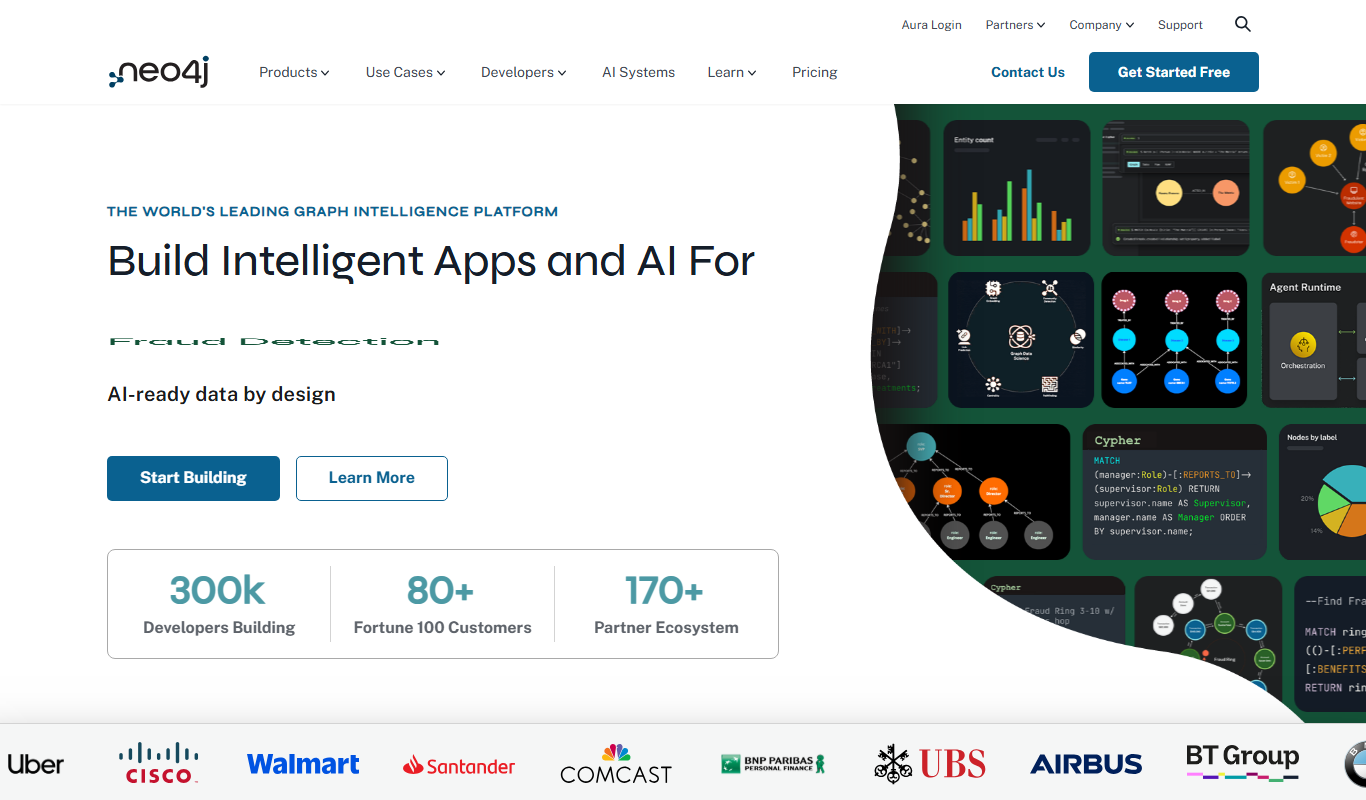
Neo4j
Neo4j is a native graph database platform that enables efficient storage, querying, and analysis of highly connected data using the Cypher query language and built-in graph algorithms.
More AI Developer Tools tools
Other tools in the same category, for when this one is not quite the fit.

BaseRock
BaseRock AI delivers agentic QA for dev teams, automating functional testing and business use case testing to catch regressions before production.

Webo.AI
Webo.AI is an AI-powered test automation platform that creates, executes and maintains software tests with generative AI and self-healing scripts.

Langtail
Langtail is a prompt management platform that helps product teams build, test and deploy AI prompts collaboratively, from ideation to production.

BuilderKit
BuilderKit is a production-ready Next.js boilerplate with pre-built AI apps and modules, Supabase, Stripe and authentication for developers who want to ship an AI SaaS fast.

Dollie
Dollie is an agency HQ for AI that connects clients, sites and processes to the AI tools a team already uses, with agents for WordPress site operations.

Ares
Ares by Traversaal.ai is a real-time AI answer engine API that returns detailed answers plus the source URLs used to generate them.
Youdao AI Open Platform
Youdao AI Open Platform from NetEase Youdao provides translation, OCR, speech and education AI APIs and industry solutions for developers, enterprises and government organizations.

BotGauge
BotGauge is an AI agent red-teaming platform to test, evaluate, monitor and govern AI agents, and an autonomous QA service for software testing.