
From my experience exploring Ant_racer, it stands out as a robust open source platform for autonomous racing simulation, especially valuable for researchers and developers working with ROS and reinforcement learning. The integration with Gazebo provides realistic physics, which is crucial for testing high-speed vehicle control algorithms. While setting up the environment requires some technical skill and familiarity with Linux and ROS, the flexibility and extensibility of Ant_racer make it a strong choice for academic and experimental projects. However, beginners might find the documentation sparse, and it lacks native support for Windows or macOS.
Ant_racer Open Source AI Tool for Autonomous Racing Simulation
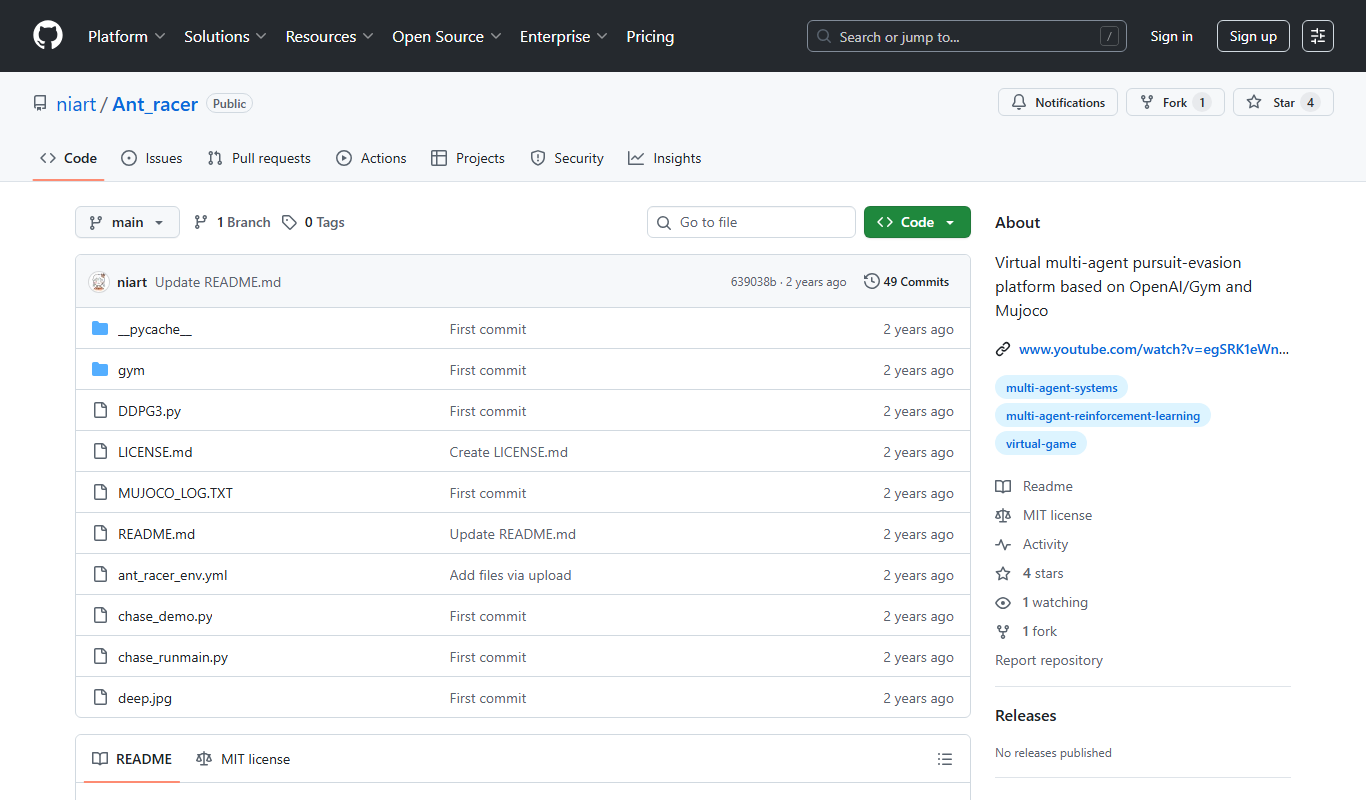
Ant_racer is an open source autonomous racing simulation tool designed for AI research, integrating ROS and Gazebo to enable realistic vehicle dynamics and reinforcement learning development.
Tech Stack:
Gazebo Simulator
Python
ROS (Robot Operating System)
What is Ant_racer?
Ant_racer is an open source autonomous racing simulation platform designed to facilitate research and development in high-speed autonomous vehicle control. It integrates with the Robot Operating System (ROS) and uses Gazebo for realistic physics simulation, enabling users to test AI algorithms in a virtual racing environment.
Key Features of Ant_racer
Realistic Vehicle Dynamics
Simulates accurate physics for high-speed autonomous racing vehicles.
ROS Integration
Seamless compatibility with Robot Operating System for modular AI development.
Gazebo-Based Simulation
Uses Gazebo for 3D environment rendering and sensor simulation.
Open Source and Extensible
Fully open source, allowing customization and extension by the community.
Support for Reinforcement Learning
Facilitates training and testing of reinforcement learning models in racing contexts.
Pros and Cons of Ant_racer
Pros
- Comprehensive open source autonomous racing simulation
- Strong integration with ROS and Gazebo
- Supports reinforcement learning development
- Active GitHub repository with community contributions
Cons
- Requires Linux and ROS setup which can be complex for beginners
- Limited documentation compared to commercial simulators
- No native Windows or macOS support
Key Use Cases for Ant_racer
Autonomous Vehicle Research
Simulate and test autonomous racing algorithms in a controlled virtual environment.
Reinforcement Learning Development
Develop and evaluate reinforcement learning models for high-speed navigation.
Robotics Simulation
Experiment with robot control strategies and sensor integration for racing scenarios.
Education and Training
Provide a practical platform for students and researchers to learn autonomous driving concepts.
How Ant_racer Works
-
1
Setup Environment
Install ROS, Gazebo, and Ant_racer dependencies on a compatible Linux system.
-
2
Configure Simulation
Load the Ant_racer simulation world and configure vehicle parameters and sensors.
-
3
Develop AI Algorithms
Implement autonomous driving or reinforcement learning algorithms using ROS nodes.
-
4
Run Simulation
Launch the simulation to test and evaluate AI performance in racing scenarios.
-
5
Analyze Results
Collect telemetry and sensor data for performance analysis and algorithm improvement.
Who's Using Ant_racer
Autonomous vehicle researchers
Robotics engineers
AI and reinforcement learning developers
Academic institutions
Students in robotics and AI
Ant_racer Pricing
Free
$0
Open source software available freely on GitHub.
Frequently Asked Questions About Ant_racer
Ant_racer primarily supports Linux-based systems with ROS and Gazebo installed.
Ant_racer is open source under the MIT License, allowing commercial use with attribution.
Ant_racer is designed for simulation and research; real-world deployment requires additional hardware and validation.
This tool is designed to help users accomplish its core tasks more efficiently. It is typically used by individuals or teams looking to improve productivity and workflow.
It depends on your specific needs and how you plan to use the tool. The official website and documentation are the best sources for the latest details.
Yes, it can help with that use case depending on how you configure it and what features are available. You’ll get the best results with clear inputs and a defined goal.
Some tools offer a free plan or trial with limited features. Availability can vary, so confirm on the official website.
Share your review
Reviews are limited to one per logged-in user and are published after moderation.
You need an account to review this tool.
0.0
★
★
★
★
★
0 reviews
5 star
0
4 star
0
3 star
0
2 star
0
1 star
0
No reviews yet
Be the first to share how this tool worked for you.
Questions from the community
Read questions and answers about this tool, or ask your own.
No questions yet
Start the conversation by asking the first question about this tool.
Is this tool helpful?
Alternative Tools
Explore similar AI tools that might fit your needs

Free
CARLA Simulator
CARLA Simulator is a free, open-source autonomous driving simulator that provides realistic urban environments and sensor data for testing and developing self-driving vehicle algorithms.

Free
AirSim
AirSim is a free, open-source simulator developed by Microsoft that provides realistic environments and sensor models for autonomous vehicle and drone research, enabling safe AI training and testing.

Free
Donkey Car
Donkey Car is an open source platform that lets users build and program small-scale autonomous vehicles using affordable hardware and AI models for self-driving capabilities.

Free
Suno API
Suno API is an open source AI-powered audio generation API that enables developers to create music and audio content programmatically using text prompts and customizable parameters.

Free
OpenRouter
OpenRouter is a platform that provides API access to various open-source large language models, enabling developers to integrate these models into applications without managing infrastructure.

Free
OpenPipe AI
OpenPipe AI is an open source platform that enables users to generate videos using various AI models through a unified API, supporting customization and community collaboration.

Free
HireBase
HireBase is an open source applicant tracking system designed for startups and hiring teams to manage recruitment workflows collaboratively with full customization and self-hosting capabilities.

Free
BlazeSQL
BlazeSQL is an open-source SQL engine built on Apache Spark that enables fast and scalable querying of big data stored in cloud data lakes using standard SQL.

Free
Open Source Database Designs
Open Source Database Designs is a free web resource offering a collection of database schema examples and ER diagrams to help developers and data professionals learn and implement effective database structures.

Free
GPT4Free
GPT4Free is a free web-based platform that provides users with access to GPT-4 AI chatbot capabilities without requiring payment or account creation.

Enterprise Licensing
Haystack
Haystack is an open-source Python framework that enables developers to build semantic search and question answering systems by combining transformer-based NLP models with scalable document stores like Elasticsearch and FAISS.