

BentoML AI Model Deployment Platform for Scalable Machine Learning Applications
BentoML is an open-source platform that simplifies packaging, deploying, and managing machine learning models as scalable APIs, supporting multiple ML frameworks and deployment environments.
- Best for
- Machine Learning Model Deployment
- Key capability
- Model Packaging
Save BentoML, follow its updates and vote on it — everything stays in your account.
Sign in or create a free accountWhat is BentoML?
BentoML is an open-source platform designed to simplify the deployment and management of machine learning models. It provides tools to package models, create prediction APIs and manage the model lifecycle in production. Modular acquired BentoML in 2026.
Key features of BentoML
BentoML offers model packaging, API generation, version control, and deployment automation. It integrates with popular ML frameworks and supports deployment on cloud, on-premise, and edge environments. The platform facilitates MLOps workflows to accelerate production readiness of AI models.
Model Packaging
Standardizes packaging of ML models for consistent deployment.
API Generation
Automatically creates scalable REST/gRPC APIs for model inference.
Containerized Deployment
Supports Docker and Kubernetes for scalable and portable deployments.
Model Versioning
Enables tracking and management of multiple model versions.
Framework Agnostic
Compatible with TensorFlow, PyTorch, Scikit-learn, XGBoost, and more.
Pros and cons of BentoML
Pros
- Simplifies ML model deployment with standardized packaging
- Supports multiple ML frameworks and deployment targets
- Open-source with active community and extensibility
- Facilitates MLOps automation and version control
Cons
- Requires familiarity with containerization and cloud infrastructure
- Enterprise features and support require paid plans
Key use cases for BentoML
Machine Learning Model Deployment
Deploy trained machine learning models as scalable, production-ready APIs.
MLOps Automation
Automate model packaging, versioning, and serving workflows to streamline operations.
API Serving for AI Applications
Serve AI models via REST or gRPC APIs for integration with applications and services.
Model Management and Versioning
Manage multiple model versions and rollbacks efficiently in production environments.
Scalable Cloud and Edge Deployment
Deploy models on cloud infrastructure or edge devices with containerization support.
How BentoML works
- 1
Package Model
Use BentoML SDK to package your trained machine learning model into a standardized format.
- 2
Create Prediction API
Generate REST or gRPC APIs automatically to serve predictions from the packaged model.
- 3
Deploy Model
Deploy the packaged model as a containerized service on cloud or edge infrastructure.
- 4
Manage Versions
Track and manage multiple model versions, enabling easy rollbacks and updates.
Who is using BentoML
BentoML pricing
Open source framework
Free
The BentoML framework is open source and free to use.
Bento Inference Platform
Usage-based
Bento Inference Platform (BentoCloud) with usage-based GPU/CPU pricing, offered as Starter, Pro and Enterprise BYOC.
Plans and prices are as published by the vendor and can change. Check the official site before you buy. Open the pricing page (opens in a new tab)
Frequently asked questions about BentoML
BentoML supports popular frameworks including TensorFlow, PyTorch, Scikit-learn, XGBoost, LightGBM, and more.
Yes, BentoML supports deployment on cloud platforms using Docker and Kubernetes.
Yes, BentoML is an open-source platform available under the Apache 2.0 license.
Yes, BentoML provides built-in model versioning and management capabilities.
It depends on your specific needs and how you plan to use the tool. The official website and documentation are the best sources for the latest details.
It depends on your specific needs and how you plan to use the tool. The official website and documentation are the best sources for the latest details.
Some tools offer a free plan or trial with limited features. Availability can vary, so confirm on the official website.
Yes, it can help with that use case depending on how you configure it and what features are available. You’ll get the best results with clear inputs and a defined goal.
Conclusion
Trained models are packaged with the BentoML SDK into a standardized format, and REST or gRPC APIs are generated automatically to serve predictions. The packaged model is then deployed as a containerized service on cloud or edge infrastructure, with support for Docker and Kubernetes. Multiple model versions can be tracked and managed, enabling easy rollbacks and updates. It is compatible with TensorFlow, PyTorch, Scikit-learn, XGBoost and other frameworks.
The framework is aimed at machine learning engineers, data scientists and MLOps teams. Next to the free open source framework, the Bento Inference Platform (BentoCloud) uses usage-based GPU/CPU pricing with Starter, Pro and Enterprise BYOC options. Familiarity with containerization and cloud infrastructure is required.
Sources
Sign in to review this tool.
Sign In to ReviewNo reviews yet
Be the first to share how this tool worked for you.
Ask about pricing, limits, or how it compares — or answer someone else.
Sign In to AskNo questions yet
Have a question about using or paying for this tool? Be the first to ask.
Featured on TiorAI



Alternative Tools
Explore similar AI tools that might fit your needs

MLflow
MLflow is an open source platform that manages the machine learning lifecycle by providing tools for experiment tracking, model packaging, registry, and deployment.
More AI API tools
Other tools in the same category, for when this one is not quite the fit.

Ares
Ares by Traversaal.ai is a real-time AI answer engine API that returns detailed answers plus the source URLs used to generate them.

HireBase
Hirebase indexes millions of jobs daily from company websites and serves them through job search, resume matching and market data APIs and a web search tool.

Captide
Captide offers enterprise APIs and agentic AI built on public companies' disclosures, turning financial filings into source-cited insights for hedge funds and investment banks.

ReceiptUp
ReceiptUp is a receipt and invoice OCR API that converts receipt and invoice images into structured data through a JSON REST API.

Myple
Myple is a developer platform to build, deploy and secure AI applications such as AI agents and RAG chatbots, with SDKs, a CLI and a free Hacker plan.
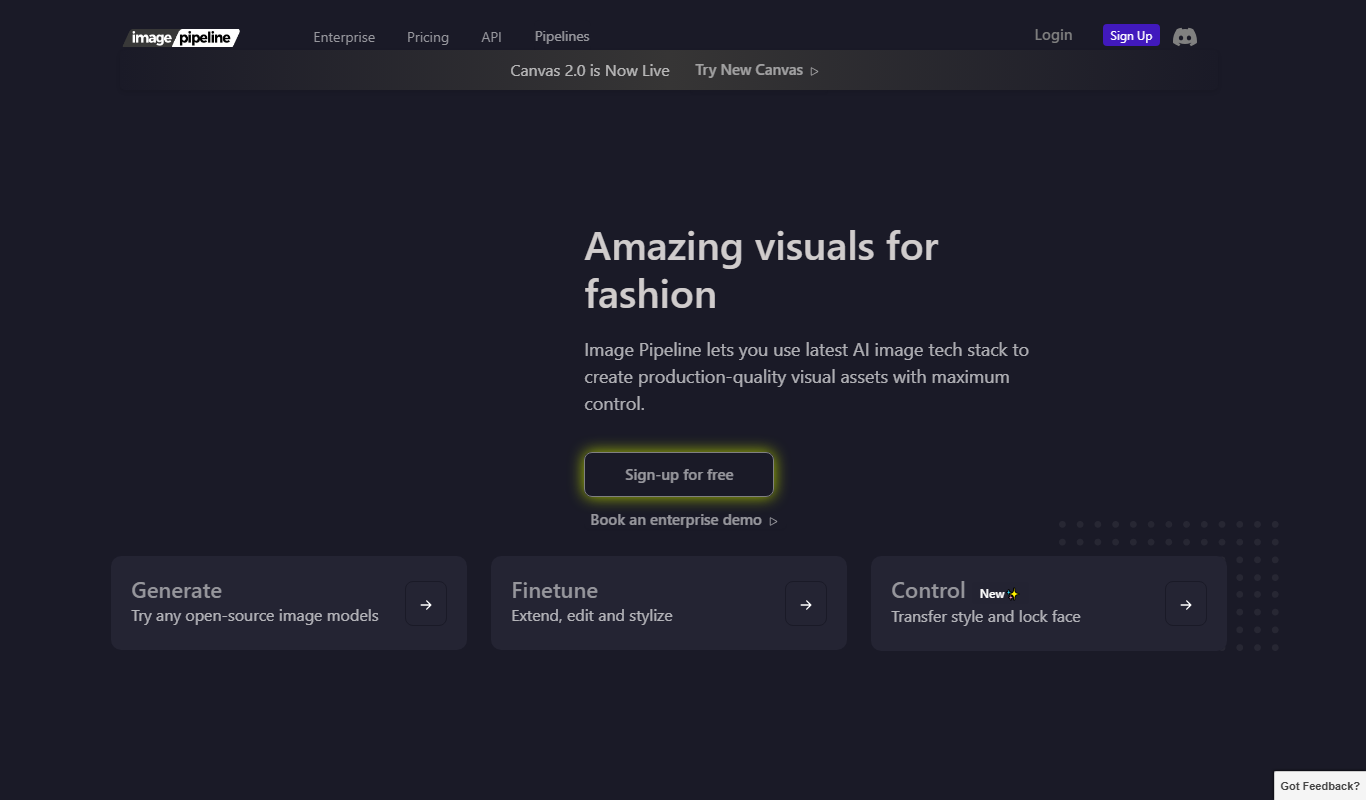
Image Pipeline
ImagePipeline is the image AI API for ecommerce and fashion teams: on-model imagery, virtual try-on, background and relight, and ad creative from one API key.

KawniX
Kawnix is a protocol for agent-to-agent commerce: discover verified agent endpoints, lock escrow and settle tasks with signed receipts.

SpamCheck.ai
SpamCheckAI is a spam detection API for free-form JSON and form submissions, with IP filtering, email validation and content analysis; it powers Basin.