
From my experience with Retool, it stands out as a powerful low-code platform that significantly accelerates building internal tools without sacrificing flexibility. Its drag-and-drop interface combined with the ability to write custom JavaScript allows both developers and less technical users to create functional apps quickly. I found it especially useful for connecting multiple data sources and automating workflows within teams. However, it is primarily designed for internal applications, so it may not suit public-facing app needs. Also, advanced features require some coding knowledge, and pricing can scale up with team size. Overall, Retool is an excellent choice for businesses looking to streamline internal operations efficiently.
Retool Low-Code Platform for Building Internal Tools and Apps Fast
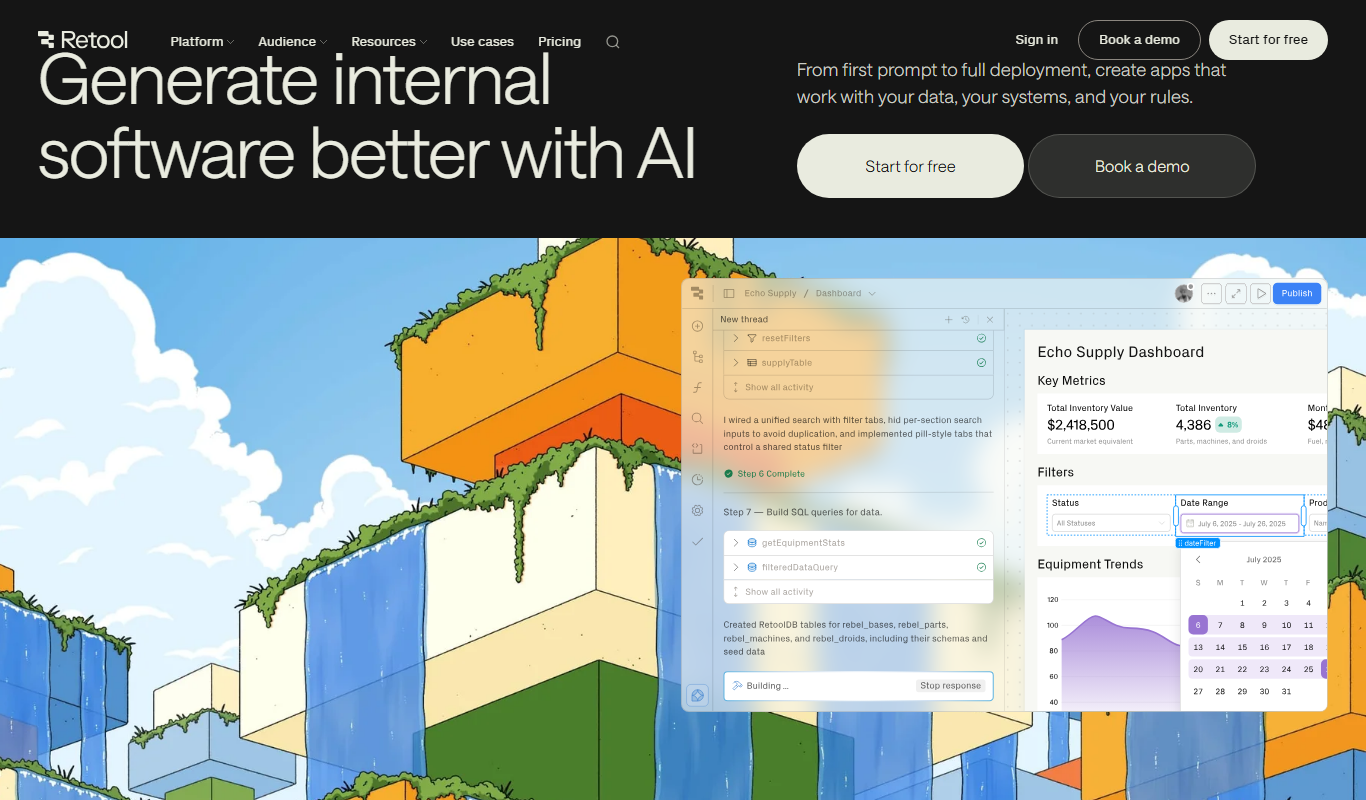
Retool is a low-code platform that helps developers and businesses quickly build internal tools by connecting to databases and APIs using a drag-and-drop interface combined with custom JavaScript.
Tech Stack:
JavaScript
Node.js
React
What is Retool?
Retool is a low-code platform designed to help developers and businesses build custom internal tools and applications rapidly. It provides a drag-and-drop interface combined with the ability to write JavaScript for customization, enabling users to connect to databases, APIs, and other services seamlessly. Retool is aimed at accelerating the development of operational software without sacrificing flexibility.
Key Features of Retool
Drag-and-Drop UI Builder
Easily assemble interfaces using pre-built components like tables, forms, charts, and buttons.
Data Source Integrations
Connect to a wide range of databases and APIs without complex setup.
Custom JavaScript Support
Enhance app functionality with custom scripts for advanced workflows.
Real-Time Collaboration
Work with team members simultaneously on app development.
Role-Based Access Control
Manage user permissions to secure sensitive data and features.
Pros and Cons of Retool
Pros
- Speeds up internal app development significantly
- Supports wide variety of data sources and APIs
- Flexible with custom JavaScript for complex logic
- User-friendly drag-and-drop interface
- Strong collaboration and access control features
Cons
- Primarily focused on internal tools, not public-facing apps
- Pricing can be high for large teams
- Requires some coding knowledge for advanced use
Key Use Cases for Retool
Internal Tool Development
Build custom internal applications quickly to manage data, workflows, and operations without extensive coding.
Dashboard Creation
Create interactive dashboards that connect to multiple data sources for real-time business insights.
Workflow Automation
Automate repetitive tasks and integrate APIs to streamline business processes.
Data Management
Visualize, edit, and manipulate data from databases and APIs with an intuitive interface.
Rapid Prototyping
Quickly prototype and iterate on app ideas to validate concepts before full development.
How Retool Works
-
1
Sign Up
Create an account on Retool’s website to access the platform.
-
2
Connect Data Sources
Link your databases, APIs, or third-party services to Retool.
-
3
Build Interface
Use drag-and-drop components to design your app’s UI.
-
4
Add Logic
Write JavaScript to customize behavior and handle data operations.
-
5
Deploy and Share
Deploy your app internally and share it with your team.
Who's Using Retool
Developers building internal business tools
Product managers needing rapid prototypes
Operations teams automating workflows
Startups and enterprises managing data
IT departments integrating multiple systems
Retool Pricing
Free
$0/month
Basic features with limited users and apps for small teams or evaluation.
Team
$10/user/month
Full feature set with more users, apps, and priority support.
Enterprise
Custom pricing
Advanced security, compliance, and dedicated support for large organizations.
Frequently Asked Questions About Retool
Yes, Retool supports connections to many databases like PostgreSQL, MySQL, MongoDB, and more.
Basic apps can be built with drag-and-drop, but JavaScript knowledge helps unlock advanced features.
Yes, Retool offers enterprise plans with enhanced security and compliance features.
Retool is primarily designed for internal tools, but apps can be shared within your organization.
This tool is designed to help users accomplish its core tasks more efficiently. It is typically used by individuals or teams looking to improve productivity and workflow.
It depends on your specific needs and how you plan to use the tool. The official website and documentation are the best sources for the latest details.
Data handling and security practices vary by provider. Review the official privacy policy to understand how your data is stored and used.
It depends on your specific needs and how you plan to use the tool. The official website and documentation are the best sources for the latest details.
Share your review
Reviews are limited to one per logged-in user and are published after moderation.
You need an account to review this tool.
0.0
★
★
★
★
★
0 reviews
5 star
0
4 star
0
3 star
0
2 star
0
1 star
0
No reviews yet
Be the first to share how this tool worked for you.
Questions from the community
Read questions and answers about this tool, or ask your own.
No questions yet
Start the conversation by asking the first question about this tool.
Is this tool helpful?
Alternative Tools
Explore similar AI tools that might fit your needs

Enterprise
Appsmith
Appsmith is an open-source low-code platform that enables developers and businesses to build custom internal applications quickly using drag-and-drop UI components and integrations with databases and APIs.

Free
Budibase
Budibase is an open-source low-code platform that enables rapid development of internal tools and web applications through a visual builder, database integrations, and automation workflows.

Free Trial
Jellyfish
Jellyfish is an AI-powered project management platform designed to help engineering teams improve productivity, optimize resources, and gain actionable insights by integrating with existing development tools.

Freemium
DataSquirrel.ai
DataSquirrel.ai is an AI-driven data analytics platform that automates data cleaning, visualization, and predictive modeling to help businesses gain actionable insights without requiring technical expertise.

Freemium
Cogram
Cogram is an AI meeting assistant that automatically transcribes and summarizes meetings, extracting key action points to improve productivity.

Freemium
Forecastio
Forecastio is an AI-driven forecasting platform that automates time series predictions for business metrics like sales and demand, providing interactive visualizations and easy-to-use tools for data-driven decision-making.
Free
ShaadiSaga
ShaadiSaga is an Indian wedding planning platform that connects couples with vendors, offers reviews, and provides planning tools to organize weddings efficiently.

Free
Siteimprove Accessibility Checker
Siteimprove Accessibility Checker is a tool that automates website accessibility audits to help organizations comply with WCAG and ADA standards by identifying and reporting accessibility issues.

Free
Forest
Forest is a productivity app that uses a gamified focus timer to help users stay concentrated by growing virtual trees during timed sessions, discouraging phone distractions.

Free
EcoCart
EcoCart is a plugin that integrates with e-commerce platforms to calculate and offset the carbon footprint of online purchases, allowing customers to contribute to verified climate projects during checkout.