

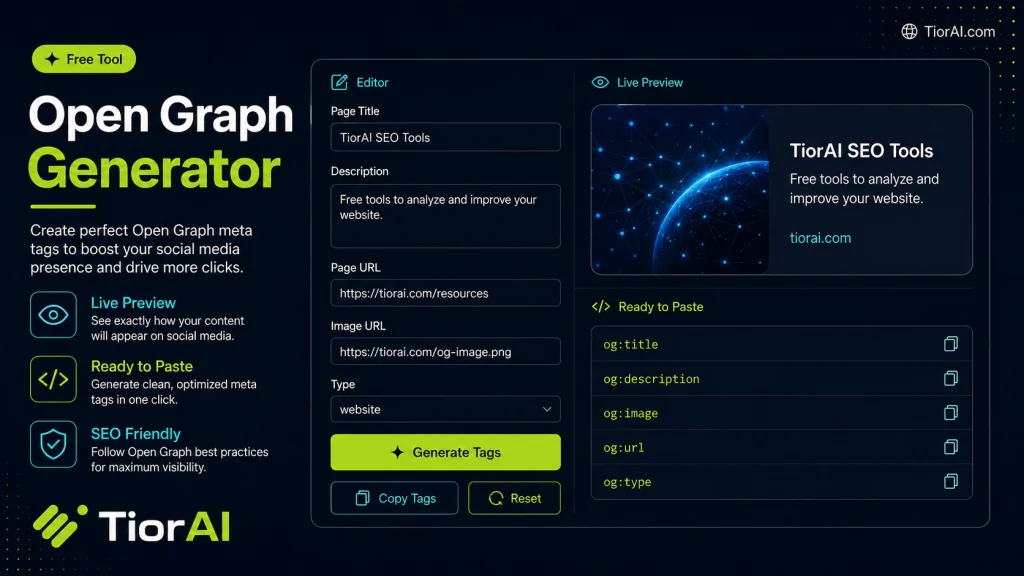
How to use it
- Configure Settings Set your preferences and parameters in the Open Graph Generator. Customize the output to match your specific requirements.
- Generate Output Click generate to create your result. The tool processes your settings and produces output instantly.
- Copy or Download Review the generated output, then copy it to your clipboard or download it for immediate use.
Tip Regenerate multiple times with the Open Graph Generator to compare variations and pick the best output for your needs.
Understanding Open Graph Protocol
The Open Graph protocol is a set of meta tags used in HTML to control how web pages are represented when shared on social media platforms like Facebook, LinkedIn, and Twitter. These tags specify key information such as the page title, description, image, and URL, which social networks use to generate rich link previews.
Why is this important? Without Open Graph tags, social platforms often display generic or incomplete information, which can reduce engagement and click-through rates. Properly configured Open Graph metadata ensures that shared links look attractive and informative, improving user experience and driving more traffic.
Common Use Cases
- Bloggers and content creators want to control how their articles appear when shared.
- E-commerce sites use Open Graph tags to showcase product images and details.
- Marketers optimize social media campaigns by customizing link previews.
- Developers integrate Open Graph tags into websites to enhance SEO and social sharing.
Open Graph generators automate the creation of these meta tags by allowing users to input relevant information and then producing the correct HTML code to embed in their web pages.
What is Open Graph and Why It Matters
The Open Graph protocol uses meta tags embedded in a webpage’s HTML to define how that page appears when shared on social media. These tags specify the title, description, image, and URL that platforms like Facebook and LinkedIn use to generate rich previews. Without these tags, social networks may display generic or incomplete information, which can reduce user engagement.
When to Use an Open Graph Generator
An Open Graph generator is useful whenever you want to create or update the Open Graph meta tags for a webpage. This includes launching new blog posts, preparing product pages for social sharing, or running marketing campaigns that rely on consistent branding in link previews. It’s also helpful for troubleshooting how your links appear on different social platforms.
Common Mistakes to Avoid
- Not updating Open Graph tags when page content changes, which leads to outdated previews.
- Using images that don’t meet recommended size or aspect ratio, causing poor display.
- Omitting essential tags like
og:titleorog:image, resulting in incomplete or missing previews.
Using an Open Graph generator helps prevent these errors by producing correctly formatted meta tags based on your input. This ensures your shared links look professional and engaging across social media platforms.
Frequently asked questions
og:image:width and og:image:height to control how the image displays on social platforms.Reviews and questions
Whether this tool gave people the answer they needed, and what they asked about it.
Sign in to review this tool.
Sign In to ReviewNo reviews yet
Be the first to say whether this tool gave you what you needed.
Ask how to read the result, or what the tool does with an edge case — or answer someone else.
Sign In to AskNo questions yet
Not sure how to read a result? Be the first to ask.
AI tools related to this topic
Tools from the TiorAI directory that work on the same kind of job.

AI graph maker
AI Graph Maker is an AI graph generator that turns text or data into interactive charts, mind maps, knowledge graphs and infographics, with free daily credits and a paid Hobby plan.

Graph Commons
Graph Commons is a web-based platform that enables users to collaboratively create, visualize, and analyze network maps to understand complex relationships and data patterns.

The Graph
The Graph is a decentralized protocol that indexes and queries blockchain data using GraphQL, enabling developers to build fast and reliable decentralized applications.