

GPT Content Detector
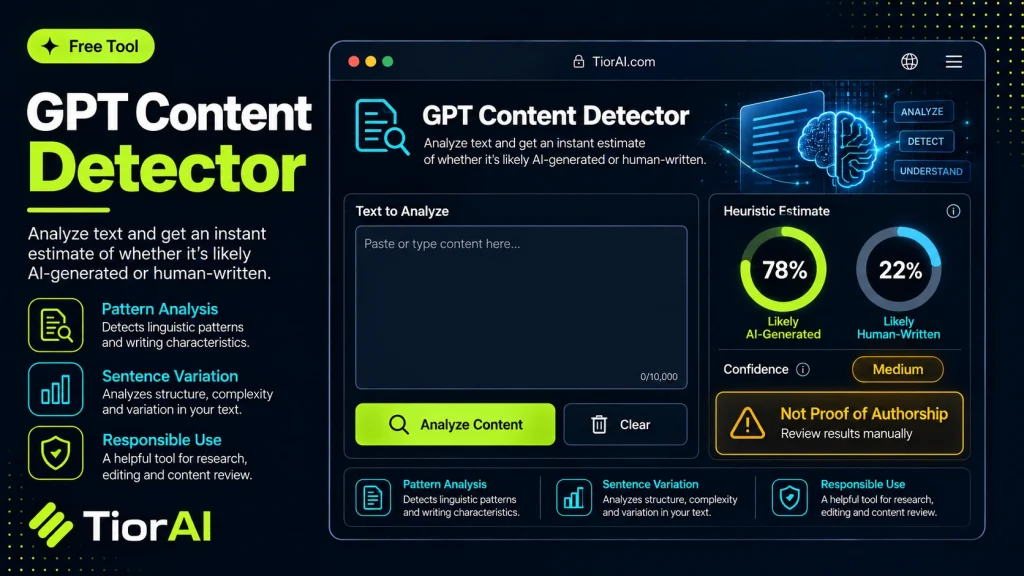
Analyze text to detect potential AI-generated content patterns. This tool uses heuristic analysis to identify common GPT writing characteristics.
GPT Content Detector
Analysis Breakdown
| Signal | Value | Impact |
|---|
About This Tool
This detector analyzes text for common patterns found in AI-generated content. Results are estimates and should not be considered definitive proof.
- Analyzes sentence structure and variation
- Checks for repetitive phrases and transitions
- Examines vocabulary diversity
- Identifies common AI writing patterns
How to use it
- Paste or Enter Your Input Paste your code, text, or data into the input field. The tool supports large inputs without performance issues.
- Process and Analyze Click the action button or let the tool auto-process your input. Results appear in real time with highlighted details.
- Copy or Download the Output Review the results and copy the output to clipboard or download as a file for use in your project.
Tip Keyboard shortcut: Ctrl+V to paste input, then Ctrl+C to copy output - saves time in repetitive workflows.
Understanding GPT Content Detection
GPT content detectors are tools designed to analyze text and determine whether it was generated by AI models like OpenAI’s GPT series or written by a human. These detectors use machine learning algorithms trained on large datasets of both AI-generated and human-written text to identify subtle patterns and linguistic features that differentiate the two.
Why is this important? As AI-generated content becomes more prevalent, distinguishing between human and AI writing is crucial for maintaining academic integrity, verifying originality in journalism, and ensuring transparency in content creation. For example, educators may use GPT content detectors to check if student essays are AI-assisted, while publishers might verify the authenticity of submitted articles.
How do they work? These detectors analyze factors such as sentence structure, word choice, repetitiveness, and statistical irregularities. They often assign a probability score indicating the likelihood that the text was AI-generated. However, detection is not foolproof because AI models continuously improve, making their output more human-like.
Common use cases include plagiarism checking, content moderation, and quality control in content marketing. Despite their usefulness, GPT content detectors should be used as one part of a broader evaluation process rather than a definitive judgment.
What is GPT Content Detection?
GPT content detection involves analyzing text to determine if it was generated by AI models like GPT or written by a human. This process relies on machine learning algorithms that identify linguistic patterns and statistical features typical of AI-generated text. As AI writing tools become more common, detecting AI-generated content helps maintain transparency and authenticity across various fields.
When to Use GPT Content Detectors
- Verifying academic work to prevent AI-assisted plagiarism.
- Checking articles or blog posts for originality before publishing.
- Screening user-generated content to detect automated spam or bots.
- Ensuring compliance and authenticity in legal or professional documents.
Common Mistakes to Avoid
- Believing the detector is 100% accurate in identifying AI-generated text.
- Relying solely on the detector without considering additional context or manual review.
- Misunderstanding probability scores as definitive proof rather than indicators.
While GPT content detectors are valuable tools, they should be part of a comprehensive approach to content verification. Understanding their limitations and appropriate use cases ensures more reliable and ethical application.
Frequently asked questions
Reviews and questions
Whether this tool gave people the answer they needed, and what they asked about it.
Sign in to review this tool.
Sign In to ReviewNo reviews yet
Be the first to say whether this tool gave you what you needed.
Ask how to read the result, or what the tool does with an edge case — or answer someone else.
Sign In to AskNo questions yet
Not sure how to read a result? Be the first to ask.
AI tools related to this topic
Tools from the TiorAI directory that work on the same kind of job.

ChatGPT
ChatGPT is an AI chatbot by OpenAI powered by GPT-4o. It handles writing, coding, research, data analysis, and natural conversation. Free tier available, Plus at $20/month.